California Governor Gavin Newsom’s decision to refuse the extradition of a doctor wanted for providing abortion pills to patients in Louisiana, where it is illegal, is more than a disagreement between two governors or two states with distinguishable abortion policies. Rather, it signifies that the United States is about to embark on a journey of unprecedented fragmentation of the national legal landscape with regard to its approaches to highly divisive social issues.
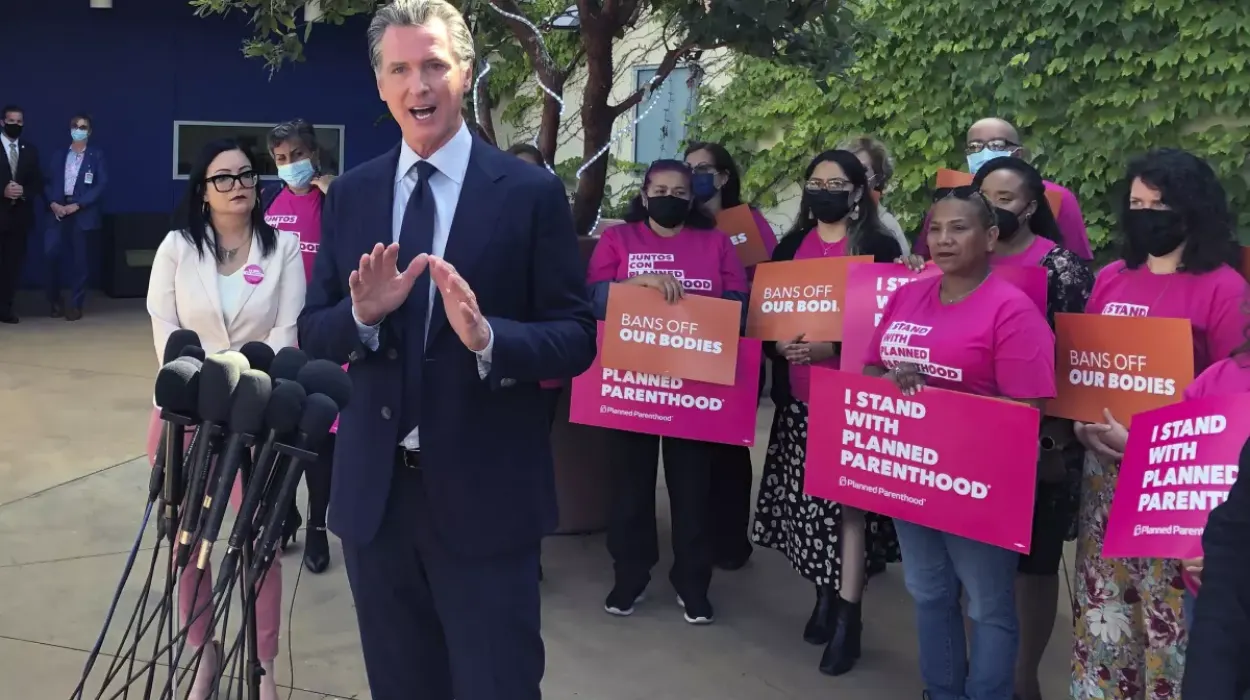
The California governor has drawn a hard line, spurning Louisiana’s request for the extradition of Dr. Rémy Coeytaux, an abortion provider who lives in California but has prescribed abortion medication via telemedicine to people residing in Louisiana. “Not today. Not ever,” he declared, framing the issue as one of defense of medical practice against what he called “extremist politicians.” Louisiana officials counter that California is actively shielding criminal conduct and nullifying their state’s laws.
That confrontation has exposed the fragility not just of the post-Roe legal arrangements but also the limits of federalism itself.
From abortion regulation to interstate confrontation
Since the US Supreme Court struck down Roe v. Wade in 2022, abortion regulations have fallen to individual states to regulate. Approximately one-third of US states are imposing a ban on abortions, while an estimated 20 states in the US are enforcing an abortion shield law to protect their clients from arrest in other states. At least eight states, including California, New York, Massachusetts, and Washington, prohibit responding to an extradition petition related to abortion services.
The trial of Dr. Coeytaux is the strongest known attempt by a ban state yet to extend its criminal power. Under accusations by prosecutors in Louisiana, a female patient of the doctor sought and received abortion drugs via mail when she found out that she was pregnant in October 2023. She paid a fee of $150.
Under Louisiana’s laws, this would be a felony. However, under California’s laws, this would be legal health care fully protected under the laws of California. The disagreement would not be factual; instead, it would be about whose laws apply.
Shield laws and the erosion of interstate comity
The reasoning behind California’s refusal is its abortion shield law, which was passed in 2023 and later enforced through executive orders signed by Newsom a few months after the overturning of the Roe decision. The abortion shield law prohibits state entities from participating in any investigation, prosecution, or extradition proceedings for providing abortion services that remain valid in California.
Extradition has been a routine practice between states. Historically, extradition between states is regulated by the Extradition Clause in the United States Constitution and the concept of interstate comity. However, extradition is becoming increasingly noted by scholars of law as a practice that has not been automatic. The governors have discretion, especially when extradition is contrary to public policy or constitutional guarantees in their jurisdictions.
What makes this case different is its open defiance. California is not quietly declining cooperation; it is publicly declaring that it will not recognise Louisiana’s abortion enforcement as legitimate. That posture risks normalising selective compliance with extradition demands—not only on abortion, but potentially on guns, immigration, gender-affirming care, and other contentious issues.
Louisiana’s escalation strategy
Louisiana Attorney General Liz Murrill has said that California’s policy is “reckless and dangerous,” stating that California is instead safeguarding “illegal, medically unethical, and dangerous activities.” Her testimony at a US Senate hearing clearly showed that Louisiana considers “shield laws” a threat to its sovereignty.
However, there are concerns regarding Louisiana’s legal approach as well. In this setup, an arrest warrant is based on post office tracking information showing a connection between abortion drugs and a business in Dr. Coeytaux’s name. Nonetheless, there are no explanations in the documents made public regarding who made the police notification of the abortion or why it received consideration so long after it occurred. Another individual in this situation is not named for privacy concerns.
This is also the second time Louisiana has sought to extradite an out-of-state abortion provider. In 2024, it indicted New York physician Dr. Margaret Carpenter on similar charges. New York Governor Kathy Hochul refused extradition, citing her state’s shield law. Louisiana has so far failed to advance that case, suggesting the strategy may be more symbolic than enforceable.
Telemedicine abortion as the new battleground
Medication abortion has become the frontline of post-Roe conflict. According to the Guttmacher Institute, more than 60% of abortions in the US now involve abortion pills, many obtained through telemedicine. In states with bans, demand for mailed abortion medication has surged, creating a legal grey zone where providers operate lawfully in one state while patients reside in another.
Public health data complicates Louisiana’s claims of danger. Major medical bodies, including the American College of Obstetricians and Gynecologists, have found medication abortion to be extremely safe, with complication rates well below those of many common prescription drugs. Framing such care as “medically unethical” places Louisiana at odds with mainstream medical consensus.
This tension highlights a broader shift: abortion bans are increasingly enforced not through clinics, but through surveillance of digital records, payment trails, and postal data—raising privacy and civil liberties concerns far beyond abortion itself.
A looming Supreme Court collision
Legal experts widely expect cases like this to reach the US Supreme Court. The central constitutional question is whether a state can criminalise conduct that occurs entirely in another state, simply because its effects are felt within its borders.
If the Court sides with Louisiana, shield laws could be gutted, and providers in permissive states could face nationwide criminal exposure. If it sides with California, ban-states would see their abortion laws effectively contained within their own borders, accelerating the creation of two parallel legal Americas.
Either outcome risks destabilising the federal balance. The Court, already under scrutiny for its role in overturning Roe, would be forced to arbitrate not just abortion rights, but the future of interstate legal cooperation.
Political theatre and national implications
For Newsom, the confrontation reinforces his national profile as a defender of reproductive rights and a counterweight to conservative state governments. For Louisiana’s Republican leadership, the case signals commitment to enforcing abortion bans even in the face of resistance, a message aimed squarely at their political base.
Yet the broader consequences may be less theatrical and more corrosive. When states openly refuse to honour one another’s laws, the assumption that Americans live under a shared legal framework begins to erode. What replaces it is a patchwork system in which rights, risks, and obligations depend increasingly on geography—and on how far a state is willing to push its authority beyond its borders.