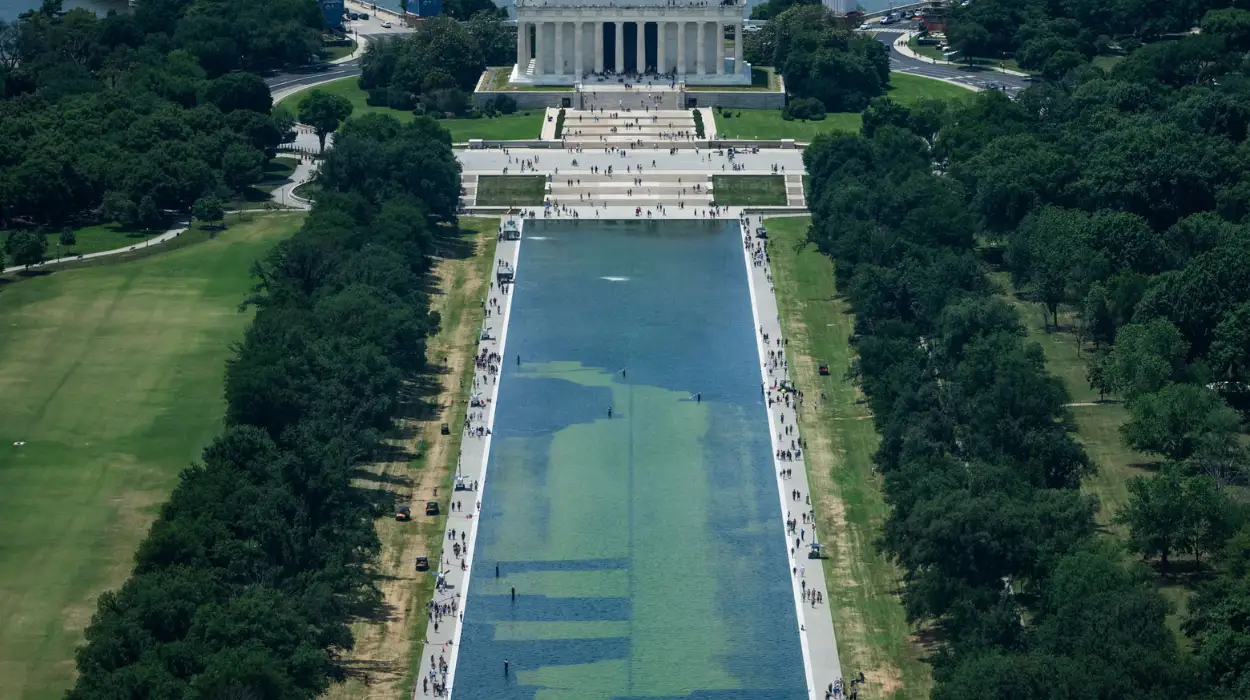
The Reflecting Pool, which is one of the key attractions in the National Mall in Washington, D.C., covering an area of more than 2,000 feet, extending from the Washington Monument to the Lincoln Memorial, has once again become the center of controversy. The pool was restored through a highly publicized renovation process costing $14.2 million by President Donald Trump’s administration; however, within weeks after the renovation process, there have been major problems at the pool due to an excessive bloom of algae and the peeling of blue paint from inside. In his post in Truth Social on Friday, June 19, 2026, President Trump admitted that there were some “real problems.”
Starting out as a project that was anticipated to cost $1.8 million, the costs of this renovation soared tremendously to more than $13 million, finally coming to an estimate of $14.2-$14.8 million. Trump was behind the support of the construction project as it was a need to beautify the pool, claiming that the pool was “filthy and dirty” and he would ensure that he makes it “beautiful and waterproof.” The basin after being painted was colored in American flag colors to commemorate the 250th anniversary celebrations of U.S. independence.
Trump Blames Vandalism Without Evidence
On Friday night, President Trump posted on Truth Social, stating:
“We’ve had some real problems with vandalism at the beautiful reflecting pool,”
marking his first public acknowledgment of the pool’s deteriorating condition. He escalated his claims further by asserting that vandals had used chemicals similar to those allegedly employed on the National Mall to damage the pool’s interior surface.
According to Trump,
“Similar to the chemicals utilized on the National Mall, they employed something akin in the Reflecting Pool to attempt to ruin and belittle our beautiful work”.
Despite these strong accusations, Trump offered no evidence to substantiate his claims of chemical vandalism. The HuffPost described his explanation as “astronomically stupid,” noting that the president
“without evidence blamed vandals with chemicals for the extensive problems at the newly reopened Reflecting Pool”.
Law enforcement officials have reportedly been tasked with investigating the situation, though no public findings or confirming details have emerged as of Saturday, June 20, 2026. Critics argue that Trump’s vandalism narrative appears to be an attempt to deflect responsibility for what may be fundamental flaws in the renovation itself.
Trump also attempted to downplay the severity of the damage, claiming that
“the algae is 75% gone, and the condition will soon be completely remedied, and the area that was vandalized, fortunately, is just a small area of damage, and will be fixed early next week”.
However, photographs and videos circulating online show extensive green algae coverage and significant portions of peeling paint, contradicting Trump’s assertion that the damage is minimal.
Algae Bloom and Peeling Paint Define Renovation Failure
The most visible manifestation of the renovation’s failure is the algae bloom that emerged just weeks after the project wrapped in late May 2026. The water, which Trump’s administration Days before described as “crystal clear,” has turned distinctly green. This algae infestation is not unprecedented; the Reflecting Pool has historically suffered from leaks and algae problems for many years prior to Trump’s renovation. Yet, the rapid return of algae after a multi-million dollar renovation raises serious questions about the effectiveness of the work performed.
In addition to the algae, the blue paint applied to the pool’s interior is peeling and flaking. Tourists have reportedly been collecting fragments of the paint as keepsakes, further exposing the compromised condition of the newly renovated surface. The RTE reported that
“the blue paint is peeling on the renovation championed by US President Donald Trump to spruce up Washington’s iconic Reflecting Pool ahead of the 250th anniversary celebrations of independence”.
The juxtaposition of Trump’s earlier claims of a “crystal clear” pool with the visible green water and flaking paint has deepened the controversy. The Guardian noted that
“his vaunted makeover of the Washington attraction has resulted in an algae bloom and peeling paint,”
underscoring the stark contrast between the administration’s promises and the pool’s actual condition. The failure of the renovation to prevent or resolve these long-standing issues suggests that the project may have been more cosmetic than substantive.
Cost Surge and Political Motivations Behind the Renovation
The renovation’s cost trajectory reveals a dramatic escalation that mirrors the project’s growing controversy. Initially estimated at $1.8 million, the budget quickly ballooned to over $13 million before reaching the final $14.2–$14.8 million figure. Critics have questioned whether the inflated costs were justified, particularly given the rapid onset of post-renovation problems. The New York Times ran a feature titled “See How Trump Is Renovating the Reflecting Pool,” offering a rundown of the problems and Trump’s attempted fixes, further highlighting the project’s troubled execution.
Trump’s motivations for the renovation appear tied to political and ceremonial considerations. The project was framed as preparation for the 250th anniversary of U.S. independence, scheduled for 2026. The Guardian reported that the renovation aimed to
“spruce up Washington’s iconic Reflecting Pool ahead of the 250th anniversary celebrations of independence”.
However, the timing of the algae bloom and paint failure—just weeks before the anniversary celebrations—has undermined the project’s intended symbolic impact.[
Trump also framed the renovation as part of a broader effort to beautify Washington, D.C., claiming that his administration
“has renovated and beautified over 28 statues and fountains in Washington”.
Yet the Reflecting Pool’s rapid deterioration suggests that the project may have been more about political optics than lasting improvement. The New York Times had previously criticized the renovation as merely a “paint job,” a description Trump strongly rejected, slaming the newspaper for its characterization.
Historical Significance Amplifies Current Controversy
The Reflecting Pool’s historical importance adds weight to the current controversy. The pool, which spans more than 2,000 feet, was the site of Martin Luther King Jr.’s iconic “I Have a Dream” speech during the 1963 March on Washington. It has also hosted numerous other historic events, making it one of the most symbolically significant landmarks on the National Mall. Any perceived neglect or failure to maintain the pool’s condition carries profound implications for America’s cultural and political heritage.
In light of Trump’s decision to renovate the pool in order to preserve it, it has instead highlighted the difficulties of maintaining it. With the quick reappearance of algae and the failing of the paint shows that the renovation was not sufficient enough to fix the problems with the pool. Considering the significance of the place regarding its involvement in historical events, such negligence is highly damaging.
Historical significance of the pool also adds to the scrutiny of Trump’s claims. When Trump made claims that the pool had been vandalized by use of chemicals, lack of evidence made Trump’s claims seem unconvincing in light of the pool’s historicity in terms of democracy and civil rights in America. Opponents have accused Trump of trying to minimize the importance of the pool through unfounded claims about the vandals.
Critical Response and Public Skepticism
The public and media response to Trump’s vandalism claims has been largely skeptical and critical. HuffPost labeled Trump’s excuse as “astronomically stupid,” highlighting the lack of evidence supporting his allegations. The skepticism extends beyond media outlets to include political observers and ordinary citizens who have witnessed the pool’s deterioration through photographs and videos.
The juxtaposition between the “small area of damage” described by Trump and the amount of algae and paint loss has led to even more suspicion. Photos posted on the internet have revealed that there is extensive green staining along with a considerable paint loss, which stands in contradiction with the statement made by Trump. It raises questions as to whether Trump really knows what is going on or tries to hide something.
Trump’s further narrative that Washington, D.C. is one of the “Safest Cities” in America while at the same time recognizing the fact that there have been acts of vandalism committed at the Reflecting Pool provides another dimension to the inconsistency of the President’s message. It has been suggested by critics that Trump’s assertion of vandalism is part of a political strategy.
What Comes Next for the Reflecting Pool?
As of Saturday, June 20, 2026, the Reflecting Pool remains in a compromised state, with algae still visible and paint peeling despite Trump’s promise that the algae is “75% gone” and that repairs will be completed “early next week”. Law enforcement’s investigation into the alleged vandalism remains ongoing, but no public findings have been released. The pool’s condition ahead of the 250th anniversary celebrations raises concerns about whether the site will be ready for the historic events it is meant to host.
The $14.2 million renovation’s rapid failure underscores the challenges of large-scale public infrastructure projects, particularly when political motivations overshadow technical considerations. Whether Trump’s administration can rectify the pool’s problems without further controversy remains uncertain. For now, the Reflecting Pool stands as a symbol of both America’s enduring legacy and the fragility of political promises when not backed by substantive action.
The incident also highlights the growing tension between Trump’s public assertions and the reality witnessed by the public. As the nation prepares for its 250th anniversary, the Reflecting Pool’s condition serves as a cautionary tale about the importance of transparency, accountability, and evidence-based decision-making in public works. Without these, even the most symbolic landmarks risk becoming focal points of controversy rather than celebration.