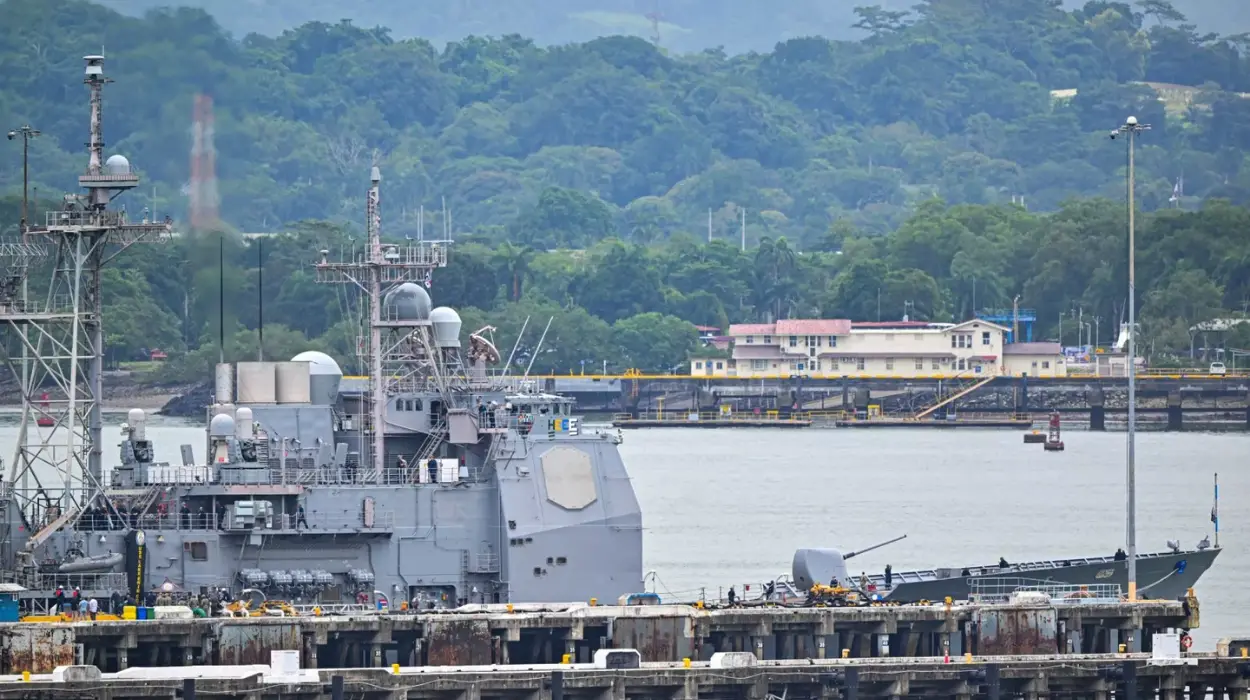
The late summer of 2025 has witnessed one of the biggest US military deployments in the Caribbean in several years. On August 29, 2025, the guided-missile cruiser USS Lake Erie passed through the Panama Canal and joined a strike group already in waters off Venezuela.
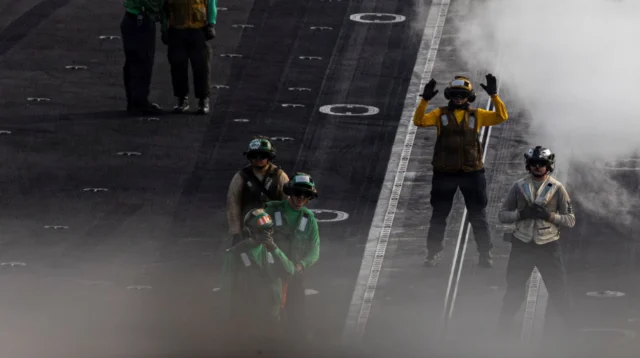
The naval force includes three Aegis-class destroyers and the amphibious assault ship USS Iwo Jima, which is said to carry 4,500 US Marines, a minimum of 2,200 of whom are combat-ready. With this naval force is the USS Newport News, a nuclear-powered fast-attack submarine, and assorted P-8 Poseidon maritime surveillance aircraft operating from unannounced forward bases in the Caribbean.
This powerful troop deployment is part of Operation Southern Sentinel, a counter-narcotics mission in the White House account. But the scale and composition of the force have seen speculation among observers in the region and foreign experts about Washington’s overall strategic intentions in the region.
Venezuela’s coordinated military countermeasures
As a result, the Venezuelan government of President Nicolas Maduro called for an emergency mobilization. Within three days of US warship passage, more than 15,000 troops were moved to strategic military locations, especially along the western borders that border Colombia, a longtime US ally. The Venezuelan Navy increased its maritime patrols in the Caribbean with upgraded Russian-made corvettes and Chinese-made surveillance drones.
Speaking from a coastal base, Maduro said:
“There’s no way they can enter Venezuela,”
presenting the situation as a national resistance movement The message was echoed in state media outlets and was stressed repeatedly with references to Bolivarian sovereignty and the history of past imperialist attempts to dominate the region.
Activation of domestic militias and political messaging
Reinforcing internal mobilization even more, Maduro issued a full mobilization of Venezuela’s civilian paramilitary network. An estimated over four million members of the militia mostly volunteers who received paramilitary training were mobilized to help logistics, intelligence collection, and rear-line defense coordination. These measures reflect the regime’s commitment to projecting a national image of unity and capacity for deterrence, despite the country’s prolonged economic crisis and dwindling conventional military assets.
Venezuela’s permanent UN representative disparaged the United States as resorting to “kinetic coercion” on a false anti-narcotics front. The speech put Venezuela in the victim position of external aggression, highlighting its call for international condemnation of the US deployment as an affront to sovereignty and peace.
Strategic implications of the confrontation
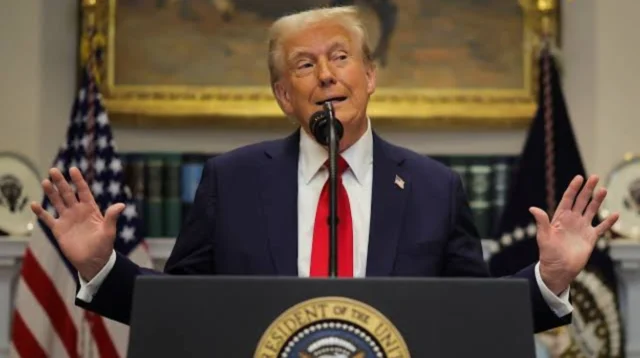
The Trump administration has claimed that the primary target of its deployment of naval power is to break up drug trafficking networks linked to the Venezuelan state. The Cartel de los Soles, a suspected syndicate within the Venezuelan military command structure, has been designated as a Specially Designated Global Terrorist (SDGT) organization. President Trump, who returned to office in January 2025, offered a $50 million reward for the capture of Maduro, a narcotics kingpin.
Much as this explanation, however, is warranted, skeptics among analysts continue. While Venezuela has contributed to South American drug trafficking lanes, most of the major trafficking streams to the US have their initial source in the Pacific, transiting Central America and Mexico. The biased deployment of power in the Caribbean implies strategic interests running beyond narcotics interdiction most prominently, destabilization of the regime.
Regional reactions and diplomatic concerns
The scope and pace of the US deployment have distressed several Latin American governments. Mexican President Claudia Sheinbaum explicitly threatened that the build-up risked igniting a regional crisis. She appealed to the G20 and the Organization of American States to create space for dialogue and ensure diplomacy is prioritized. Brazil, staying neutral, has bolstered security along its northern border, and Caribbean nations have called for de-escalation.
Geopolitically, the deployment is indicative of trends in strategic power projection where posture is employed as a tool of indirect compellence. The growing identification of Venezuela with Russia, China, and Iran makes the situation more complicated. Russian Defense Minister Sergey Shoigu announced that Russian and Venezuelan forces have debated collaboration on naval logistics, but no deployments were agreed upon.
The optics and risks of power projection
For the United States, the naval operation aligns with broader domestic political discourse. By characterizing Maduro as a transnational menace, the Trump administration secures bipartisan support for a hardline foreign policy and diverts scrutiny from domestic policy squabbles about immigration and inflation. The operation also toughens defense cooperation with Colombia, the Dominican Republic, and other Caribbean nations eager to resist transnational crime.
But the optics of a powerful naval armada facing off against a weakened, sanctioned state produce international critical reactions. European Union authorities have kvetched about increasing rhetoric, issuing threats that destabilization in Venezuela would trigger mass migration and humanitarian implications.
Deterrence versus escalation dynamics
This individual has weighed in on the topic, noting the fine line between deterrence and escalation that the US must walk as its bravado of military might imperils Venezuelan sovereignty:
Maduro oversees massive military exercise as US warships closes in
— Jack Straw (@JackStr42679640) August 30, 2025
'Today we are stronger, more prepared to defend sovereignty'
Footage: Revolutionary Special Operations course from AP
MTodayNews pic.twitter.com/O5YNRsqgSQ
The analysis rings true to greater security concerns that highly provocative signaling may spark miscalculations. The deployment of submarines and electronic intelligence collection platforms heightens the risk of inadvertent confrontation in contested maritime zones, particularly if Venezuelan military forces detect what they perceive as clandestine incursions.
Maduro’s use of hybrid defense mechanisms like irregular militias and de-centralized command would also make US attempts to contain escalation difficult. A different character of battlefield, where any hot spot could involve asymmetric confrontations with civilian zones exposed to increased risk, makes tremendous demands on diplomatic backchannels to prevent misinterpretation or accidental war.
Broader implications for regional stability and US policy
The US-Venezuela crisis reopens old debates over American interventionism in the Western Hemisphere. Latin American countries, including those that are opposed to Maduro, are concerned about unilateral action outside the multilateral rules. In confronting such an approach, the US has to rebalance its regional strategy, weighing security interest versus respect for national sovereignty, but without seeming to come off as being just as big a bully as the former colonial powers themselves.
In the meantime, Venezuela reframes the crisis in terms of regional solidarity as the symbol of resistance against foreign domination. As domestic repression and economic decline continue, the discourse of outside threat remains an effective instrument of domestic cohesion and regime survival.
Military diplomacy and strategic ambiguity
The central tactic of the two nations is posturing militarily and ambiguously. The US does not stop short of threat of intervention but instead interdictates. Venezuela is posturing for total war at and without provocation. This shared equivocation leaves room for backchannel diplomacy to operate, which in turn may be a step in the direction of a managed pullback should political goals be achieved with pressure as a lone option.
However, a high-risk environment is created by the presence of high-capability naval and air units nearby, and the presence of paramilitary mobilization. Any miscalculation, whether mechanical, human or cyber induced would have cascading effects on wider regional conflict, especially if outside powers such as Russia or Iran decide to openly intervene.
The next few months will determine whether this crisis proves to be a watershed in US-Latin American security relations or whether it recedes back into a cycle of strategic signaling. For the time being, the convergence of geopolitics, and illicit economies together with military posturing serve to highlight how confrontation in the 21st century goes far beyond conventional warfare. As gunboats patrol the Caribbean and militias train along Venezuelan borders, the calculus of influence remains in flux.