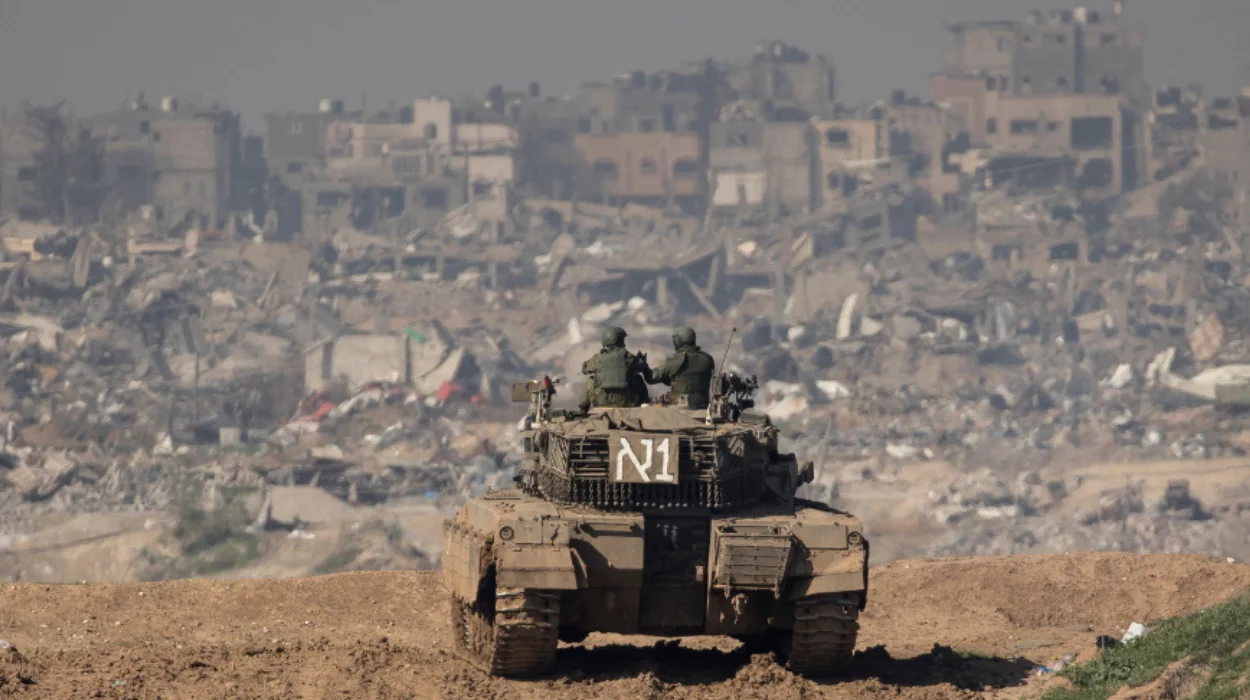
In early 2025, a pivotal moment in the international diplomatic situation surrounding Gaza happened as the United States undertook to develop plans for a multinational stabilization force under a proposed UN Security Council resolution. This stabilization force would assist in providing stability to the fragile ceasefire that had been established between Israel and Hamas, while also seeking to repair the security void and vacuum that had existed since combat operations ceased in late 2024. The multilateral stabilization force is tabled as a two-year renewable mandate, of up to 20,000 troops drawn from a roster of non-Islamic nations, reflecting operational sensitivity and concerns about a geopolitical fallout.
The mission being proposed expands beyond a traditional peacekeeping mission, giving authorization for “everything necessary” to secure Gaza’s borders, protect humanitarian lines, and ensure it redevelops a new Palestinian police service, including proper training and transportation. This type of mission authorized to use military force further establishes Washington’s shift from passive observer of peace efforts to a more proactive stabilization initiative designed to enforce ceasefire compliance, rather than monitoring compliance.
Redefining Peace Enforcement Mandates
This new enforcement model indicates a resetting of international engagement in Gaza. UN-led missions have historically been hampered by the guaranteed neutrality of the mission, as well as engagements that strictly restrict rules of engagement. The stabilization force will have broader authority to possibly take pre-emptive action against evolving militant threats, say U.S. officials. There has been an indication of legitimacy being established by the UN and cooperation with both Israeli and Palestinian authorities, which means that an operational military capability is intended to buttress a diplomatic consensus.
The Role of Washington’s Strategic Agenda
At the same time, the licensing of this development fits within the broader American agenda of regional stabilization without a prolonged U.S. troop presence in an indefinite mission. The Biden administration’s preference for multilateralism and sharing the burden of the region signals a clear continuity of the post Afghanistan strategic doctrine: taking an operational lead role in cooperation with allies in the region and relying on U.S. political and logistical support. Therefore, Gaza convenes as a potential proving ground for how successfully Washington can navigate its commitments to Israeli security with its declared support for Palestinian self-determination.
Israel’s Security Imperatives and Conditions
Israel’s response to the proposed stabilization force has been characterized by cautious collaboration. In a January 2025 speech, Prime Minister Benjamin Netanyahu reaffirmed that Israel “will retain ultimate security responsibility for the foreseeable future,” indicating Israel’s historical hesitance to allow foreign military oversight.
Operational Control and Sovereignty
Israeli defense planners maintain that their forces must have the freedom of action to conduct military operations against Hamas, Islamic Jihad, and other terror organizations. Their request arises from a long history of asymmetric warfare in which operational flexibility has been viewed as a significant aspect of national security. While it is diplomatically beneficial to have foreign troops, there are operational implications, particularly if the international commanders impose limitations viewed as inhibiting Israeli deterrent capability.
Restrictions on Troop Composition
A major point of contention stems from Israel’s unwavering refusal to allow armed contingents from Muslim majority countries to participate in the stabilization force. Israeli officials suggest that while these troops may try to act impartially, they could ultimately guarantee neither neutrality nor intelligence security. This has required US diplomats to navigate a delicate balancing act of ensuring adequate representation from troop contributing countries while also having Israeli support, emphasizing the political ramifications of executing the mission.
The Internationalization of Gaza’s Security Landscape
Israel’s response to the suggested stabilization force has been tempered cooperation. Prime Minister Benjamin Netanyahu reaffirmed in an address in January 2025 that Israel “will retain ultimate security responsibility for the foreseeable future,” meaning that Israel’s skepticism towards external military authority is long-standing.
Challenges of Legitimacy and Local Acceptance
Israeli defense planners argue that their armed forces need to maintain freedom of action to conduct operations against Hamas, Islamic Jihad, and others. They derive this requirement from their decades of asymmetric conflict, which they considered critical to national security policy, operational flexibility. They can conduct operations freely without foreign troops operating in their space. While foreign troops may provide a diplomatic boon, it risks an operational peril if international commanders take steps that may inhibit Israel’s deterrence capacity.
Balancing Enforcement and Humanitarian Mandates
Particularly contentious is Israel’s flat-out objection to any armed contingents from Muslim-majority nations participating in the stabilization force. Israeli officials worry that armed contingents may either taint the perception of neutrality or risk Israeli intelligence security. Consequently, U.S. diplomats were compelled to navigate a complex set of negotiations so that contributing countries would not only represent the global community but also would be acceptable to Israel; evidence of the political complexity of implementing this mission as discussed in Section 4.
Fragility of the Ceasefire and On-Ground Realities
The truce established on October 10, 2025, continues to be severely tested. The Israeli air operations against suspected militant sites, coupled with the ongoing prohibitions on aid convoy movements, are raising deep concern in humanitarian circles. Escalation of the conflict could undo months of diplomacy, especially if the deployment of the stabilization force is delayed or perceived as biased.
Gradual Transfer of Security Responsibilities
A critical assumption of the stabilization plan is the training of a new Palestinian police force to conduct internal security operations. The plan is to transition some internal security responsibility over time to this force, which will reduce Israel’s direct involvement within Gaza. Whether this transition can be accomplished will depend on the professionalism, legitimacy (denoted by popular acceptance), and neutrality of these newly reconstituted Palestinian forces all of which are in serious question due to a fractured political environment in the territory.
Risks of Operational Misalignment
While military units from Israel’s defense establishment will coordinate with the deployment of the multinational forces, this assignment will continue to test the limits of two command structures and the patience of the diplomats facilitating the arrangement. A major line of tension could arise if the various contingents interpret rules of engagement differently or have varying prioritization of intelligence priorities. Examples from military analysis indicate that hybrid arrangements, with one party retaining the ultimate authority, foster confusion over stabilization.
Diplomatic Implications and Regional Reactions
The stabilization framework established by the United States represents broader changes in diplomacy in the Middle East. Arab countries, particularly Egypt and Jordan, publicly endorse the humanitarian goals of the initiative, while worried about its implications for future political processes. Iran and its partners in the region have condemned the idea, calling it an extension of the Western military framework.
The Question of Political Endgame
In addition to stabilization of immediate security, the plan raises important uncertainties related to the political future of Gaza. Without a framework for political transitions, the result may be a ratification of arrangements where security forms a substitute for political discourse. While European diplomats are pushing Washington to add some political benchmarks to the mission’s mandate to allow for stabilization to address political governance and decision making rather than a prolonged military presence; even proportional consequences may produce major political unrest.
Balancing Peace and Power Projection
For Washington, the stabilization force serves not only as a humanitarian endeavor, but it also projects U.S. strategic leadership at a time of changing global order. The project strengthens U.S. credibility as a mediator without deploying ground troops. Yet maneuvering this balancing act engages even more complicated optics: projecting strength while not reframing the narrative of neo-interventionism through the lens of the Arab world.
Prospects for Stability and Control
The presence of an international, U.S.-backed stabilization force amid an Israeli sovereign military-influenced regime is a complicated framework of shared but competing authority. While Israel has responsibility for borders and other strategic external security decisions, the international force’s role is to ensure civilian protection and a related reconstruction agenda, which will sometimes be at odds with the military function.
Military observers have noted that the success or failure of the stabilization force will be based on transparency in communications, strong accountability through defined operational space, and sustained diplomatic engagement. Without these, the international stabilization force will be left at an extreme disadvantage, as it raises the very real prospect of being jammed between enforcement mandates and the occupation’s current reality.
As Gaza approaches a new international practice in stabilizing conflict dynamics, the upcoming months will demonstrate whether this ambitious framework can survive its own contradictions. The region has an extensive history of good faith efforts failing amid mistrust and political stagnation, so whether the Gaza stabilization framework is a new turning point or an old cyclic exercise in external intervention will depend on whether the international community can align power, principle, and pragmatism in one of the most contested geographies in the world.