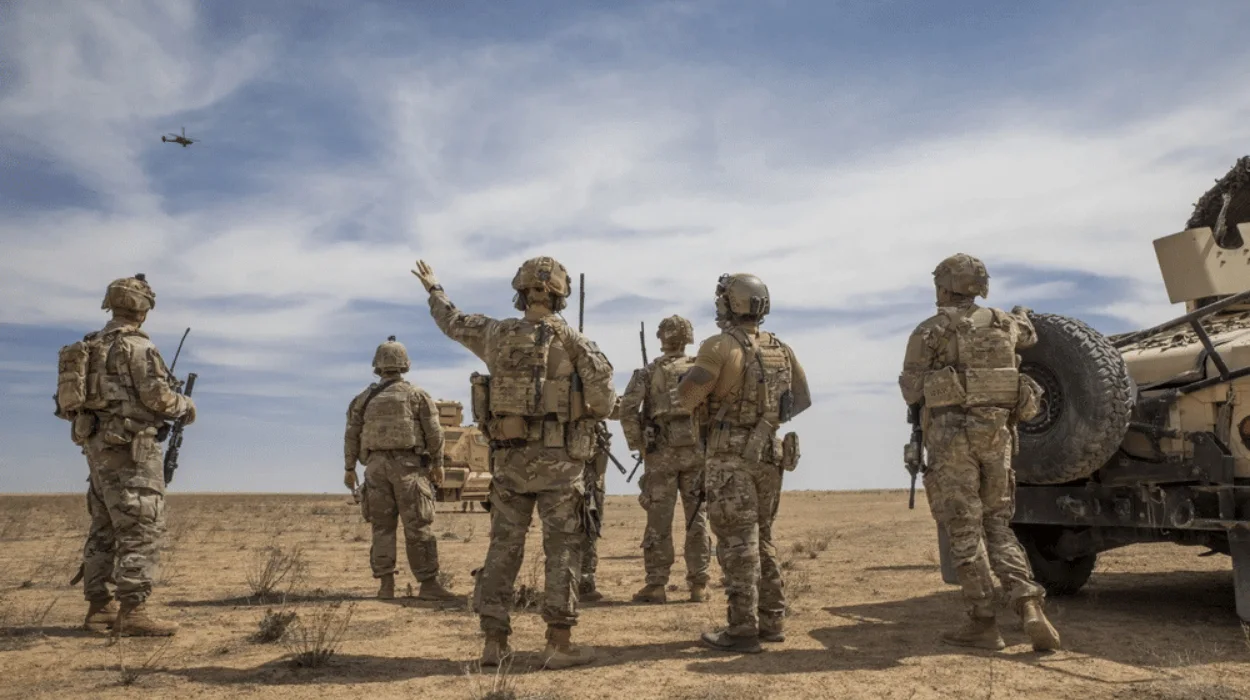
A joint patrol by US and Syrian forces was under fire near the city of Palmyra, Homs province and several US service members and 2 Syrian soldiers were injured. According to the local security sources, the assailant was killed in the exchange. No armed faction swiftly took credit, which continues to strengthen the confusion that is taking shape in the security situation in central Syria.
Even when Washington indicates a desire to draw down its presence, US helicopter-borne evacuation of the wounded to the Al-Tanf base underscores the operational value of the facility. The Syrian state media reported the incident and did not blame anyone, which indicates some interest in limiting the decline in politics and in the meantime, investigations take place.
Tactical characteristics of the strike
The raid had the characteristics of newer low-signature attacks in the Syrian desert, which are quick strikes, a small logistic footprint, and no public identification. According to analysts, these deterring tactics make deterrence a challenge since the absence of a claim postpones revenge and muddles the strategic message.
It is also a good indication that the US and Syrian forces have better coordination in close quarters since the attacker was neutralized on the scene. Simultaneously, the received injuries demonstrate the weaknesses of joint patrols working in the environment of poorly regulated land.
Strategic importance of Palmyra and Homs province
Palmyra is strategically located on major transit routes connecting the eastern part of Syria and the rest of the country, as it is the center of the counter-Islamic State efforts. The desert around has been in the past used as a route of militant transport, arms smuggling, and informal trade system particularly following years of poor governance.
Joint patrols, in this region, represent an attempt to deny the remnants of the Islamic State the freedom of maneuver. Nevertheless, the sheer size of the region and the lack of population density are in favor of ambush-based attacks that overburden the intelligence gathering and early warning programs.
Symbolic resonance of the location
In addition to its military importance, Palmyra has a symbolic value as it is an ancient city with ruins and was previously inhabited by the Islamic State fighters. Attacks in the vicinity of the city are reverberated both nationally and internationally and enhance their political effects despite the number of people affected in the incident being minimal.
To the US planners, what happened in Palmyra is an indicator that central Syria is still disputed, a factor which makes it difficult to believe that the threat levels are low enough to enable the rapid withdrawal of forces.
Trump administration Syria policy in 2025
In January 2025, the white house reiterated desires to reduce the US presence in Syria, and the decision was made after President Trump returned to office. The administration put the drawdown in the context of a correction to the long-term deployments and the local actors have to take up the burden of long-term stability themselves.
By the middle of 2025, the US forces were estimated to be less than 1,000 spread out at Al-Tanf and at isolated positions in the northeast. Policy briefings provided a stepwise decrease in relation to evaluations of Islamic State operation and partner force preparedness.
Conditional engagement framework
The Syria policy of the administration correlates military presence with counterterrorism goals that are tightly defined. The need to keep the ground forces at home has prompted the authorities to emphasize on the over-the-horizon strike capability, intelligence sharing and limited advisory roles.
The Palmyra incident challenges this structure as it demonstrates the ability of US forces to suffer first-hand damage, despite engaging in a regular patrol, through the lack of visibility and dependence on local cooperation.
Unclaimed attacks and evolving threat patterns
Even though the Palmyra attack was not linked to any particular group, its timing and methods are similar to those of the Islamic state cells that were present in the Homs and Deir ez-Zor. In 2025, analysts have recorded a transition to unclaimed or squarely credited attacks that aim at keeping the pressure but not decisively retaliate.
These cells use the local grievances, tribal conflicts and economic deprivation to infiltrate civilian settings. It also makes narrative control difficult due to the lack of claims, since counterterrorism forces are deprived of a transparent opponent to fight before the public.
Alternative actors and proxy dynamics
There have also been speculations on the existence of Iranian-allied militias working around Palmyra. Nonetheless, the absence of messaging or escalation after the incident diminishes the presence of a calculated proxy signal. Such groups, in general, prefer deniable pressure in 2025 more than the isolated attacks on joint patrols.
The uncertainty supports the greater dilemma of the strategists of the US: to differentiate among opportunistic violence and organised offensive actions intended to control the withdrawal procedures.
Implications for US-Syrian cooperation
The collaborative aspect of the patrol indicates apprehensive operational alignment that was extended in the year 2025 as both parties within the operation attempted to restrain the revival of the Islamic state. Limited US involvement by the authorities has been seen by the Syrian authorities as a counter to the opposing forces, and Washington has understood cooperation as a phase in transition.
The damage to US personnel can lead to changes in the structure of the patrols, rules of engagement, and intelligence-sharing. Even the single cases can cause doubt in the partners, the motivation towards collaborating is still shaky.
Political signaling and restraint
Both parties were quite diplomatic in their official statements and this may indicate the desire to ensure the incident did not jeopardize the bigger goals. To Damascus, open outcry is a threat that will compromise its story of reinstated sovereignty. In the case of Washington, excessive reaction will cause the entangling of forces at the time when the political leadership would prefer non-committance.
This measured silence is an indication of an appreciation that visibility per se can determine results just as much as force deployments.
Domestic and allied reactions in 2025
In America, the deployment of troops that are attacked atrociously without being noticed usually leads to a fresh wave of investigations by legislators. Members of Congress who take a security perspective believe that there will be a resurgence of militancy in a premature withdrawal and proponents of the administration present such cases as testimony that US troops are just left vulnerable in wars that have no clear end states.
The Palmyra strike comes at the time of budgetary discussions and more general debates on overseas commitments, so it has an inappropriate weight in comparison with its tactical size.
Regional allies and spillover concerns
The developments are monitored by allied states in the region such as Jordan and Iraq. Any weakening of central Syria threatens to have cross border flow of fighters and weapons as far as fragile stabilization efforts in other regions.
To the partners in the coalition, what occurred is a reaffirmation that the drawdowns should be sequenced in order to avoid security lapses that have been a characteristic of the previous transitions in the area.
Strategic calculus moving forward
The policy of the Trump administration in Syria is based on the belief that the localized threats could be controlled without the presence on the ground. The cases such as Palmyra make it harder to calculate that the numbers are only lower as they show that the reduced deployments are still susceptible when passing through transition periods.
Modifications can incorporate reducing joint patrols, augmenting use of remote surveillance or enhancing partner force training, each with consequences of efficiency and impact.
Broader implications for counterterrorism posture
Outside of Syria, the episode contributes to the discussions of the sustainability of counterterrorism in the world. With lighter foreign footprints, which the militant groups have learned to employ in their operations, unclaimed attacks might become a favorite strategy in manipulating the strategic environments without completely initiating counter-measures.
Whether this trend brings about a re-evaluation of the draw down strategies is an unresolved question among the policymakers in Washington and elsewhere.
As 2025 draws to a close, the unclaimed strike near Palmyra stands as a quiet but consequential signal. It underscores how unresolved conflicts resist clean exits, and how the absence of a claimant can be as destabilizing as a public declaration of responsibility. For President Trump’s Syria drawdown policy, the challenge lies not only in reducing numbers on the ground, but in anticipating how unseen actors may test the limits of disengagement before the last patrol leaves the desert.