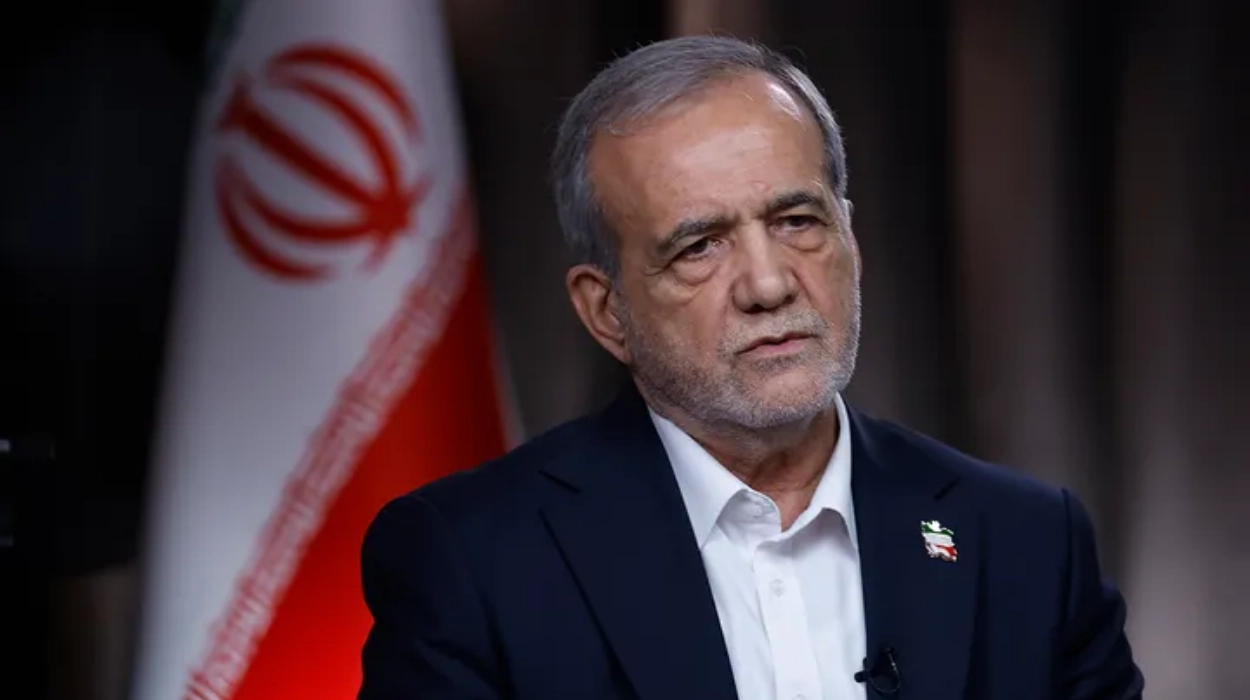
Iranian President Masoud Pezeshkian stated on Saturday that the United States together with Israel and European countries are conducting a complete war against Iran by working together to destroy his nation through military, economic, and political means.
Pezeshkian’s claim that the United States and other countries are engaged in a “full-fledged war” against Iran is more than just rhetorical hyperbole. The rhetoric shows a critical moment in a forty-year competition which started with military battles and nuclear facility attacks, and evolved into political disagreements and economic restrictions.
The ongoing nuclear conflict between Tehran and Washington became evident during June 2025 when Israel, together with the United States, launched attacks against Iranian nuclear facilities. The Middle East security environment underwent a major shift. This made the region more dangerous.
Roots of the U.S.–Iran Rivalry
The United States and Iran started their rivalry after the Islamic Revolution of 1979 because the revolution ended the Shah’s rule who received American support. It brought Ayatollah Ruhollah Khomeini’s anti-Western religious leadership to power. The 444-day hostage crisis, along with the U.S. Embassy seizure in Tehran, established permanent distrust between the two nations’ military thinking.
Washington identified post-revolutionary Iran as a destabilizing force because it spread revolutionary ideas and worked against American control in the Middle East, and supported armed groups including Hamas, Hezbollah, and multiple Shiite militias throughout Syria and Iraq.
From Tehran’s perspective, the US emerged as an existential enemy pursuing economic strangulation, regime change, and strategic containment.
The United States gave secret support to Saddam Hussein’s Iraq during the Iran-Iraq War from 1980 to 1988, which led Iran to believe that Western powers were attacking them. The relationship between the two countries has evolved through proxy conflicts and cyber attacks. Secret operations and economic restrictions and the assassination of Iranian scientists have occurred since that time.
What role does Israel play in shaping US policy toward Iran?
The two nations of Iran and Israel exist in a continuous fight which impacts their core survival, their strategic goals, and their national belief systems. Israel considers Iran’s nuclear program and regional power expansion as a direct threat to its security but Iranian leaders keep doubting Israel’s right to exist.
Iran leads the “resistance axis” to fight against Israeli and American control. Arab countries have worked to reestablish diplomatic ties with Israel.
Israel has consistently pushed Washington to take stronger action against Iran, particularly in relation to its nuclear program. Israeli intelligence services have been conducting sabotage missions against Iranian facilities through nuclear scientist assassinations and the Stuxnet cyberattack for a long time.
But for the first time, Israel’s campaign turned into a direct, massive military attack on Iranian territory with overt U.S. involvement in June 2025.
How did US and Israeli strikes escalate tensions in June 2025?
The 12-day conflict began in June 2025 when Israel carried out an unprecedented set of air and missile attacks against Iranian military and nuclear facilities. The Iranian government stated that the attacks resulted in more than 1,000 deaths while they struck facilities for enrichment operations, missile bases, command centers, and areas close to civilians.
After joining the operation, the US bombed three significant nuclear sites in Iran. Washington defended its engagement by claiming that it was a preventative action meant to stop Iran’s nuclear development and safeguard regional security.
The diplomatic channels became inactive because of the strikes, which supported Iran’s claims about Western misconduct, through the complete cessation of nuclear negotiations that resumed in April 2025.
The United States’ participation confirmed Tehran’s belief that negotiations function as a tool for intimidation. The US carried out the attacks because it grew more concerned about Iran’s expanding uranium enrichment program and its failure to maintain proper access for international inspection agencies.
How did the nuclear dispute become central to the US-Iran rivalry?
The core disagreement between the parties stems from the ongoing nuclear weapons problem which remains unresolved. The United States, together with its allied nations, have accused Iran of trying to build nuclear weapons while claiming they are working on peaceful energy projects.
"Iran should have signed the “deal” I told them to sign. What a shame, and waste of human life. Simply stated, IRAN CAN NOT HAVE A NUCLEAR WEAPON. I said it over and over again! Everyone should immediately evacuate Tehran!" –President Donald J. Trump pic.twitter.com/oniUSgsMWA
— The White House (@WhiteHouse) June 16, 2025
The Iranian government denies these charges by stating their program operates for peaceful purposes while pointing out religious bans against weapons of mass destruction.
The international community has become more worried because Iran stopped allowing inspectors to enter its territory while it continued to produce enriched uranium at levels surpassing what is needed for peaceful purposes. Citing Iran’s disregard for earlier agreements, France, Germany, and the United Kingdom reinstated UN sanctions in September 2025.
The Iranian government shows Western nations through its actions, yet they deny their involvement. The Nuclear Non-Proliferation Treaty (NPT) does not bind Israel because it remains outside the treaty. It probably maintains a secret nuclear weapons program. According to Tehran, the nuclear issue is more about denying Iran strategic parity and regional influence than it is about non-proliferation.
How has Trump’s “maximum pressure” strategy reshaped the conflict?
The White House welcomed Donald Trump back as president in January 2025 which brought back the “maximum pressure” strategy from his previous term in office. The plan consists of broad sanctions which aim to destroy Iran’s economy, while cutting off its oil sales, and creating diplomatic barriers for Tehran.
The US-Iran relationship has grown more hostile because of Trump’s “maximum pressure” approach which combines stronger sanctions with military threats during his two terms in office. His policy resulted in Iranian countermeasures and nuclear progress. Military clashes instead of diplomatic solutions.
Trump withdrew from the JCPOA in 2018 to force Iran into nuclear and missile concessions through the implementation of over 1,500 new sanctions against their shipping and oil industries, and economic operations.
The 2020 Soleimani assassination led to US troop deployment and new sanctions which made Iran break its enrichment limits. While attacking oil tankers and firing missiles at US military bases, the United States forces became labeled as terrorists by Iran which led to the country issuing symbolic arrest warrants for Trump during their escalating hostile relations.
In a National Security Presidential Memorandum dated February 4, 2025, Trump reinstated maximum pressure on Iran, focusing on its nuclear program, missiles, and terror proxies, while promising to cut oil exports to zero.
Iran accelerated its nuclear activities and planned additional power plants, dismissing negotiations as “meaningless” in the face of the sanctions. Meanwhile, Trump threatened to use military force against Khamenei in a March letter. The United States and Iran began direct talks in April 2025. Yet their discussions ended because they lacked trust and faced potential military confrontations.