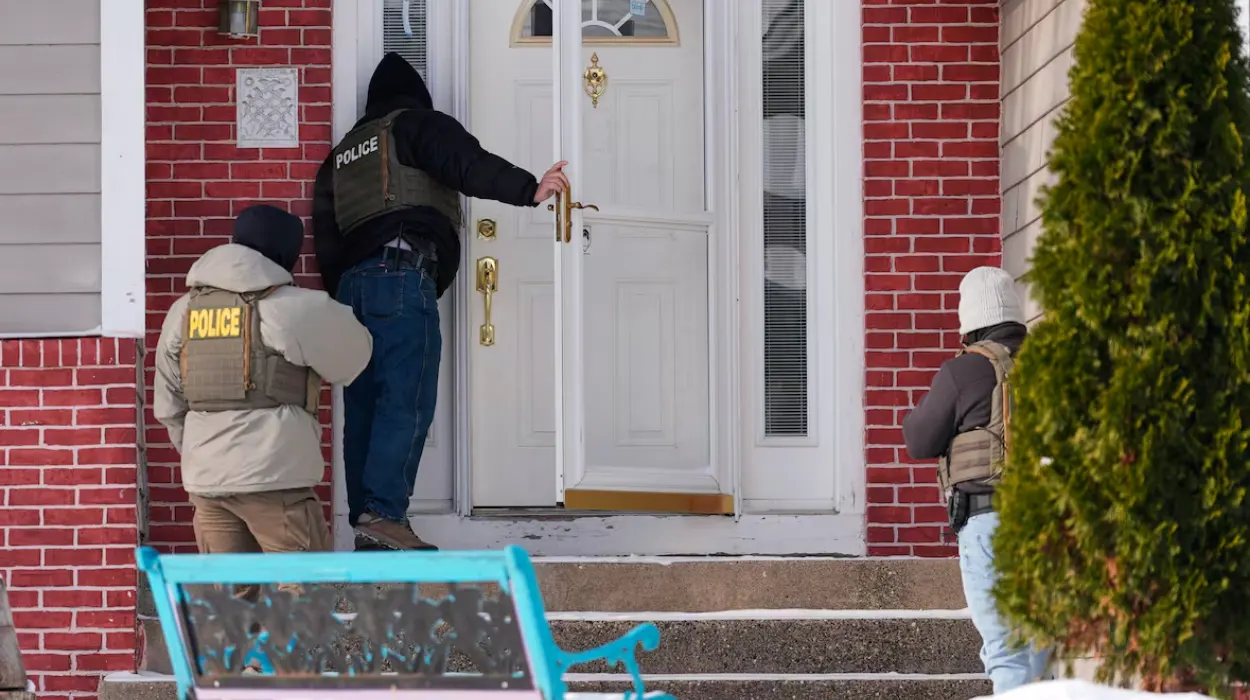
Federal immigration officers are asserting broad authority to forcibly enter private homes without a judge’s warrant, according to an internal Immigration and Customs Enforcement (ICE) memo obtained by The Associated Press. The directive marks a dramatic departure from longstanding guidance designed to respect constitutional limits on government searches.
According to this memorandum, ICE officers can employ the use of force to enter a residential home based solely on a warrant for the administrative arrest of an immigrant who has a final order of removal. According to supporters of civil freedoms, this guideline violates the Fourth Amendment by reversing guidelines set many years ago for immigrants.
Why Is ICE Rewriting the Rules Now?
The move comes as the Trump administration is aggressively increasing the number of immigration arrests across the country, deploying thousand of agents as part of its mass deportation strategy. This comes even as the manner of enforcement is changing already, especially in urban areas such as Minneapolis where ICE agents have been spotted conducting raids in residential homes.
Critics characterize the memo
“as part of an overall strategy of speeding up removals by reducing the legal and procedural hurdles that have traditionally limited immigration agents in carrying out their mission in people’s homes.”
Is Congress Being Left in the Dark?
Democrats on Capitol Hill were quick to raise an alarm when they got word of the new order. Senator Richard Blumenthal from Connecticut demanded that Homeland Security head Kristi Noem and ICE Acting Director Todd Lyons appear before Congress.
Senator Blumenthal wrote a letter to the chairs of the Senate Homeland Security and Judiciary Committee chairs in which he asked them to ‘immediately’ hold hearings in light of what he called a ‘shocking anonymous whistleblower revelation.’ He also sent a parallel letter to Noem and Lyons, cautioning that the claims of broad enforcement powers included in the memo should “appall every American.”
Does This Policy Threaten Basic Privacy Rights?
“Every American should be terrified by this secret ICE policy authorizing its agents to kick down your door and storm into your home,”
Blumenthal said in a statement, calling the directive legally and morally abhorrent.
Even Minnesota Governor Tim Walz echoed these sentiments, declaring the policy an “assault on freedom and privacy,” with civil liberties organizations warning the policy chipped away at constitutional rights afforded to all people, regardless of their immigration status, in America.
What Have People Been Told About Warrants Until Now?
Residents have long been urged by advocates for immigrants, Legal Aid groups, and local authorities to refuse to let immigration officers in unless presented with a judicially signed warrant. This is due to the Supreme Court rule that prevents law enforcers from searching a dwelling without the approval of the judiciary.
Administrative warrants, which are internal ICE records signed by immigration agents, permit arrests but not entry into non-public residences by force. Only a judicial warrant allows that action.
The new ICE directive directly undercuts that longstanding advice at a time when arrests are accelerating nationwide.
Is This Memo Being Quietly Enforced?
According to a whistleblower complaint, the memo has not been widely circulated within ICE. Instead, its contents have reportedly been used to train newly hired officers, who are being deployed across cities and towns to carry out the administration’s enforcement push.
Whistleblowers allege that recruits are being instructed to follow the memo’s guidance—even though it contradicts written Homeland Security training materials that emphasize Fourth Amendment compliance.
Are These Tactics Already Being Used in the Field?
It remains unclear how broadly the directive has been applied. However, The Associated Press witnessed ICE officers ramming the front door of a Minneapolis home on January 11 while arresting a Liberian man with a deportation order. Officers wore heavy tactical gear and carried rifles.
Documents reviewed by the AP showed that agents relied only on an administrative warrant, meaning no judge authorized the entry into private property.
How Is Homeland Security Defending the Policy?
Homeland Security spokeswoman Tricia McLaughlin said in an emailed statement that individuals served with administrative warrants have already received “full due process” and have final orders of removal.
She added that officers issuing the warrants had found probable cause and argued that both Congress and the Supreme Court have recognized the use of administrative warrants in immigration enforcement. McLaughlin did not answer questions about how often ICE has entered homes under the new guidance.
Who Exposed the Memo—and How?
Whistleblower Aid, a nonprofit legal organization, said it represents two anonymous U.S. government officials who disclosed what it called a
“secretive—and seemingly unconstitutional—policy directive.”
According to the complaint, the memo was shown only to select DHS officials, who then shared it with some employees under strict conditions. One whistleblower was allowed to view the document only in the presence of a supervisor and was barred from taking notes.
Eventually, one whistleblower was able to lawfully disclose the memo to Congress.
What Exactly Does the Memo Authorize?
The memo states that ICE officers may forcibly enter a residence using only an administrative warrant—known as Form I-205—if the individual has a final removal order issued by an immigration judge or appeals board.
Officers are instructed to knock, identify themselves, and explain their purpose. Entries are restricted to between 6 a.m. and 10 p.m., and residents must be given a “reasonable chance” to comply. If they refuse, officers are authorized to use what the memo calls “necessary and reasonable” force.
Are New ICE Officers Being Taught Something Different?
ICE has rapidly hired thousands of new deportation officers, training them at the Federal Law Enforcement Training Center in Georgia. During an August visit by the AP, ICE officials emphasized that recruits were being trained to respect constitutional limits.
But whistleblowers say that, in practice, new officers are being told they can rely solely on administrative warrants to enter homes—directly contradicting formal training materials.
Is This a Fundamental Break From Constitutional Law?
Whistleblower Aid described the policy as a “complete break from the law” that undermines the Fourth Amendment and the rights it protects.
Legal experts warn that if the directive is upheld or normalized, it could permanently alter the balance between immigration enforcement and constitutional protections—reshaping not only how deportations are carried out, but how secure Americans can feel inside their own homes.