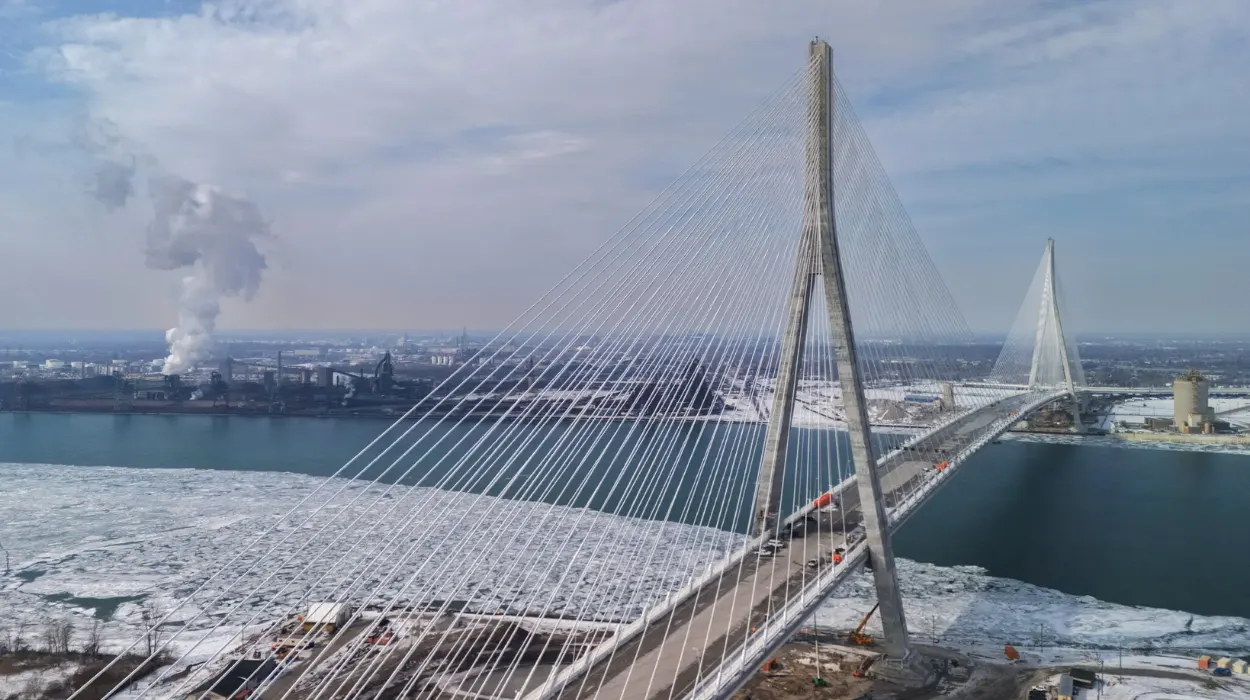
A Detroit billionaire had a meeting with U.S. Commerce Secretary Howard Lutnick just hours before President Donald Trump threatened to prevent the opening of a new bridge connecting Detroit to Canada, two officials with knowledge of the meeting told Reuters. The meeting is indicative of the rising political and economic tensions surrounding the Gordie Howe International Bridge and U.S.-Canada relations.
Matthew Moroun, a trucking mogul whose family owns the Ambassador Bridge connecting Detroit to Windsor, Ontario, met with Lutnick in Washington on Monday. Lutnick reportedly then talked to Trump about the issue by phone before the president began his public attack on the new bridge project.
Is the Gordie Howe Bridge a Threat to Moroun’s Business Empire?
The Gordie Howe International Bridge will likely compete head-to-head with the Moroun family’s Ambassador Bridge, which takes in considerable toll dollars from one of the busiest trade routes in North America. The Moroun family has been fighting the bridge for decades through various appeals, including ones that have gone to the Supreme Court of Canada.
The new bridge is to be paid for by Canada and will be owned by Canada and the state of Michigan.
Why Did Trump Threaten to Block the Bridge?
Shortly after Lutnick’s conversation with Trump, the president threatened to block the bridge’s scheduled opening later this year unless Canada addressed a series of grievances. Trump accused Canada of exploiting the United States and criticized its renewed trade ties with China.
In a social media post, Trump suggested the United States might seek ownership of “at least one half” of the bridge and a share of toll revenues, though it remains unclear how his administration could legally prevent the bridge from opening.
Is This Another Flashpoint in U.S.-Canada Relations?
The bridge threats are the latest in a series of escalations between the United States and Canada, one of the United States’ closest allies and largest trading partners. Since taking office, Trump has challenged the sovereignty of Canada and imposed tariffs on important sectors such as steel, lumber, and autos.
The United States, Canada, and Mexico are set to renegotiate their free trade agreement, which has been in place for many years, and this is expected to be contentious given Trump’s tariff stance.
What Is the White House’s Position on the Bridge Dispute?
White House press secretary Karoline Leavitt said Trump is opposed to the bridge because Canada is the one that controls what goes over the bridge and owns land on both sides of the bridge. She also expressed her disapproval of the use of foreign materials in the construction of the bridge and stated that Trump’s position on the bridge is in the best interest of America.
“This is just another example of President Trump putting America’s interest first,”
Leavitt said.
How Have U.S. and Canadian Leaders Responded?
Canadian Prime Minister Mark Carney has confirmed that he did speak with Trump and explained that the Canadian government did pay for the bridge, although the ownership will be split with the state of Michigan. Carney said that the bridge is a symbol of cooperation between the two countries and that he looks forward to its opening.
Democrats were critical of Trump’s position, claiming that he is taking the side of big money against workers. Representative Debbie Dingell of Michigan said that this incident shows how billionaires get to shape policy that ends up hurting the people who voted for Trump.
Did Trump Previously Support the Gordie Howe Bridge?
During his first term, Trump publicly supported the bridge as a vital economic link between the United States and Canada. His reversal underscores the shifting tone of his second-term foreign and trade policies.
Has Political Tension Between Trump and Carney Escalated?
Trump and Carney had a stable relationship at first, but things escalated after Carney’s speech at the World Economic Forum in Davos. Carney said that the world order led by the U.S. was going through an “irreversible rupture” and called for the middle powers to come together, which was seen as a criticism of Trump’s leadership in the world.
Trump was angry at the criticism and said that Canada was taking advantage of the United States.