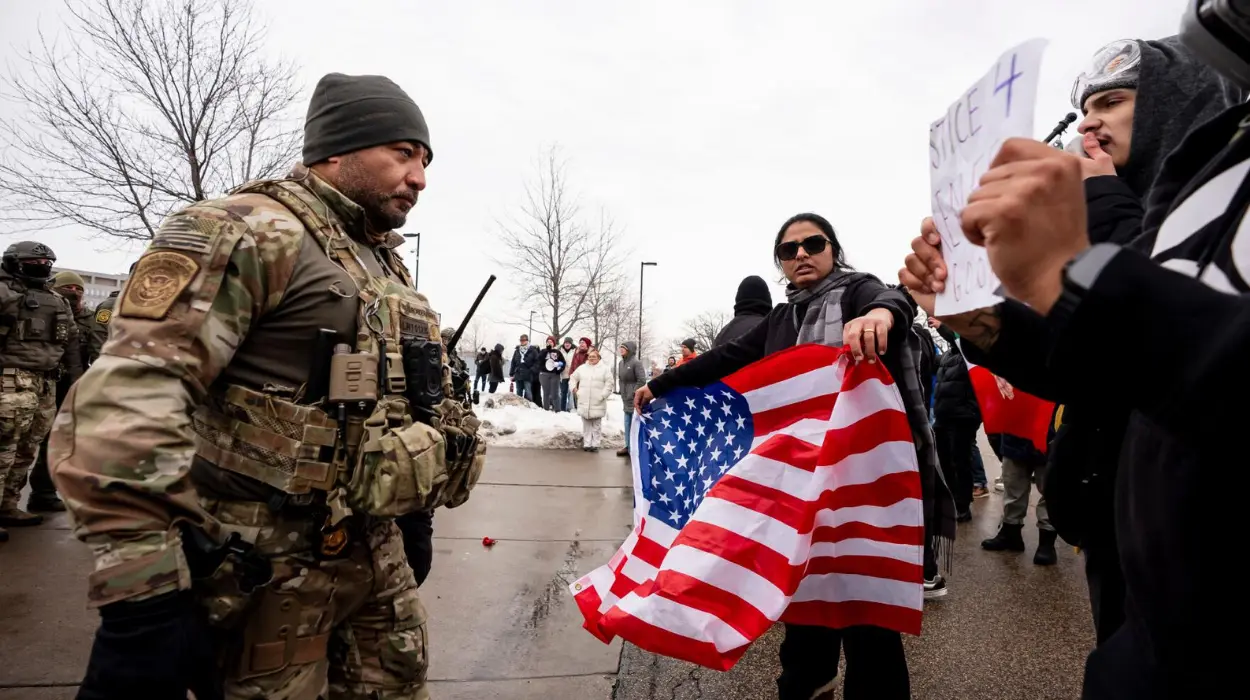
Just hours after an ICE agent fatally shot 37-year-old Renee Nicole Good in Minneapolis, Homeland Security Secretary Kristi Noem publicly declared that the officer “did exactly what he was taught to do.” The speed and certainty of that statement have drawn criticism from former Department of Homeland Security officials and civil rights advocates, who warn that such claims risk prejudging an incident that remains under active investigation.
At the center of the controversy is a basic but unresolved question: whether the use of deadly force was legally justified under DHS’s own standards — and whether senior officials undermined the investigative process by offering immediate political cover.
If Trump and Vance were truly confident in their (false) narrative around the ICE killing in Minneapolis, they’d allow a joint investigation with state law enforcement.
— Tina Smith (@SenTinaSmith) January 8, 2026
Was the shooting justified under DHS use-of-force rules?
DHS policy sets a high threshold for the use of lethal force. According to the department’s 2018 “Use of Force” memorandum, law enforcement officers may use deadly force only when they have a reasonable belief that a subject poses an imminent threat of death or serious bodily injury to the officer or others.
I am praying for the family and loved ones of the woman who was shot and killed by an ICE agent in Minneapolis this morning. This tragedy is the result of the administration sending federal agents onto our streets against the wishes of local law enforcement, including our…
— Amy Klobuchar (@amyklobuchar) January 7, 2026
Crucially, the policy is explicit on several points that complicate the official narrative:
- Deadly force cannot be used solely to prevent escape
- Officers are generally prohibited from firing at the operator of a moving vehicle
- An exception applies only if the vehicle itself is being used as a deadly weapon and no other reasonable defensive option exists
Video footage recorded by bystanders — now circulating widely — has already cast doubt on whether those conditions were met. Yet before investigators could formally reconstruct events, DHS leadership publicly absolved the officer of wrongdoing.
What we all saw yesterday, the fatal shooting of Renee Nicole Good, was absolutely sickening.
— Chuck Schumer (@SenSchumer) January 8, 2026
ICE does not belong in our neighborhoods. pic.twitter.com/9D5tdRX8s4
Former DHS officials have warned that such statements are not only premature but institutionally damaging.
“Anyone saying right now that they know exactly what happened is absolutely wrong,” one former senior official told Axios. “This hasn’t gone through an investigation. Period.”
Why are federal officials rushing to clear the officer?
Even within the Trump administration’s own enforcement apparatus, there has been caution. Tom Homan, the former ICE director and current border czar, declined to endorse Noem’s conclusion, telling CBS News:
“Let the investigation play out and hold people accountable based on the investigation.”
That divergence highlights a growing tension within DHS: political leadership has embraced a maximalist law-and-order posture, while career officials remain bound by procedural norms and legal exposure.
The Trump administration has repeatedly framed aggressive immigration enforcement as a response to “domestic security threats.” In that context, Noem claimed that Good was “harassing and impeding law enforcement operations” — a characterization that has not yet been tested against forensic evidence, witness testimony, or prosecutorial review.
How does federal immunity complicate accountability?
Federal law enforcement officers enjoy broad immunity while performing official duties, but that protection is not absolute. States retain the authority to prosecute federal officers when their actions fall outside federal authorization or violate state law.
ICE’s actions today were unconscionable and reprehensible. I am beyond outraged that their reckless, callous actions led to the killing of a legal observer in Minneapolis. My heart breaks for the victim’s family, who will have to forever live with the pain caused by the Trump…
— Rep. Ilhan Omar (@Ilhan) January 7, 2026
Bryna Godar, a staff attorney at the University of Wisconsin Law School, notes that state prosecutions of federal agents, while rare, are legally permissible.
“States can and do prosecute federal officials when they break state law,”
she said, particularly in use-of-force cases involving civilians.
Minnesota law applies a reasonableness standard similar to federal guidelines — meaning the outcome will hinge on whether prosecutors believe the officer faced an imminent and unavoidable threat.
Why was Minnesota investigators removed from the case?
The handling of the investigation itself has raised alarms. On Thursday, the FBI and the U.S. Attorney’s Office abruptly removed the Minnesota Bureau of Criminal Apprehension (BCA) from the inquiry.
The BCA is now barred from accessing scene evidence or case materials — a move that critics say centralizes control of the investigation within federal agencies that work closely with ICE.
BCA Superintendent Drew Evans confirmed the decision but emphasized expectations of transparency:
“We expect the FBI to conduct a thorough and complete investigation and that the full investigative file will be shared with appropriate prosecutorial authorities.”
Civil rights advocates argue that excluding state investigators undermines public trust, particularly in a case involving federal agents killing a civilian during an immigration operation.
Is this part of a broader pattern of force in immigration enforcement?
The killing comes amid a dramatic expansion of ICE operations under Trump’s second term. Arrests have surged, enforcement has increasingly spilled into non-border states, and ICE agents are now conducting more high-risk operations in residential neighborhoods.
Independent watchdogs and academic studies have long warned that aggressive immigration raids — especially those involving armed federal agents — significantly raise the risk of civilian harm, misidentification, and escalation.
Yet DHS has consistently resisted external oversight, and internal disciplinary actions against officers involved in fatal incidents remain exceedingly rare.
What happens next — and who decides accountability?
Federal and local investigations are now proceeding, but the early political framing may shape public expectations long before prosecutors weigh evidence. If the DOJ declines to bring charges, the decision will almost certainly fuel accusations of impunity.
For the family of Renee Nicole Good, and for communities already wary of ICE’s expanding footprint, the case has become emblematic of a deeper concern: whether immigration enforcement is operating beyond meaningful civilian control. As one former DHS official put it bluntly:
“The facts should come before the politics. Here, it looks like the politics came first.”