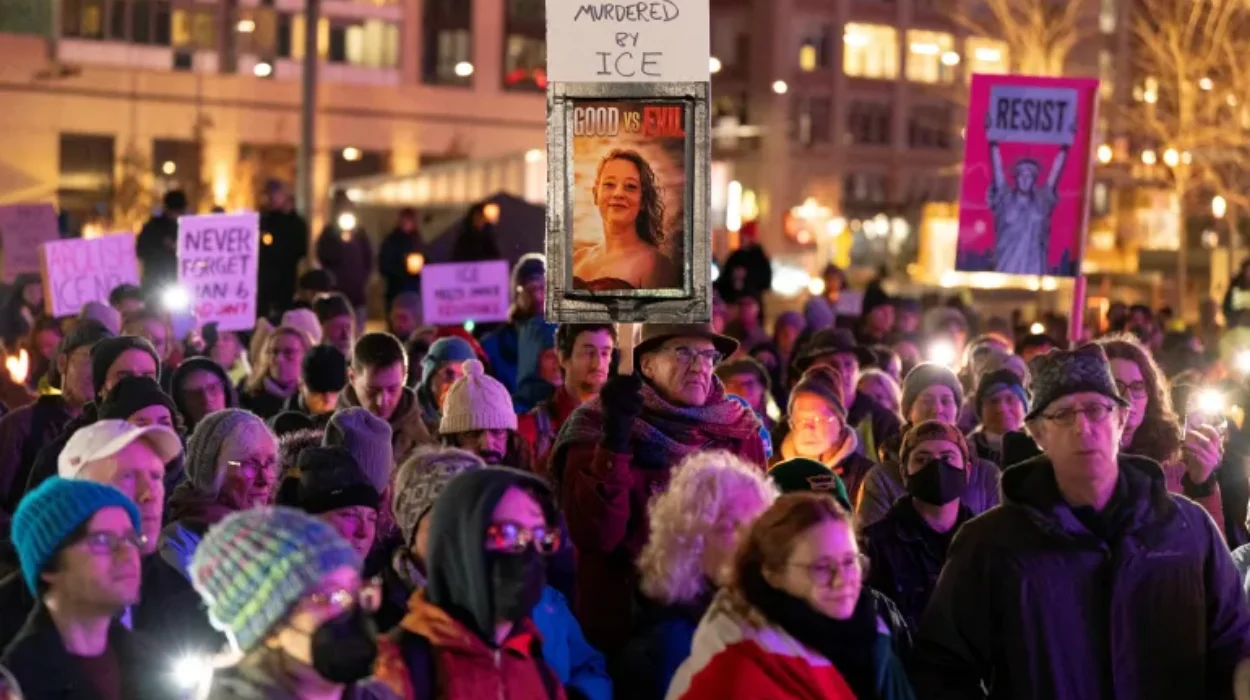
The fatal shooting of Renee Nicole Good, a Minneapolis mother of three, by an Immigration and Customs Enforcement (ICE) officer has become more than a local tragedy. It has emerged as a flashpoint in a broader political struggle over immigration enforcement, executive power, and the expanding use of the term “domestic terrorism” by the Trump administration.
The decision by Homeland Security Secretary Kristi Noem to publicly label Good’s actions as “domestic terrorism” has triggered fierce backlash from legal experts, civil liberties advocates, and state officials, who argue that the term is being weaponised to justify lethal force and suppress dissent.
At stake is not only the accuracy of the government’s account of what happened in Minneapolis, but also the integrity of a legal concept traditionally reserved for acts of politically motivated mass violence. Critics warn that blurring this definition risks eroding constitutional protections and normalising extraordinary state power against ordinary citizens.
A deadly encounter and a disputed narrative
According to the Department of Homeland Security (DHS), Good refused orders to exit her vehicle, “weaponised” her car, and attempted to run over an ICE officer. Secretary Noem framed the incident as an act of domestic terrorism, suggesting political intent and imminent danger.
Minnesota officials, however, have sharply disputed that characterisation. Attorney General Keith Ellison described Noem’s statement as
“an abuse of the term domestic terrorism,”
pointing to video evidence that appears to show Good attempting to drive away rather than deliberately attack officers. Frame-by-frame analyses conducted by The New York Times and The Washington Post found that while Good’s vehicle moved toward an agent, the officer was able to step aside and fired multiple shots from the side of the car as it veered away.
Good, a US citizen with no criminal record, was not known to be politically active. Her ex-husband told The Associated Press that she was a poet and a mother focused on raising her children, not an activist or protest organiser. She had just dropped off her six-year-old son at school when she encountered ICE officers in her own neighbourhood.
Why the “domestic terrorism” label matters
The controversy is not merely semantic. In US law and political culture, “domestic terrorism” carries extraordinary weight. It evokes mass casualty attacks, ideological violence, and existential threats to public safety. Applying the label to a single civilian encounter—before an investigation is complete—fundamentally alters how the public interprets state violence.
Federal law provides definitions of domestic terrorism, but notably does not provide a specific criminal charge called “domestic terrorism.” According to the FBI, the term applies to acts dangerous to human life that violate criminal laws and are intended to intimidate civilians or influence government policy. The Department of Homeland Security uses a similar definition tied to threats against life or critical infrastructure.
The Congressional Research Service noted in 2023 that, unlike foreign terrorism, there is no formal legal mechanism to designate an individual as a domestic terrorist. Former FBI agent Michael German has repeatedly emphasised that government officials have no legal authority to unilaterally label US citizens as domestic terrorists.
From legal definition to political rhetoric
Despite these limitations, the Trump administration has increasingly relied on the phrase as a rhetorical tool. In September, a DHS memo instructed law enforcement to prioritise threats including “violent efforts to shut down immigration enforcement,” claiming that “domestic terrorists” were advancing “extreme views in favour of mass migration and open borders.”
Civil liberties experts warned that such language dangerously conflates political beliefs with criminal intent. The memo’s broad framing, they argue, risks criminalising protest, resistance, and even non-compliance with law enforcement—activities traditionally protected under the First Amendment.
Keith Ellison’s criticism reflects this concern. By labelling Good a domestic terrorist almost immediately, the administration effectively framed her killing as justified self-defence against an existential threat, rather than a police use-of-force incident subject to scrutiny.
A pattern in immigration enforcement cases
The Good shooting is not an isolated case. In October, during “Operation Midway Blitz” in Chicago, a Border Patrol agent shot US citizen Marimar Martinez five times. DHS described Martinez as a domestic terrorist, alleging she rammed an agent’s vehicle and possessed a firearm. Federal charges against her were later dismissed by a judge.
Legal analyst Joey Jackson noted that once evidence was fully reviewed, “there were serious questions about the officers’ narratives.” The pattern is troubling to experts: aggressive claims made by federal authorities are later undercut by courts, but only after public perception has been shaped by official statements. This raises a fundamental question: is the “domestic terrorism” label being used to pre-empt accountability?
Immigration, enforcement, and racialised scrutiny
The Trump administration has recently intensified immigration enforcement in Minneapolis following media reports about alleged daycare fraud involving members of the local Somali community. While Good herself had no connection to these allegations, the broader enforcement surge has heightened tensions in immigrant-heavy neighbourhoods.
Critics argue that aggressive tactics, combined with politicised rhetoric, create conditions in which routine encounters escalate rapidly. When enforcement operations are framed as counterterrorism missions rather than civil immigration actions, the threshold for force inevitably lowers.
Expanding the label beyond immigration
The administration’s use of the term extends beyond immigration cases. After the murder of conservative activist Charlie Kirk, Trump issued a memo expanding “domestic terrorism” priorities to include organised doxxing, swatting, trespass, rioting, and civil disorder. Days earlier, he signed an executive order designating antifa as a domestic terrorist organisation, despite its lack of formal structure.
Attorney General Pam Bondi instructed federal agencies to compile lists of groups that “may constitute domestic terrorism,” prompting warnings from legal scholars about viewpoint-based enforcement.
Faiza Patel of the Brennan Center for Justice described these moves as “ungrounded in fact and law,” arguing they threaten to turn ideological disagreement into a basis for surveillance and prosecution.
Selective enforcement and ideological imbalance
Notably, critics point out what the administration does not label domestic terrorism. The policy directives do not prominently reference right-wing violence, including the politically motivated assassination of Minnesota state legislator Melissa Hortman months earlier.
Former DOJ counsel Thomas E. Brzozowski argued that when enforcement priorities target one ideological family while marginalising others, “any pretense of neutrality collapses.” This selective framing fuels perceptions that “domestic terrorism” has become a partisan instrument rather than a neutral security concept.
Experts warn of long-term consequences
Legal scholars stress that the danger lies not only in mislabelling a single incident, but in normalising executive discretion over fundamental definitions. Brzozowski warned that labelling Good’s actions as domestic terrorism before an investigation strips the term of meaning and undermines the rule of law.
Shirin Sinnar of Stanford Law School added that while intentionally ramming a vehicle for political purposes could constitute terrorism in certain contexts, the available evidence in this case does not support such a conclusion. “Here,” she said,
“the administration’s language appears designed to malign a civilian and justify lethal force.”
Michael German was even more blunt: there is no public evidence that Good’s actions could have been prosecuted under terrorism statutes.
“Calling her a domestic terrorist is entirely pejorative and prejudicial,”
he said.