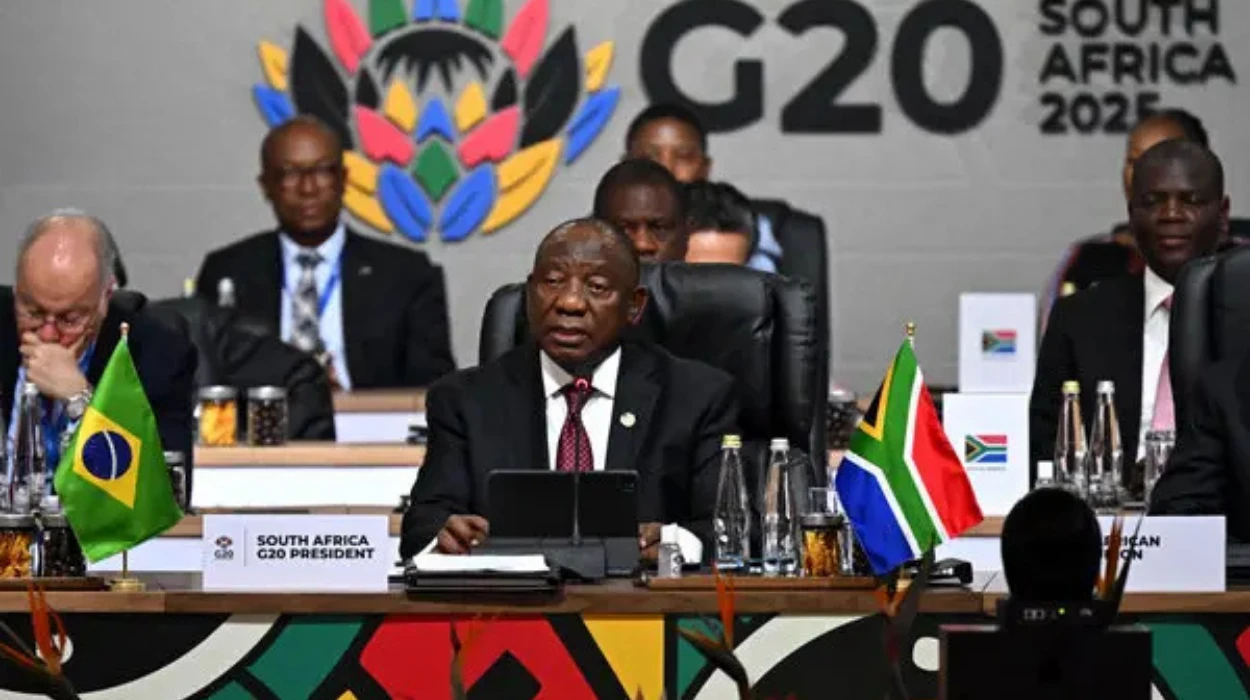
The African country South Africa headed the global most influential economic forum in the G20 presidency of December 2024 to November 2025, the first time such an African country took the lead. The Johannesburg summit scheduled in November 2025 was intended to boost the UN 2030 Agenda, speed up climate adaptation funding, and support the agenda of the developing economies. It was considered a continental landmark in regards to the presidency, where South African officials pointed out the necessity of structural change in the world financial system.
The historic moment was soon however marred in a harsh diplomatic break with the United States. The Trump administration declared that it would neither attend the Johannesburg summit at all nor protect the white Afrikaner minority in South Africa, claiming that the South African government mistreats them, a claim denied by Pretoria many times but branded as fake political drama. South Africa also did not welcome the climate-focused agenda of Washington, and the country condemned its perceived one-sidedness in the developmental model.
The situation continued to deteriorate when the U.S suggested to dispatch a junior member of the embassy to take the ceremonial handover of the presidency. South Africa declined, saying that President Cyril Ramaphosa would never give up the leadership to any other representative who was under the rank of a head of state. The lack of progress of the procedures was the symbolical representation of the increasing diplomatic rift at the time when the G20 traditionally focuses on cohesion and continuity.
Challenges To G20 Unity And Multilateralism
The Johannesburg summit eventually came up with a declaration by the leaders in the areas of climate resilience, pathways to debt restructuring, and sustainable industrial transitions. But the non-presence of the United States – the largest economy of the world – left a great shadow in the capability of the forum to promote visible policy coordination in the world.
Fragmented Leadership And Geopolitical Tension
The absence of the U.S. in drafting was the first occasion since G20 history that a consensus document was proceeded without the direct involvement of Americans. This change revealed growing geopolitical divisions, especially with the world power centers re-evaluating priorities in economic uncertainties, technological rivalry and longstanding conflict in Eastern Europe.
Another irregularity to an already troubled forum was the partial disengagement of Argentina, which did not even attend the summit. These advancements cast doubt on the analysts that the G20 can work as a unit in the long-term and that the bloc can remain the leading platform in world economic governance.
Diverging National Agendas
Mismatch in strategic agendas is a major point of tension. South Africa demanded more climate finance commitment and placed more emphasis on multilateral cooperation with Global South economies. The United States, on the other hand, had a more limited economic orientation and lamented the way it saw it to be politicization of development structures.
The conflict brought out a wider ideological flaw. South Africa supported multipolar political systems and reforms that were reformist and Washington upheld a more transactional policy that was in accordance with its domestic and geopolitical demands.
Implications For Future Summits
The divide is posing unparalleled doubts on the 2026 G20 cycle, which is set to be hosted by the United States. South Africa has already been indicated by Washington that it might not even be part of crucial planning conferences in the American presidential year. This would violate decades of G20 tradition and upset the principle of equal membership of member states.
South Africa’s Strategic Position And Regional Importance
The presidency of South Africa had been regarded as a representation of the new leadership of Africa in the international diplomatic and economical platform. The chairing was used by the country to predict the problems that challenged developing countries such as distress of debts, regional-specific energy transitions, and availability of innovation facilities to low-income economies.
Africa’s Role In Global Economic Governance
The leaders of the African Union gave a clap to the agenda of South Africa saying that the presidency was not just about mere participation. It provided a tangible chance to influence world policy in an Africanese way. This ambition was reflected in the record budget of the summit and increased participation tracks which included the participation of the think tanks, civil societies and regional development institutions in the policy discussions.
However, the diplomatic confrontation with the United States highlighted the institutional issues of how African states seek to exercise power in institutions that are influenced by the interests of the major powers. Analysts observed that the U.S. boycott would undermine the saliency of African concerns, particularly on climate adaptation finance, where the continent is overrepresented given that it contributes the least to the global emissions.
Constraints Of Middle-Power Diplomacy
The diplomacy of South Africa emphasized the precariousness that was needed in middle-power politics. Although Pretoria was able to rally international G20 to pursue the objectives of climatic changes and development, the tussle with Washington demonstrated that international governance is prone to bilateral political influences.
This dynamics created discussions in the circles of African policies on whether the continent requires more powerful collective tools of approaching the major powers, especially when individual states experience diplomatic pressure linked to the global economic negotiations.
Implications For Global Governance And Future Engagement
What happened to the 2025 Johannesburg summit has a lot of implications of what the future of global governance and the reputation of the G20 as a worldwide decision-making body can look like.
Shifting Power Centers And Structural Limitations
The capacity of G20 to produce consensus-based solutions relies more and more on the process of reconciliation of the divergent concerns between old powers and emerging economies. The divide between the United States and South Africa is not just a political contest, but also a clash of ideas on the way the global institutions are to be developed in a multipolar world.
The increasing need to be represented by Global South countries disrupts the old-fashioned structures that used to give power to the richer economies in the past. Consequently, the future path of G20 reform can be dependent on the rate of integration of emerging economies into agenda-setting processes in the future.
Prospects For Reform
By early 2025, the think tanks and policy analysts argued that there were various possible reform directions, which would involve greater rotating leadership arrangements, increasing regional blocs and enhancing dispute settlement systems within the G20 framework. However, these propositions have a big challenge especially when the top officials have divergent views regarding the world agenda.
Whether the G20 can adjust to this complicated environment with the ability to organize responses to cross-national crises will determine the future credibility of the G20.
A Transforming Platform At A Critical Global Moment
The presidency of South Africa in G20 also raised the hope of a more inclusive system of international governance and the frailties of international relations that occur when geopolitical strains take center stage at the expense of shared agenda. The diplomatic confrontation with the United States can be a clue to the overall changes that influence the international system in 2025. With the spotlight on the next US-hosted summit in 2026, people will be keen to find out whether the G20 will sail through these fractures or the action of this year will be an indication of more serious realignments that can redefine the role of the forum in the global system.