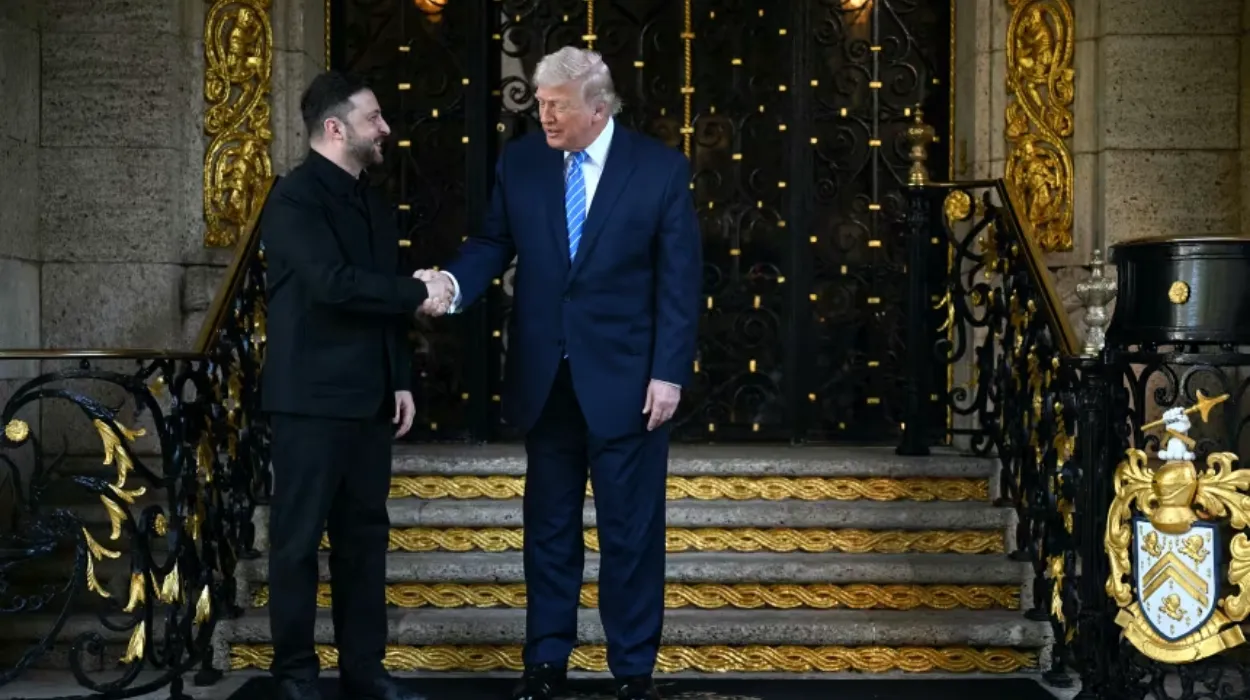
Volodymyr Zelensky left a cold, missile-damaged Kyiv on Sunday for an unlikely diplomatic destination: Donald Trump’s Mar-a-Lago estate in Florida. It was an ambitious goal to win Trump’s support for a revised 20-point peace framework meant to end Russia’s war on Ukraine, which is now in its fourth year.
After more than three hours of private discussions, neither side announced a breakthrough. Both leaders acknowledged the challenges of the negotiations and cautioned that an end to the war is still far off.
I thank President Trump @POTUS and his team for the negotiations. I thank the United States for its support. Together, we must – and can – implement our vision for the sequencing of steps toward peace. pic.twitter.com/YklMUd62BA
— Volodymyr Zelenskyy / Володимир Зеленський (@ZelenskyyUa) December 28, 2025
Trump again voiced sympathy for Moscow’s viewpoints after speaking with Russian President Vladimir Putin earlier in the day, a stance that continues to unnerve Kyiv’s allies.
Still, the tone marked a departure from earlier encounters. Trump publicly praised Zelensky and expressed renewed optimism that a deal could be within reach. “I do think we’re getting a lot closer, maybe very close,” Trump said, striking a notably warmer note.
According to Trump, negotiations between the US, European, and Ukrainian teams will continue in the coming weeks, perhaps in Washington. More talks with Putin are expected, emphasizing that Moscow’s approval is ultimately necessary for any agreement.
Is this the final window to end the war — or another missed chance?
Although Trump insisted that there is no formal deadline for the conflict to end, his comments suggested that he believed this might be the best opportunity yet to do so.
Trump presented the negotiations as approaching a decisive stage through increased diplomacy spearheaded by his adviser Jared Kushner and envoy Steve Witkoff.
“We’re in the very final stages of talking,”
Trump said, warning that failure would mean the war drags on indefinitely with devastating human costs.
“It’ll either end, or it’s going to go on for a long time, and millions of additional people are going to be killed.”
The remarks reflect Trump’s growing frustration. After campaigning in 2024 on a promise to end the war within a day of returning to office, he has since acknowledged that the conflict is far more entrenched than expected — particularly without the personal leverage over Putin he once assumed he would have.
Sunday’s inconclusive meeting reinforced that reality. Trump described progress but stressed the difficulty of resolving “one or two very thorny issues” that cannot be settled overnight.
“In a few weeks, we’ll know one way or another,”
he said, leaving open the possibility that diplomacy could still fail.
How central was Putin — even in his absence?
Despite not being present at the Palm Beach negotiations, Vladimir Putin’s influence was evident. Before meeting Zelensky, Trump acknowledged that he had a conversation with the Russian leader for over an hour, and he plans to speak with him again afterward.
This sequencing has alarmed Ukraine’s supporters in the past. Previous Trump-Putin calls have sometimes preceded setbacks for Kyiv, including Trump’s decision last year to withhold long-range missiles after initially signalling openness.
This time, however, Trump’s conversation with Putin did not derail the meeting with Zelensky. Still, Trump praised Putin’s handling of one sensitive issue: the Zaporizhzhia nuclear power plant.
“President Putin is actually working with Ukraine on getting it open,”
Trump said, adding that refraining from bombing the facility was “a big step.”
Trump reiterated his belief that Putin is genuinely interested in peace.
“He wants to see it happen,”
Trump said.
“He told me very strongly, I believe him.”
Why does the last 10% of the deal matter most?
Both US and Ukrainian officials have suggested that roughly 90% of a potential peace agreement has been settled. Zelensky repeated that assessment after the meeting, though Trump said he dislikes quantifying progress in percentages.
What remains unresolved, however, may be the most consequential elements of the deal. Chief among them are territorial questions — particularly land already occupied by Russian forces — and the future of the Zaporizhzhia nuclear plant. Trump openly floated the idea that Ukraine might be better off conceding territory now rather than risking further losses.
“Are you better off making a deal now?”
he asked, warning that Russia could seize additional land in the coming months.
As mandated by Ukraine’s constitution, Zelensky has demonstrated greater adaptability by indicating his readiness to put any peace deal to a national referendum. But he is adamant that any vote must come after a ceasefire.
Moscow has rejected that requirement. Before the talks, Russia launched another missile and drone attack on Ukraine, and Kremlin officials reiterated their conviction that a temporary ceasefire would only exacerbate the conflict.
Trump and Putin “generally share similar views” on this matter, according to Kremlin aide Yuri Ushakov, and Ukraine must soon decide the fate of the eastern Donbas region, which is a key objective of the Russian campaign.
Later, Trump called the future of the region “one of the big issues” still up for discussion and stated that progress was being made.
Has the Trump–Zelensky relationship finally stabilised?
Relations between Trump and Zelensky have been closely watched since their contentious first meeting in February. None of the subsequent encounters has escalated into a public altercation, although they have reportedly been tense behind closed doors.
On Sunday, the optics were carefully managed. Trump greeted Zelensky with praise, calling him “very brave” and commending the resilience of the Ukrainian people. Zelensky, in turn, repeatedly thanked Trump — a notable shift after Trump and Vice President JD Vance publicly chastised him earlier this year for failing to show sufficient gratitude for US mediation efforts.
The informal setting of Mar-a-Lago also played a role. Trump has long used the estate to cultivate personal rapport with world leaders, from China’s Xi Jinping to Japan’s late Prime Minister Shinzo Abe.
While Zelensky’s visit was driven largely by Trump’s holiday schedule rather than diplomatic symbolism, the relaxed environment appeared to soften the tone.
“He walked in, he said, ‘This place is gorgeous,’”
Trump remarked afterward.
“I don’t think he wants to go to the White House anymore.”