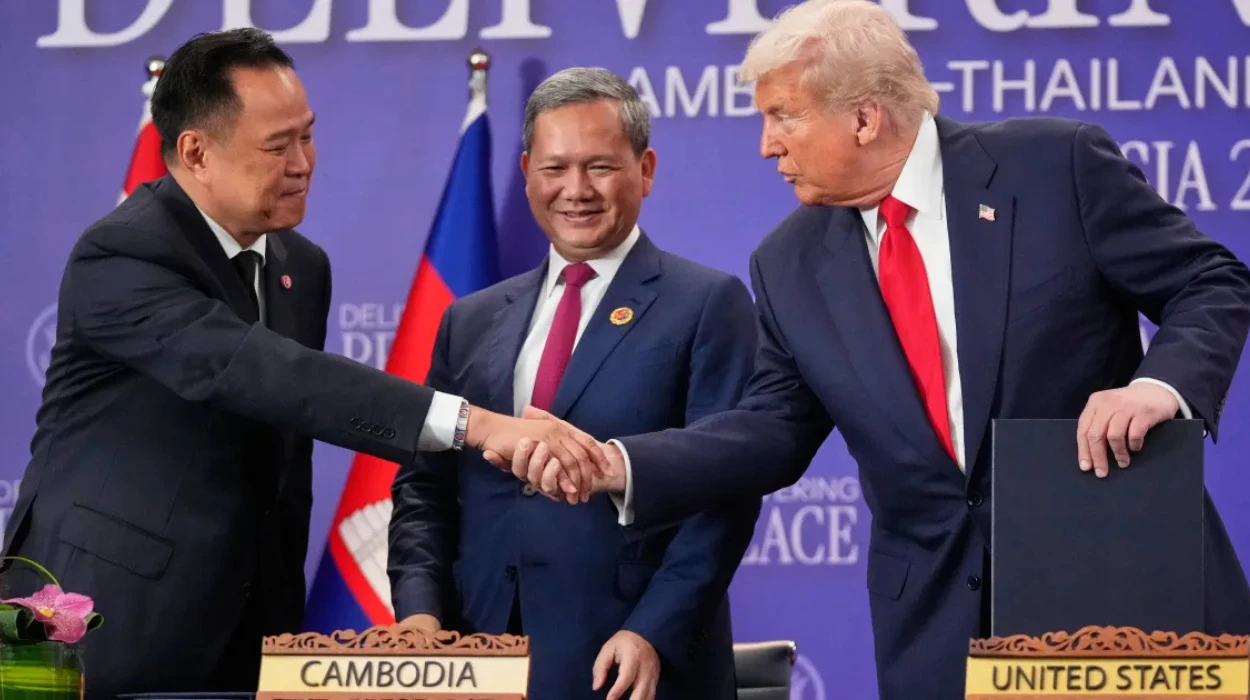
The tensions between Cambodia and Thailand escalated between mid and late 2025, a fact that highlights the rapidness with which a so-called truce may be ruined. The sporadic interactions around the Emerald Triangle in May grew heated when a Cambodian soldier died and both of them began firing back. By July, the tensions intensified as another soldier of Thai origin sustained a severe wound because of landmine which resulted in heavier exchanges which caused homes to be damaged, and civilians moved towards improvised shelters.
It was further worsened by December 2025 when the fighting had spilt over to the third day. F-16 jets deployed by Thais were used in a massive display of force and the Cambodian artillery still hit contested zones along the border. Over half a million civilians displaced the region, making it difficult to supply the region with humanitarian aid with Laos experiencing shell spillover, shutdown of schools and emergencies.
Contested Narratives And Historical Layers
The events leading to the triggering were surrounded by contradictory stories. The first Cambodian movements were conditioned as the statements of the Thai military, which was the intrusion of Cambodia, and the Defense Ministry of Cambodia asserted that Thai artillery was used on civilian territories. These wrangles serve as the lack of resolution of frictions related to the 1962 ICJ decision of the Preah Vihear temple, which had been a long nationalist issue to both regimes.
Humanitarian Pressures And Regional Response
Over 500,000 displaced people put a heavy burden on provincial borders and temporary relief mechanisms. The retaliation by Cambodia on Thai fruit and Thai soap operas gave an economic angle to a conflict which was already characterized by loss of life and infrastructure destruction. The appeals of ASEAN to restraint failed, and in both capitals the nationalism was more apparent.
Trump’s Eight Wars Myth Confronted By Renewed Fighting
In 2025, a year after leaving office, President Donald Trump would still claim to have ended eight wars, building on the previous six or seven. His utterances often touched on Gaza, Israel-Iran conflict, India-Pakistan conflict and the Cambodia-Thailand conflict. These claims came under new scrutiny with the outbreak of violence once again on the Cambodian Thailand border.
Fact-checkers had already noted that a number of the so-called wars were not official wars and the U.S. influence in many of the mentioned situations was restricted. In a campaign stop in Pennsylvania, Trump repeated that he had prevented a war between two very mighty nations, which was understood as referring to Cambodia and Thailand. The July ceasefire which ensued after U.S. mediated talks in Malaysia fell apart months later undermining the argument that a durable peace was achieved.
Marginal U.S. Involvement In Regional De-escalation
According to Indian officials, the India-Pakistan de-escalation has mainly been attained through a direct bilateral engagement as opposed to the United States mediation. Ceasefires collapsed over and over again in Gaza and the broader scenario of Israel-Iran. These instances revealed a tendency in which the pauses that are temporary are placed as permanent without a system to follow up on long-term compliance.
Evolving Narratives And Shifting Numbers
The list of finished conflicts that Trump lists has been expanded following late 2024 to include cases of disputes or military engagements that do not meet classic definitions of war. According to analysts, no accompanying peace treaties were signed to the same effect undermining the foundation of numerical inflation. Media houses in the U.S. and Europe released reviews of the factual fallacies that put the Cambodia-Thailand crisis on the frontline of the myth-versus-reality theory.
Limits Of Trump’s Peacemaking Model
The diplomatic policy of Trump was characterized by a significant emphasis on personal contacts, direct phone contacts, and tariff suspensions as a way of encouraging cooperation. Although effective in creating short-term tranquility, these strategies had a tendency of bypassing regional institutions that could create compliance. This limitation was echoed in the Cambodia-Thailand case, where the July 2025 deal did not provide any demilitarized buffer zone, no monitoring organ, and incentives to ensure de-escalation.
Thai Foreign Minister Sihas Phuangkeow stressed that Thais were only acting in self defense and that Cambodia was the aggressor; a position that made it difficult to construct a balanced peace process. Cambodian officials came back with cries of Thailand weakening the sovereignty and the mistrust cycle continued, which could not be fixed by surface-level diplomatic talks.
Structural Gaps In Ceasefire Design
Ceasefires were not checked and both sides were left to define the violations as per the domestic political demands. The lack of third parties observers implied that the skirmishes would easily go out of control without any consequences. Economic indicators, including the import bans of Cambodia, marked the ways in which the unresolved political tensions could spread to the general bilateral relations.
Domestic Pressures As Conflict Accelerants
Political situations in the two countries enhanced the instability. Thailand’s election was a source of nationalistic rhetoric, and the leadership in Cambodia mobilized the masses by making the war a battle of keeping the territory. These forces minimized chances of any of the two governments to yield in a compromise that would be construed to be a sign of weakness.
Comparing Foreign Policy Patterns Across Administrations
The unilateral strategies of Trump were based on speed and appearance, in comparison with those of Presidents Obama and Biden, which were multilateral in nature. The previous governments preferred coalitions, commitment through treaties, and mediating in the form of institutions. The strategy of Trump was based on the instant disruptiveness, the tariff suspensions, the public calls, and announcements, not always supported by the institutions.
These methods proved frailer as border skirmishes were rekindled at the end of 2025. Reductions of casualties in the past were short-lived and the number of displaced individuals started to skyrocket. As half a million civilians crossed the Cambodian-Thai border, the indicators of war termination were reconsidered in the larger framework of the repetitive conflict.
Geopolitics And Strategic Implications For Southeast Asia
The new confrontation suggested the small scope of U.S. diplomacy in a part of the world becoming penetrated by the economic and security presence of China. The investments in Cambodia and Laos by Beijing Belt and Road activities appreciated its influence, overtaking those of Washington to influence the result. Such a change made the U.S. support of peace accords in Southeast Asia without regional involvement doubtful in terms of strategic viability.
Cambodian actions were framed by Thai military sources as being aggressive whereas the actions of Thailand were accused by Cambodia as having weakened the integrity of the borders. This paranoia was also enhanced by the intensifying military actions in the region such as Thai jet flights and Cambodian artillery retaliations. These developments questioned the fact that external diplomacy pressure would be sufficient to resolve the conflicts that have been founded on the decades of territorial disputes.
Resurgent clashes continue challenging narratives of resolved wars and revived stability. As observers assess shifting power dynamics and fragile ceasefires, attention now turns to whether structural diplomacy or escalating rivalry will define the next phase of the Cambodia-Thailand conflict and the broader debate over the credibility of the Trump eight wars myth.