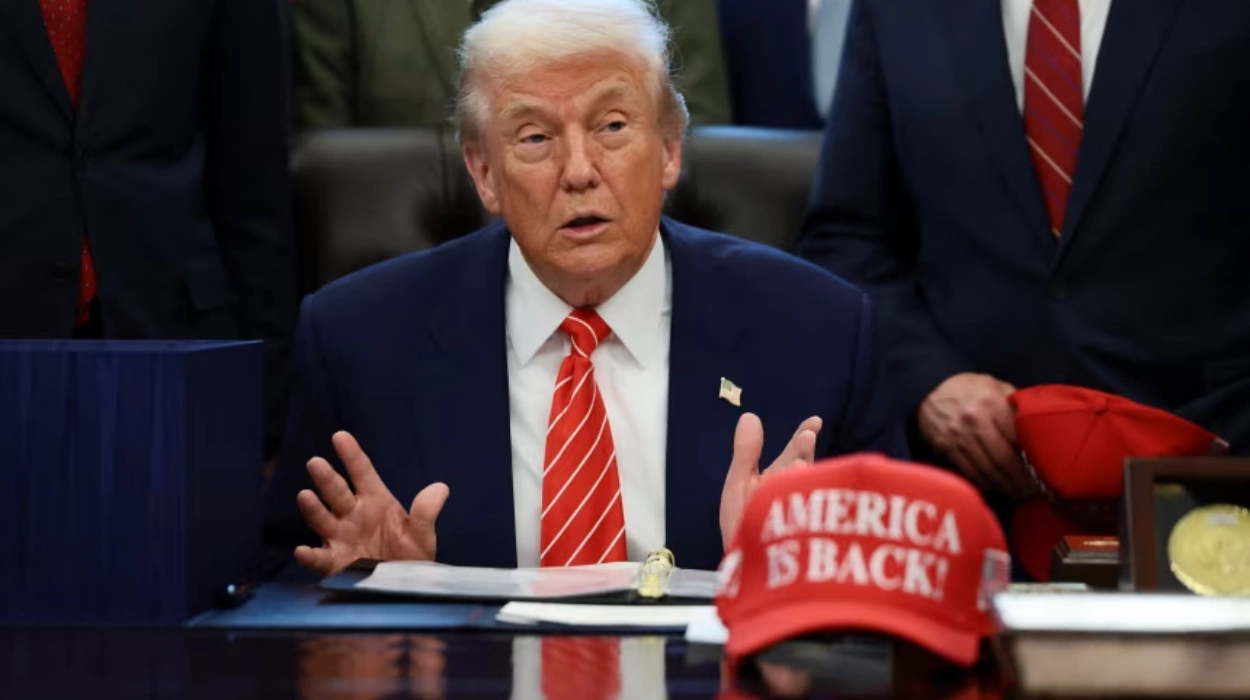
President Donald Trump’s rallying cry to “nationalize the voting” has caused great concern among election officials, constitutional lawyers, and non-partisan experts, who believe that such rhetoric is a sign of a dangerous escalation of his long-term campaign to change the way elections are conducted in the US.
The comments are particularly disturbing, according to experts, because they are made by a president who has already tried to reverse an election outcome and is now claiming presidential powers that have very little historical precedent in the United States.
A Vague Proposal With Sweeping Implications
Trump’s comments, made during a Monday interview, were striking both for their ambiguity and for how radical they could be if taken literally. While the federal government does play a limited role in elections—such as deploying Justice Department voting-rights monitors—Trump’s suggestion that Republicans should “take over the voting” would represent an unprecedented federal intrusion into powers long reserved for the states.
Election lawyers and administrators told CNN that such a move would directly conflict with the Constitution’s structure, which intentionally decentralizes election administration to prevent the concentration of power.
White House Attempts to Walk Back the Remarks
In the wake of the backlash, the White House attempted to play down Trump’s statements, claiming Tuesday that he was simply expressing his support for the SAVE Act, a Republican-sponsored bill that would require proof of citizenship to register to vote.
However, the bill does not call for federal control of elections, and research has repeatedly shown that the problem of illegal voting by undocumented immigrants is a microscopic issue. Analysts have suggested that connecting the bill to Trump’s comments does not help to shed any light on what he is trying to get across.
Timing Raises Red Flags for Election Officials
Trump’s comments landed amid a tense political moment:
- Two days after Democrats flipped a long-held Republican state Senate seat in Texas
- Five days after the FBI seized 2020 election records in Fulton County, Georgia
- As the Justice Department pursues lawsuits seeking access to voter rolls in Democratic-led states
To election professionals, the timing suggests an intensifying federal pressure campaign around election administration.
What Trump Actually Said
During the interview with conservative podcaster Dan Bongino, Trump reiterated his claims that undocumented immigrants had flooded into the country during the presidency of Joe Biden, which threatened the electoral chances of Republicans. Trump did not provide any specifics, and Bongino did not ask for further explanation. The White House later clarified that Trump was talking about states that he thinks have a “high degree” of election fraud, which has been repeatedly debunked by courts and audits.
“If we don’t get them out, Republicans will never win another election,”
Trump said.
He then added:
“The Republicans should say, ‘We want to take over.’ We should take over the voting, in at least, many, 15 places. The Republicans ought to nationalize the voting.”
Trump Doubles Down on Federal Control Claims
Rather than retreat from the idea, Trump later urged lawmakers to act on his “nationalization” proposal and asserted—incorrectly—that states act as agents of the federal government in elections.
“A state is an agent for the federal government in elections,”
Trump said.
“I don’t know why the federal government doesn’t do them anyway.”
Legal experts say that claim directly contradicts the principles of federalism embedded in the Constitution.
What the Constitution Actually Says
The constitutional framework governing elections is brief but explicit. Article I, Section IV—known as the Elections Clause—states:
“The Times, Places and Manner of holding Elections for Senators and Representatives, shall be prescribed in each State by the Legislature thereof; but the Congress may at any time by Law make or alter such Regulations…”
The clause gives primary authority over elections to the states, while allowing Congress—not the president—to set national standards, such as a uniform Election Day.
Importantly, the Constitution gives the executive branch no authority to unilaterally control election administration.
Why Elections Are Decentralized by Design
The U.S. election system is intentionally fragmented, with more than 10,000 local election jurisdictions nationwide. State legislatures set the rules—early voting periods, mail voting, polling hours—while local officials implement them.
Secretaries of state typically oversee audits and certify results.
Experts say this decentralized structure serves two critical purposes: it allows local flexibility and makes it far harder for any single actor to manipulate results nationwide or carry out large-scale cyberattacks.
Lessons From Trump’s 2020 Efforts
Trump’s actions after losing the 2020 election provide a blueprint for how he could attempt to disrupt future elections.
Because elections are run by states and localities, Trump focused his efforts on pressuring Republican officials to delay certification, reject results, or “find” votes. One contemplated federal move stood out: Trump considered signing executive orders directing the Pentagon and the Department of Homeland Security to seize voting machines.
He ultimately backed down after intense pushback from senior advisers. But Trump later told The New York Times that he regretted not signing those orders, saying, “I should have.”
Experts Warn the Guardrails Are Weaker Now
Election experts say the difference between 2020 and today is the composition of the administration itself.
“There’s a big difference between then and now,”
said David Becker, a leading nonpartisan election expert.
“A lot of conspiracy theorists are now in the administration, working for the president. And a lot of the people with principles have been purged. That makes us much more vulnerable.”
A Constitutional Collision Ahead
Regardless of how Trump frames his proposal, legal experts are clear on one point: nationalizing elections cannot be done by presidential decree. Any such effort would require congressional action and would almost certainly face immediate constitutional challenges.
Still, election officials warn that even rhetoric suggesting federal takeover risks undermining public trust—and signals an administration increasingly willing to test the limits of American democracy.