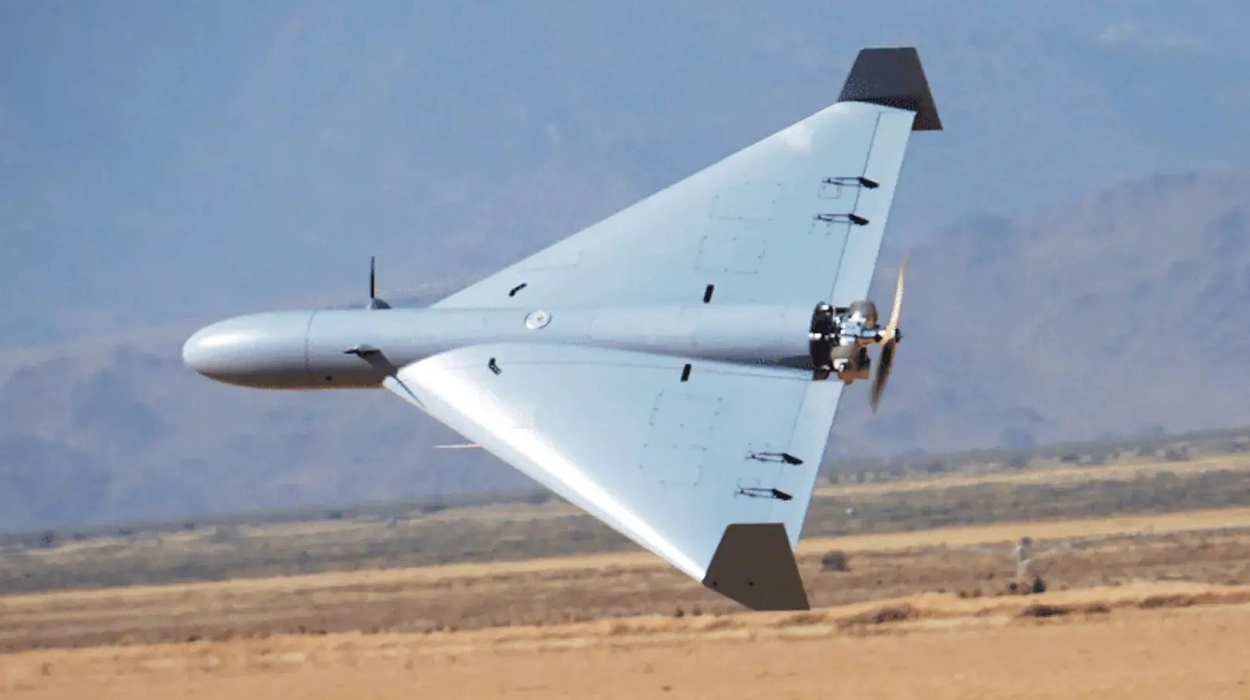
The activation of Task Force Scorpion Strike under US Central Command in late 2025 marked a decisive shift in the military’s approach to unmanned warfare. This operational unit introduced the first one-way attack drone squadron in the Middle East, composed of Low-cost Unmanned Combat Attack System drones reverse-engineered from a captured Iranian Shahed-136. The financial contrast remains one of the program’s strongest advantages. At roughly $35,000 per drone, LUCAS offers a scalable alternative to high-priced precision munitions, enabling a volume-based strategy that mirrors Iran’s own asymmetric approach.
LUCAS maintains the Shahed’s delta-wing layout, with a compact ten-foot frame optimized for long-range autonomous navigation. Its launch versatility, whether through catapults, mobile platforms, or rocket-assisted systems, positions the squadron for flexible forward deployment. Approximately twenty personnel from Special Operations Command-Central oversee the program, conducting controlled test launches across the region. As of December 2025, the system had not been confirmed in active combat, but CENTCOM has signaled its readiness for operational use should regional threats escalate.
How LUCAS Enhances Volume-Based Strike Capabilities
The design supports saturation tactics similar to those employed by Iranian proxies, enabling coordinated drone swarms intended to overwhelm defenses through sustained pressure. Its integration into CENTCOM networks allows operators to deploy multiple drones simultaneously with minimal logistical cost.
Why A Dedicated One-Way Attack Squadron Marks A Shift
This dedicated squadron represents a new chapter in US unmanned doctrine, where expendability becomes a feature rather than a limitation. By adopting Iran’s low-cost model, the US shifts from primarily intercepting hostile drones to fielding its own attritable systems.
Role Of CENTCOM In Accelerating Deployment
CENTCOM accelerated acquisition four months prior to activation after commanders noted that adversarial drone stockpiles were growing faster than legacy US systems could counter. That acceleration underscores a broader institutional recognition that traditional procurement timelines can no longer keep pace with emerging threats.
Reverse-Engineering Process And Development
US engineers worked from a damaged Shahed-136 recovered in a prior conflict zone, partnering with private firms such as SpektreWorks to replicate the airframe while improving reliability to meet American military standards. The rapid production timeline reflects lessons drawn from repeated drone incursions in Ukraine, the Red Sea, and across US positions in Iraq and Syria. The Iranian model demonstrated that sheer numerical advantage could bypass even sophisticated air defenses—an insight that shaped the LUCAS program from inception.
Through iterative testing, the new platform achieved a range of approximately 444 miles with six hours of endurance. Its payload capacity of forty pounds excludes fuel, providing room for modest warheads or specialized mission packages. Cruise speeds near 74 knots, with short dashes exceeding 100 knots, allow predictable flight behavior suited for swarm programming rather than precision maneuvering. The emphasis remained on affordability and scalability rather than elite performance.
Technical Enhancements Over Shahed-136
Several improvements distinguish LUCAS from its Iranian predecessor. While the Shahed-136 originally served as a threat emulator for US training, LUCAS expanded into a combat-ready system through upgraded command links and improved navigational resilience in contested electromagnetic environments. Most enhancements address interoperability, enabling the drones to plug into US network-centric warfare systems without extensive modifications.
Production expanded rapidly across multiple US innovative firms in 2025, reflecting a growing preference for agile manufacturing pipelines over conventional defense contractors. This approach allows CENTCOM to replenish stock quickly, ensuring that drone availability remains steady even if operational tempo increases.
Strategic Context In Middle East Conflicts
Iran and its regional proxies intensified their drone campaigns following the October 2023 Hamas attack on Israel, broadening the scope of asymmetric warfare. In 2024, Iran launched more than 170 drones and over 120 ballistic missiles toward Israel in a single operation, with US forces intercepting a significant portion. The following year saw continued proxy assaults on US positions in Iraq and Syria, with militia groups leveraging slow, inexpensive Shahed variants to stretch defensive systems.
Admiral Brad Cooper described the LUCAS deployment as “setting the conditions for using innovation as a deterrent,” a statement that reflects US acknowledgment of prior gaps in counter-saturation strategies. The undisclosed Middle East base hosting the squadron strengthens US quick-response capabilities, particularly in areas where small militias had previously exploited the time lag between detection and interception.
How Drone Volume Shapes Regional Dynamics
The volume-based advantage displayed by Iranian systems shifted the operational landscape, forcing militaries to reconsider how many interceptors they could expend. LUCAS offers an alternative by enabling the US to respond in-kind rather than relying solely on defensive measures.
Regional Proxy Activity And Escalation Patterns
Militia attacks throughout 2024 and 2025 illustrated how non-state actors could replicate state-level drone capabilities. The US adoption of similar cost-effective platforms signals a shift from pure defense to calibrated reciprocal pressure.
CENTCOM’s Networked Response Framework
The deployment fits within a broader layered defense approach emerging across the region, where early-warning systems integrate with unmanned strike assets to pre-empt attacks before they reach critical infrastructure.
Response To Proxy Drone Campaigns
Proxy groups in Iraq, Syria, and Jordan increasingly deployed one-way drones designed to drain US resources. Many of these attacks relied not on advanced technology but on quantity, exploiting how expensive interceptors limited sustained defensive operations. LUCAS reverses this imbalance by providing the US with an economically viable counter-saturation capability. Instead of firing costly missiles at cheap threats, CENTCOM now possesses a tool for proportional response.
The system aligns with broader global trends observed in Ukraine and Israel, where low-cost attritable drones have become essential components of national defense strategies. By introducing LUCAS, the US demonstrates willingness to adopt similar tactics against non-state actors without escalating into high-intensity confrontation.
Broader Implications For Drone Warfare
The introduction of LUCAS signals a doctrinal shift toward attritable systems across the US military, challenging the dominance of high-value platforms in contested environments. The proliferation of Iranian designs through proxies and Russia underscores a diffusion of technology that traditional procurement structures struggled to counter. With LUCAS, the US compressed development cycles from years to months, leveraging commercial partnerships to improve agility.
Regional actors may now face mirrored threats, pressuring governments to invest in more advanced detection systems. Training exercises conducted through 2025 validated LUCAS against simulated swarm attacks, encouraging considerations for additional squadrons across other theaters.
Proliferation And Countermeasure Dynamics
The adoption of Iranian-inspired drone technology accelerates global competition in low-cost unmanned systems. As more nations adopt swarm autonomy, electronic warfare becomes increasingly important. Defensive doctrines shift from relying on interceptors to emphasizing jamming, spoofing, and network disruption. Middle Eastern deployments of LUCAS may serve as a template for broader US planning in Europe and the Indo-Pacific.
Evolution Of US Military Innovation
Task Force Scorpion Strike illustrates the growing influence of rapid prototyping within Pentagon modernization efforts. LUCAS exemplifies a system transformed from a threat replica into an operational asset. The July 2025 CENTCOM demonstration at the Pentagon previewed the drone’s maturity, signaling early confidence from military leadership. Continued proxy engagements pushed development further, placing affordability at the center of unmanned strategy.
Future versions may incorporate improved sensors or modular payloads, reflecting lessons learned from persistent low-intensity conflicts. The LUCAS framework may support procurement reform through the establishment of joint ventures with smaller innovative companies that have the ability to provide innovative products in a very timely manner.
The emergence of Iranian drone designs in the United States indicates a transition into a new phase in which both adversarial and non-adversarial nations and organizations have access to this technology in much faster times than previous eras. This rapid proliferation raises the issue of whether similar low-cost swarming systems will result in a common strategic focus where matching attritable systems will provide a justification for the escalation of the conflict, or lead to the emergence of new levels of saturation warfare in the highly volatile environment of the Middle East.