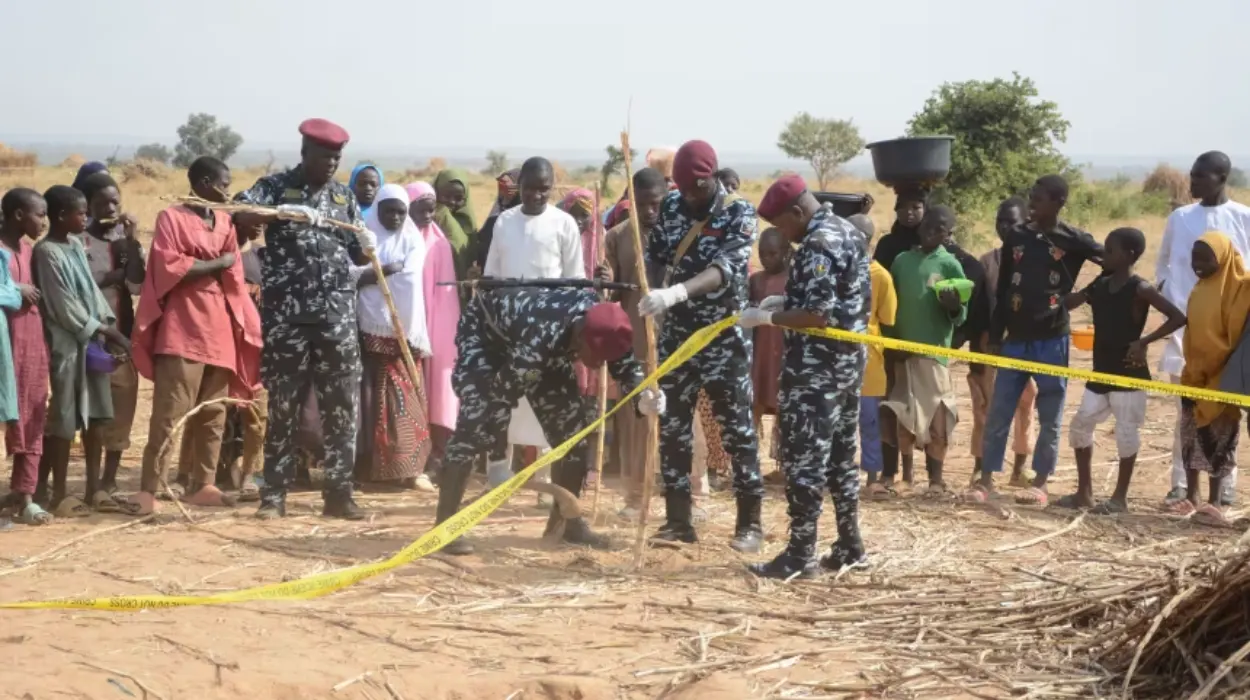
The United States airstrikes in northwest Nigeria have brought back three major issues which include jihadist threats in Nigeria, foreign military intervention success, and religious violence and political use in Africa’s largest nation.
The US has carried out strikes against militants connected to the Islamic State group (IS) in north-western Nigeria. US President Donald Trump has framed the operation as a reaction to the purported mass murder of Christians, and Washington has described it as a decisive blow against militants associated with the Islamic State (IS).
At the direction of the President of the United States and the Secretary of War, and in coordination with Nigerian authorities, U.S. Africa Command conducted strikes against ISIS terrorists in Nigeria on Dec. 25, 2025, in Sokoto State.
— U.S. Africa Command (AFRICOM) (@USAfricaCommand) December 26, 2025
However, local communities doubt whether ISIS even operates in the affected areas. Nigerian authorities have rejected the religious framing.
The episode presents a detailed examination of how counterterrorism stories clash with actual intelligence data while showing how ordinary people face danger from both hostile states and terrorist groups during their everyday lives.
Does ISIS really exist in Northwestern Nigeria?
Through Boko Haram and Islamic State West Africa Province (ISWAP), which functions as a branch of Islamic State in the northeastern region of Nigeria, jihadist insurgencies have afflicted Nigeria for a long time.
Since 2009, these groups have killed tens of thousands of people and forced millions to relocate. There are significant distinctions between the situation in northwest Nigeria and Sokoto State.
The US strikes have targeted militants who receive the local name Lakurawa. Nigerian authorities state that this small armed group maintains connections with jihadist networks which function across the Sahel region. This includes Mali and Niger.
Security officials believe these groups established their presence in remote, rural areas through open borders and weapons smuggling, and religious beliefs that spread from the main West African jihadist network.
The independent analysts have stated that the Islamic State maintains a direct link to the group. However, the lack of concrete evidence shows Lakurawa does not operate as a complete ISIS franchise like ISWAP, even though it might share some jihadist methods and language, and weak connections to other jihadist groups.
The experts describe this group as a hybrid because it combines local complaints with criminal operations, banditry, and jihadist beliefs.
The residents of Jabo and Tangaza who live in affected areas state that ISIS forces do not exist in their territory and radical religious control does not occur, and Christian communities face no persecution. The intelligence reports and local witness statements show different views about northwest Nigeria becoming an ISIS stronghold. This makes it difficult to confirm this claim.
Did US airstrikes actually target ISIS?
US Africa Command (AFRICOM) has reported that multiple ISIS militants lost their lives during the military operations which targeted terrorist bases in the forested Sokoto state region near the Niger border. Nigerian authorities confirmed that the operation received joint planning support and intelligence-driven execution, and President Bola Tinubu granted his approval for the mission.
PRESS RELEASE
— Fed Min of Info & Nat’l Orien (@FMINONigeria) December 26, 2025
FG: SUCCESSFUL PRECISION STRIKES ON FOREIGN ISIS ELEMENTS APPROVED BY PRESIDENT BOLA AHMED TINUBU
The Federal Government of Nigeria, in close coordination with the Government of the United States of America, has successfully conducted precision strike operations…
The military operations were conducted by Nigerian forces who worked in partnership with American forces, according to the statements.
The fallout creates doubts about both the accuracy and the importance of the data. The US military debris from their operations reached civilian areas at great distances from the original targets, which included Jabo village and specific areas of Kwara state. Although Nigerian officials confirmed their targets were authentic military threats.
The villagers, who had no previous knowledge of airstrikes, became terrified and confused, although the attacks did not result in any fatalities.
The strikes lack any independent verification which shows they had a substantial effect on jihadist operational power or resulted in the death of important ISIS leaders. The results of counterterrorism air campaigns mirror other similar operations because their proclaimed achievements do not match the actual strategic results that can be measured.
Analysts state that airstrikes against unorganized groups produce temporary wins which fail to establish enduring security progress. The main causes of northwest Nigeria violence stem from internal criminal activities combined with weak government control, and resource, and land conflicts instead of external jihadist command.
Are Christians being persecuted as Trump claims?
President Trump supports a narrative which certain US advocacy organizations, and lawmakers have promoted about ISIS militants operating in Nigeria.
The United States government continues to identify Nigeria as a “country of particular concern” because of its religious freedom violations. Trump stated that Nigeria runs a policy of Christian genocide through its government.
Real-world observations provide detailed information about the present state of affairs. The Armed Conflict Location & Event Data Project (ACLED) reveals that Muslim civilians from northeastern Nigeria made up the majority of jihadist violence deaths in Nigeria throughout the past ten years.
The main cause of attacks comes from insurgent groups who oppose government authority, while trying to control specific areas, and extract natural resources.
The northwest region of Nigeria shows no evidence that religious beliefs define the nature of violence, which occurs there. The region experiences insecurity because of banditry operations, ransom kidnappings, cattle rustling, and conflicts between farmers and herders in their land use. The local leaders show no evidence of religious discrimination because Christian and Muslim groups maintain peaceful relations in their areas.
Trump’s framing has been categorically rejected by Nigerian Foreign Minister Yusuf Maitama Tuggar, who claims that the operation had “nothing to do with a particular religion” and was only intended to protect civilians.
Nigerian Government approved the air strikes by US: Foreign Minister Tuggar
— Bayo Onanuga, OON, CON (@aonanuga1956) December 26, 2025
The Nigeria government said President Bola Tinubu gave the go-ahead for the US strikes against terrorists in the country’s North-Western region.
Foreign Affairs Minister, Yusuf Tuggar, said this on… pic.twitter.com/TEuCQbfHhM
His comments are indicative of Abuja’s larger worry that religious narratives run the risk of oversimplifying disputes and escalating sectarian tensions where none previously existed.
The timing of the strikes together with their political language shows that they have a strong political influence. Trump supported a civilizational perspective, which gained support from certain domestic political followers through his description of the operation as a “Christmas present” to terrorists. However, Nigerian officials maintain that the strikes had nothing to do with the holiday and were prearranged.
The difference shows that counterterrorism operations transform into political tools at times. This destroys the complex local environment and its actual conditions. The community of Jabo faces confusion and mistrust instead of assurance because residents report peaceful living and no evidence of militant presence.
Do airstrikes address Nigeria’s core security crisis?
The US military operations create short-term disruptions to armed groups, but security specialists agree these strikes fail to solve Nigeria’s core instability issues. The rural areas have become a refuge for armed groups because of ongoing funding shortages in rural governance and the combined effects of poverty, corruption, climate challenges, and weak law enforcement.
Nnamdi Obasi from the International Crisis Group states that Nigeria’s military operates beyond its capacity while foreign military support provides strategic advantage but does not substitute for domestic political transformation, CNN reported.
Complete government control is necessary. The absence of solutions for land access problems, youth unemployment, and community conflicts will lead to the return of militant groups under new organizational structures.