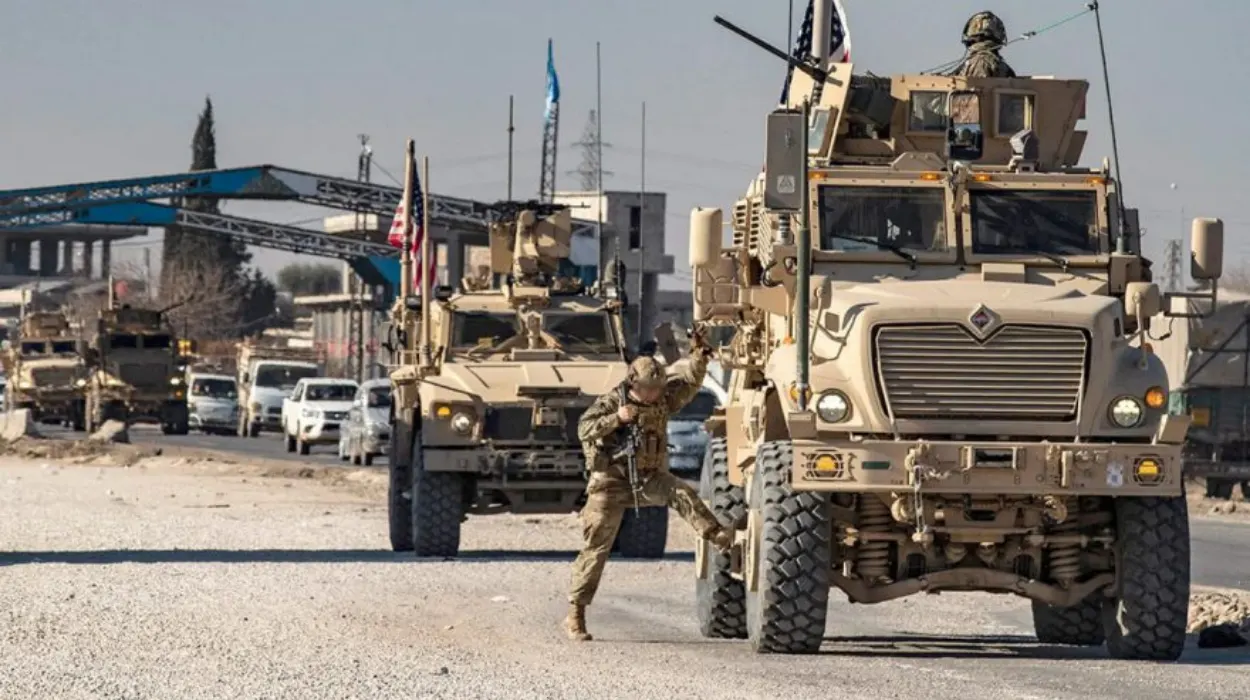
The assassination of US troops in mid-December 2025 in Palmyra has put the US military presence in Syria back under the media limelight. The reported ISIS-related killing of two US soldiers and a civilian interpreter, and many others injured, highlights an ongoing susceptibility of a relatively small US presence working in a high-risk area. Although years ago it was claimed that ISIS had been defeated in terms of the territory, the incident revealed that the group still managed to organize the deadly attacks against the high-value targets of the coalition.
Palmyra is an important symbolic and strategic point, which lends the attack more significance. The city has changed hands in Syria many times in the long conflict and thus is an effective platform to convey messages of insurgents. ISIS used this strike as an indicator that it can still take advantage of security lapses and challenge the determination of the US, despite its status as a scattered insurgent organization and not a traditional force.
The immediate response of President Donald Trump with a promise of very serious retaliation is a well-established reaction of the US on the victims abroad. The current dilemma of policymakers is to find the necessary balance of response to discourage additional attacks and not to lure the United States into entanglements that are more unforeseeable in the broken battlefield in Syria.
Evolving Justification For US Forces In Syria
The argument of US troops presence in Syria in the wake of the fall of the self-proclaimed caliphate of ISIS has been slowly changed. The initial counter-terrorism mission, which was initially a small scope operation, has grown to be wider in scope, including deterrence, local cooperation, and stability in the region. All projections in 2025 show the US presence ranging between hundreds to approximately 900 soldiers, whom they are mostly based in the eastern and central parts of Syria.
This deployment has been successively positioned by the Trump administration as providing a stabilizing force in the Middle East. The authorities claim that US troops can stop an ISIS rebound and restrict the impact of malicious state and non-state organizations as well. The attack at Palmyra though explains the strain of such framing: a deployment that is billed as bringing about stability still puts American forces at the risk of constant and even fatal attacks.
A Changing Relationship With Damascus
The US position has continued to be complicated in 2025 due to political developments in Syria. The rise of President Ahmed al-Sharaa after the formal ceasefire of the rule of Bashar al-Assad changed the Washington calculation of Diplomacy. Public statements made by Trump as a shower of praise to al-Sharaa as a powerful leader and that Damascus was not involved in the attack in Palmyra was a significant change in rhetoric after years of hostile policy.
Less coordination has been used against ISIS and partial lifting of sanctions, indicating careful involvement as opposed to direct normalcy. The developing relationship can have a potential benefit of better deconfliction and decreased risks of confrontations with the Syrian governmental forces to US troops. Simultaneously, it also runs the risk of losing some of its local partners and involving the United States in new political and security politics in the weaker states of Syria.
The Military Calculus Of Retaliation
The killing around Palmyra has given the national pressure on a visible military response. In the past, any violent assault on US troops would result in focused airstrikes or special operations operations in response to an assault with the aim of penalizing the perpetrators and deterring future attacks. The rhetoric of Trump implies that he wants to seem powerful and assure the listeners and neighbors that the assaults on American personnel will not be without consequences.
Military planners have a complicated combination of choices. Accurate attacks on known ISIS facilitators might show commitment but will contain the explosion, but these measures might work only in the short term with a decentralized insurgence force. Expanding operations may destroy the ISIS networks more significantly but increase the risk of civilian casualties and cause retaliation by other armed forces working in the very same area.
Force Protection And The Risk Of Mission Creep
Stricter force protection measures are probable in the short run following the attack. The typical responses include adjustments to patrol routes, increased use of air support and stricter movement protocols, but can gradually modify the mission. The lack of communication with the local partners can restrain intelligence and situational awareness and it can open new opportunities to the insurgents.
Revengeful measures also have the danger of gradual mission creep. The scope of US involvement can be expanded over time with temporary deployments of more assets, an increase in target sets, and increased coordination with partner forces. The nature of the Syrian operation environment is congested, with any minor expansions bound to have a ripple effect that complicates the process of ensuring that the mission remains nimble.
Regional And Geopolitical Ripple Effects
Any US military intervention in Syria should consider a thick network of players in overlapping space. The Syrian government troops, the Russian troops, Iranians-linked militias, and other local groups all are present in the regions in which the cells of ISIS are still active. An attack that is aimed only to attack ISIS may be construed as a message to other players, especially in a location close to combative infrastructure or vulnerable khTwT of communication.
US-Russian deconfliction mechanisms have so far prevented major incidents, but tensions have periodically surfaced when forces operate in close proximity. A more assertive US posture following the Palmyra attack could prompt adjustments by Moscow or its partners, increasing the risk of unintended escalation even where interests partially align around containing ISIS.
Impact On Regional Partners And Rivals
The next steps of Washington are being followed closely by the regional players. Israel will evaluate the impact of any change of US posture on its own calculations of the influence and freedom of action of the Iranians in Syria. Turkey is still a country that is sensitive to the developments that will either strengthen or weaken the Kurdish-dominated forces on its border, and the Gulf states and Jordan are considering how US action overlaps with their more cautious re-engagement with Damascus.
Given that the Arab governments are keen to present Syria as on its way to relative stability, the US response is likely to be narrowly oriented to be presented as complementary to the wider security initiatives. An exchange of revenge and retaliation on the other hand would only reinforce skepticism on the sustainability of the political change in Syria and the feasibility of limited foreign military intervention.
Domestic Debate And Strategic Uncertainty
The killings of the Palmyra have intensified longstanding debates in Washington on the future of the US troops in Syria. Opponents say the deployment has turned into an open-ended project whose political goals are not well defined and its American troop is being subject to continuous danger with no defined end-state. They argue that intelligence cooperation and over the horizon capabilities can be used to deal with ISIS instead of forward presence.
Supporters counter that the attack demonstrates precisely why a residual force remains necessary. From this perspective, US troops provide the backbone of a fragile security architecture that deters ISIS resurgence and influences Syria’s post-conflict trajectory. The evolving relationship with Damascus and limited sanctions relief are cited as evidence that the strategic costs of staying may be shifting, even as the risks remain real.
As Washington weighs retaliation options and reassesses its posture, the stakes extend beyond the immediate response to the Palmyra attack. Decisions made now will shape perceptions of US credibility, deterrence, and strategic patience across the region. Whether the United States can balance retaliation with restraint, and presence with purpose, will determine if the risks facing US troops in Syria can be managed or whether they will continue to regenerate with each new confrontation.