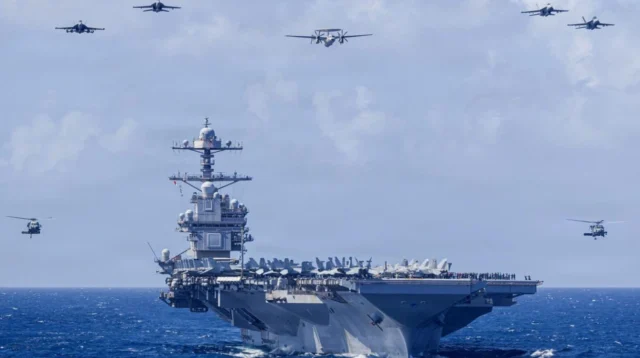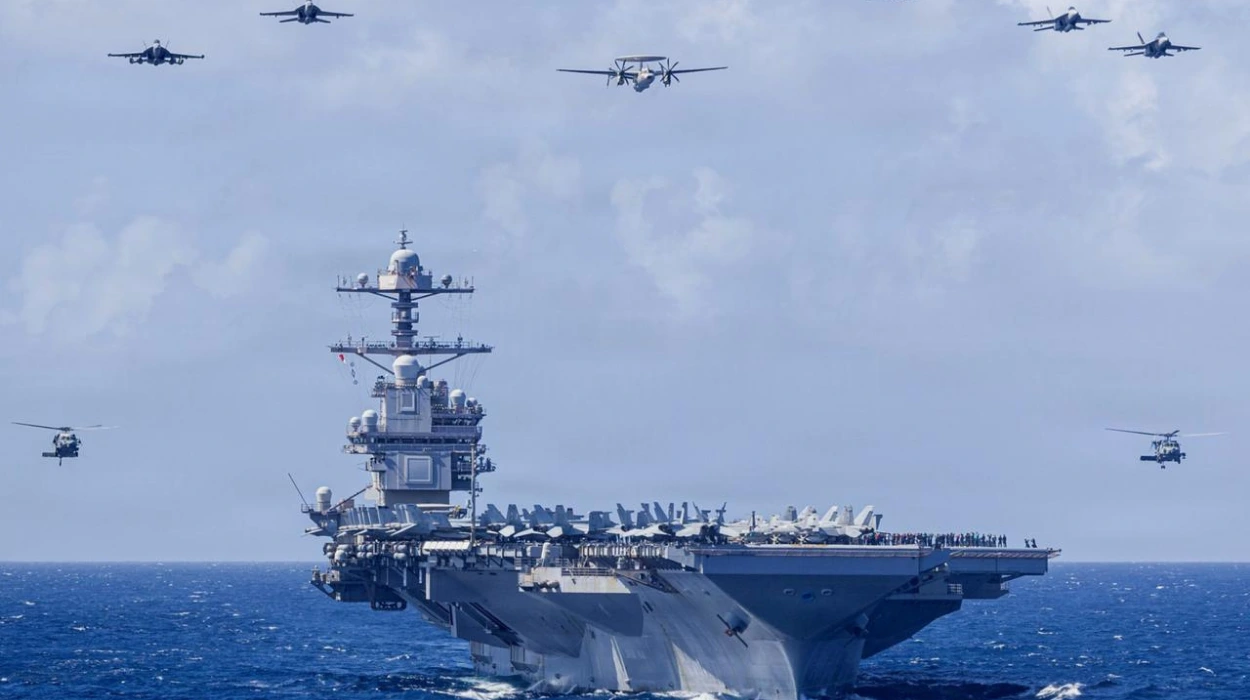
USS Gerald Ford En Route to the Middle East is one of the most influential military naval operations by the U.S. military since the beginning of the 2000s. The deployment puts the largest nuclear-powered aircraft carrier in the world beside USS Abraham Lincoln, and it makes a unique two-carrier set-up as both countries were on the verge of war with Iran after the 2025 attacks on Natanz and Fordow.
The U.S. authorities have presented the pose as precautionary. President Donald Trump referred to the movement as a significant force, just in case, and stressed that Washington would monitor the development of events. The wording highlights a tactful attitude that is assertive in the sense of presentation, formal in the way it is communicated.
The alliance of carrier strike forces is coming at a time when indirect diplomatic relations via Oman are still weak. The size of the buildup connotes credibility of deterrence and leaves room to bargain.
Asset Composition And Operational Scope
USS Gerald R. Ford is carrying over 75 aircrafts including F-35C stealth fighters and electronic warfare EA-18G Growlers. Its electromagnetic airlift vehicle improves the rate of generation of sorties and this minimizes the strain on the regional land bases susceptible to the reach of the Iranian missiles.
The strike group of USS Abraham Lincoln supplements that ability with guided-missile destroyers carrying Tomahawk cruise missiles and layered air defense systems. Littoral combat ships along with other destroyers support chokepoints across the Red Sea and the Arabian Gulf which overlaps sea coverage.
Geographic Positioning And Overlapping Coverage
Operational depth is made possible by placing both carriers in position. Lincoln has continued to be on the Arabian Sea and the forecasted arrival of the Ford into the Gulf of Oman by early spring 2026 would permit a common air patrol on the Strait of Hormuz and the surrounding routes.
This kind of alignment makes it difficult to calculate adversary targets. It makes less use of fixed installations as well, spreading strike capabilities on mobile platforms.
Aftermath Of The 2025 Nuclear Strikes
The deployment of the dual carriers cannot be dissociated with the Operation Midnight Hammer which was the strike against the nuclear facilities in Iran at Natanz and Fordow which occurred in 2025. The intelligence estimates made by the U.S. showed that centrifuge capacity had been greatly damaged, but not entirely destroyed.
The International Atomic Energy Agency verified that major facilities were destroyed without disastrous radiological emission. Tehran then said it was still enriching and it remained resilient despite the setbacks.
Iranian Military Signaling
Iran responded by holding naval exercises in the Strait of Hormuz in simulated attacks on big surface vessels. The exercises involved swarms of fast-attack crafts, anti-ship missile attacks, and sub maneuvers. The Iranian state media used these exercises as evidence that the appearance of foreign naval forces would not stop the retaliatory strike.
There is also an increased development of missiles. Extended-range ballistic tests were reported in late 2025, which supports the Iranian layered deterrence strategy, which combines conventional naval asymmetric warfare with strategic missiles.
Proxy Network Activation
In addition to the direct military signaling, there is more movement of regional partners by Iran. Missile and drone attacks on Red Sea shipping by Houthi have continued, and U.S.-led maritime intercept operations have continued. The position of Hezbollah in Lebanon is highly observed especially with the current attacks of Israel against Iranian-linked targets in Syria.
This dispersed pressure is indicative of the Tehran doctrine of indirect confrontation in which we see escalation being brought about by proxy openness instead of open interstate war.
Regional Alliances And Security Architecture
GCC countries have been covertly allowing the U.S. to increase its airspace and logistical facilities. The United Arab Emirates and Saudi Arabia have advocated the overflight permission and coordination of the bases, befitting between the security relations and economic expediency.
The U.S. remains based in Bahrain. Fifth Fleet, a marine coordination center. The dual carrier stance is interpreted by those in the region as an assurance that commercial shipping routes are not interfered with, especially because the Strait of Hormuz is an important energy passageway.
Israel’s Parallel Posture
Israel has been keeping an independent operational pace against Iranian-related targets in Syria. Although no information on coordination is released, Israeli defense planners indicate publicly their need to stop strategic entrenching around their northern border.
This deterrent framework is indirectly supported by the dual-carrier presence, which indicates that the escalation of attacks on U.S or allied possessions may provoke more wide-ranging response mechanisms.
Escalation Risks In Maritime Chokepoints
The Strait of Hormuz is the most tense hot spot. Its passage is home to approximately a fifth of the oil in the world traded. Iranian ability to use sea mines, coastal missile batteries and swarm tactics poses ongoing weakness.
Dual carriers increase sortie creation ability and, in principle, allow the coastal missile facilities to be suppressed and allow quick access to maritime aggravation. Nonetheless, the multinational coordination and purposeful vessels are essential in mine clearance operations making sustained maritime security complicated.
Nuclear Threshold Calculations
It was estimated in 2025 that the breakout time that Iran would take to weaponize itself, as per its intentions to do so, is limited, although not absent. The deep underground bases like Fordow make any thought of follow-on strikes (with no advanced capability of bunker-penetration) difficult.
This uncertainty perpetuates strategy tension. Washington wants to discourage the nuclear acceleration and not to take a step that will join the domestic hardliners in Iran together.
Diplomatic Channels And Economic Leverage
Indirect exchanges are still being mediated by Oman and Qatar. The talks are said to be focusing on verification measures and giving of the sanctions a relaxation of phased sanctions. Officials of the U.S. indicate that they are willing to be flexible in terms of sequencing but insist that the enrichment thresholds should be verifiable.
Economic measures are still a parallel tool. The sanctions have limited Iranian exports of oil, yet there is still shadow fleet export of shipments to Asian markets. The military presence in the seas is also used as a tangible deterrent against the seizing of tankers that may disrupt the world markets.
Multilateral Balancing
China has proposed updated diplomatic structures of previous nuclear deals and Russia has been augmenting military cooperation with Tehran. Advanced air defense transfers were reported which makes the calculation of aerial domination complicated in future operations.
Surveillance aircraft and missile defenses coordination are provided by European allies, which are part of the wider NATO interoperability activity, implemented in the defense planning allocations of 2026.
Operational Sustainability And Force Projection
The nuclear propulsion of USS Gerald R. Ford has long-range endurance, and therefore, it has reduced the logistical weaknesses. However, maintained two-carrier tasks require complicated supply chains, such as renewal ships and supporting refueling platforms.
The issue of rotational strain on the personnel and aircraft maintenance cycles does not disappear in the long-term planning of posture. The adoption of two carriers at a time is a sign of short-term deterrence focus as opposed to permanent stationing.
The USS Gerald Ford En Route deployment is thus a lot more than a figure head measure. It summarizes a calculated strategy that is influenced by nuclear insecurity, maritime insecurity, and regional alliance politics. The existence of overlapping air wings along the Iranian coastline will determine whether the existence has reinforced the leverage of diplomacy or limited the ability to compromise, and the success of indirect negotiations to convert deterrence as a demonstration of power into a brokering of long-term stability in one of the most contentious waterways in the world.