It has been revealed that the White House is inflating inflation by making false comparisons. When Donald Trump returned to the presidency in January, the inflation rate stood at 3.0%. According to the latest Consumer Price Index figures available, inflation in September remained at the same level—3.0%.
After eight months in office, there has been no change from the rate he took over, calling into question Trump’s repeated assertions that the nation’s worst inflation crisis has ended.
— The White House (@WhiteHouse) November 14, 2025
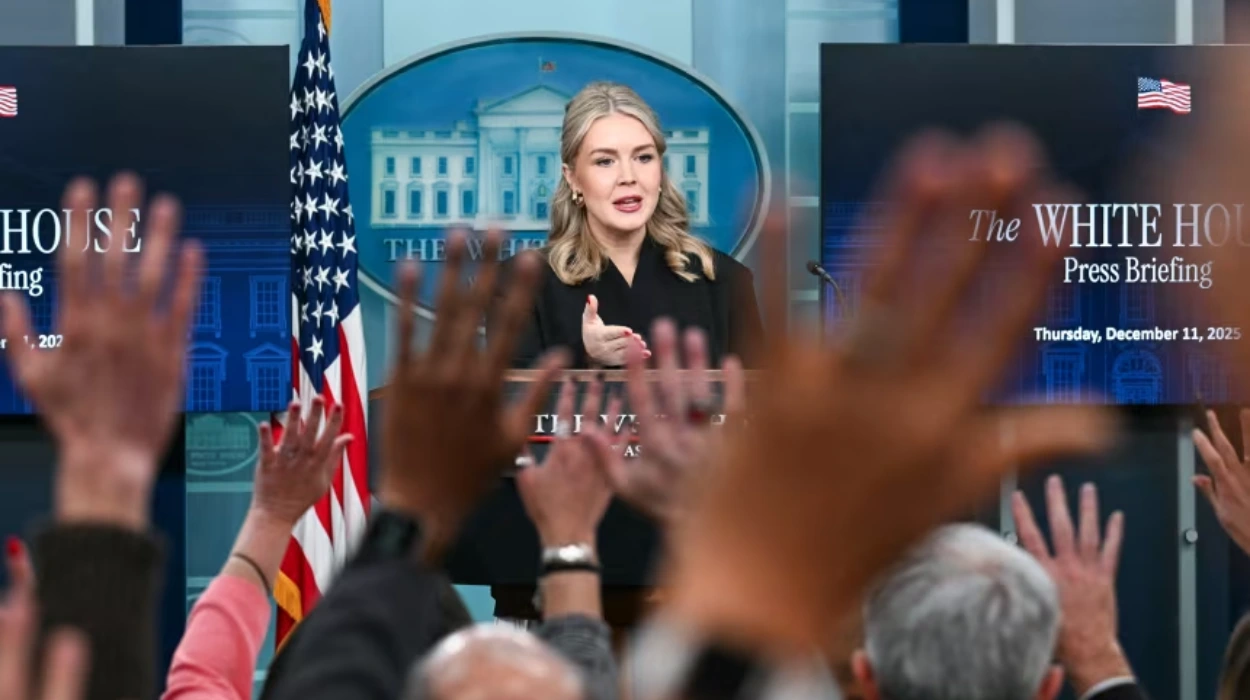
To bolster those statements, the administration has relied on misleading comparisons and narrowly selected data. White House press secretary Karoline Leavitt echoed this approach during a recent briefing.
What data is the White House leaving out?
CNN White House correspondent Kaitlan Collins pushed back, telling Leavitt that economic indicators are mixed, grocery costs continue to climb, and inflation remains close to where it was a year ago.
In response, the White House press secretary argued that inflation has eased compared with earlier levels. She said that overall CPI figures show inflation averaging about 2.5%, which she described as an improvement from what President Trump inherited upon taking office. While inflation stood at 2.9% in December and January, she claimed it has since declined and is now moving in a positive direction.
Every month since President Trump took office, core inflation — the best measure of inflation — has beat or matched expectations. The data proves that President Trump is stabilizing inflation and the Panicans continue to be wrong about tariffs raising prices. pic.twitter.com/Pox82EuryQ
— Karoline Leavitt (@PressSec) July 15, 2025
However, the latest economic data suggest a different trend. Consumer Price Index figures show that September marked the fifth straight month in which year-over-year inflation increased compared with the prior month, indicating that inflation is not consistently moving downward.
Leavitt later clarified what she meant by referencing a 2.5% figure. She explained that this number reflects an average inflation rate during Trump’s first eight months in office. According to her, when measured by the overall CPI, inflation during that period averaged 2.5%, a statistic she said she had in front of her during the briefing.
Is the claimed 2.5% inflation figure accurate?
After being corrected about the inflation rate in January, Leavitt shifted to citing an average drawn from eight months of data, covering February through September. That comparison, however, does not measure equivalent time periods.
Using an eight-month average also minimizes the severity of current inflation pressures because it blends in the relatively lower inflation readings from Trump’s first few months back in office, before and immediately after he announced sweeping global tariffs in early April. Inflation began to pick up in May.
It is also important to note that the 2.5% figure is not a straightforward arithmetic average. Leavitt mentioned this number at the start of the briefing, and the White House later repeated it in a social media post in late November.
When the year-over-year inflation rates from the past eight months are averaged mathematically, the result is closer to 2.7%. The White House later explained that Leavitt was referring to an annualized rate over the eight-month period when citing 2.5%, even though she did not explicitly describe it as such.
Does the Biden inflation comparison mislead the public?
The comparison used in the White House’s social media graphic was even more misleading. It contrasted “9.1% inflation under Biden” with “2.7% inflation under Trump,” a comparison that was fundamentally mismatched and only clarified in fine print. The figures did not represent equivalent measures.
President Trump inherited Biden’s inflation and high prices. While progress is underway and inflation is falling, he will keep fighting to bring costs down for EVERY American. pic.twitter.com/v5RXOC4GCJ
— The White House (@WhiteHouse) November 24, 2025
Trump’s 2.7% number reflected an average inflation rate across the first eight months of his current term through September. Biden’s 9.1% figure, by contrast, referred to a single-month peak in inflation that occurred in June 2022.
Notably absent from the graphic was the broader context: inflation had fallen to 3.0% by June 2023, declined further to 2.4% in September 2024, and stood at 3.0% in January 2025, which was Biden’s final partial month in office.
Earlier in the briefing, Leavitt used a similar peak-versus-average framing, saying that inflation had “fallen to an average of just 2.7% under Trump,” while during what she described as the “painful Biden years,” inflation hit a record 9%. What she did not note was that the 9% figure occurred during a single month more than two years before Trump returned to office. While both statistics are technically accurate, presenting them side by side without context creates a distorted impression.
Is the peak-versus-average comparison missing crucial context?
The peak-versus-average comparison is “technically valid but cherry-picked without full context,” according to Yale economist Danny Yagan, who points out that it ignores Biden’s post-2022 disinflation from 9.1% to 2.4% by late 2024, potentially inflating perceptions of Trump’s unique impact while downplaying inherited stability at 3.0%.
Despite brief YoY increases caused by 4.1% gas surges and supply volatility, Fox Business analyst Phil Kerpen praises the 2.7% eight-month average as “genuine disinflation progress on a post-COVID trajectory,” attributing it to energy policies and deregulation for surpassing EU peers (2.1% in September 2025).
Will inflation ease further despite recent year-over-year increases?
According to a Reuters economist survey of 75 forecasters, the CPI will ease to 2.6% by Q1 2026. September’s fifth consecutive monthly YoY increase was attributed to temporary factors, such as government shutdown data gaps and pre-tariff baselines, rather than structural policy failure.
The survey also urged attention to be paid to downward monthly trends (0.3% in September) and core stability rather than headline snapshots. Trump’s lower averages—3.1% core CPI compared to Biden’s 4.8% in comparable periods—reflect successful supply-side reforms, according to WSJ economics editor Greg Ip. However, he warns that tariffs could reverse gains if they are not offset by growth.
Ben Harris, a senior fellow at the Brookings Institution, highlights trajectory:
“From 9.1% inheritance chaos to sustained sub-3% holds real merit, but messaging risks complacency if shelter and food don’t follow energy’s lead,”
he says, striking a balance between calls for multi-metric transparency and praise for wage gains (+1.2% real).