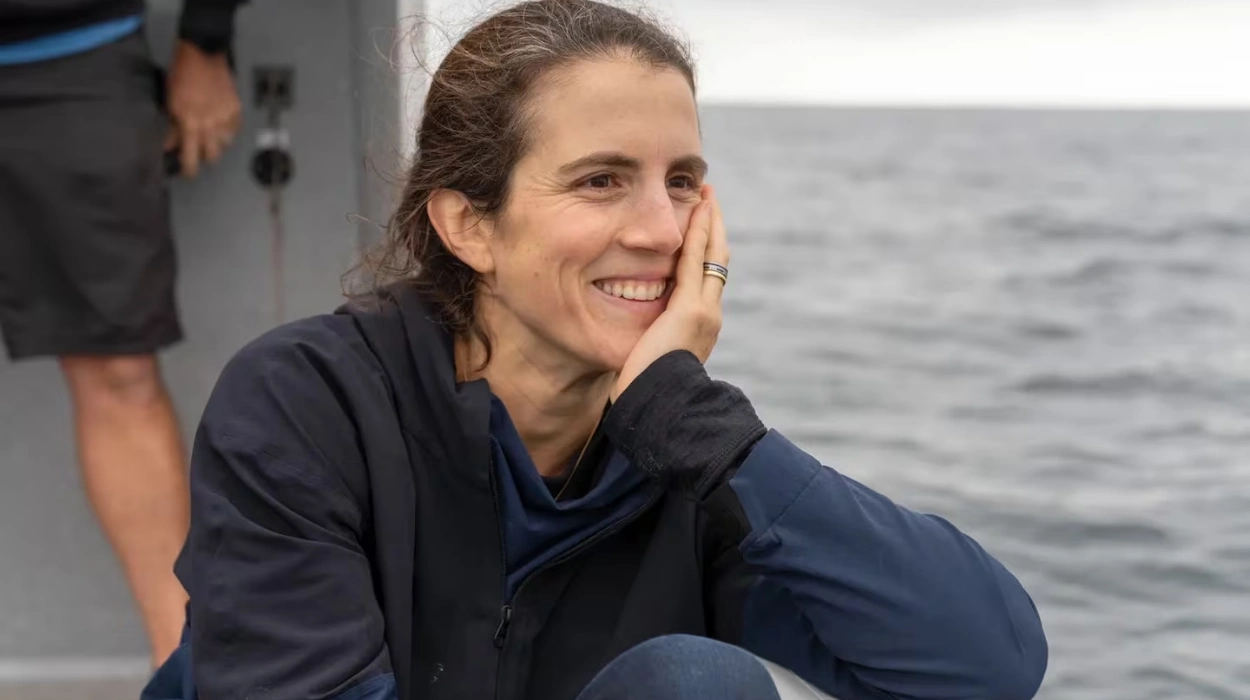
Tatiana Schlossberg, a climate reporter and daughter of former Ambassador Caroline Kennedy, died on Tuesday at the age of 35 from a rare and aggressive type of blood cancer. Tatiana Schlossberg’s death comes after the publication of an extremely personal piece at The New Yorker magazine, where Tatiana Schlossberg described living with the disease in a profoundly moving and extremely generous manner to the great admiration of the international community.
The news of her death was shared via a post from the John F. Kennedy Library Foundation, which is based in Boston, Massachusetts, signed by members of her family on Instagram. No further information about where she had passed away was mentioned.
Our beautiful Tatiana passed away this morning. She will always be in our hearts.
— ᶠᵃⁿˢ JFK MEMORIES (@JFK_MEMORIESS) December 30, 2025
George, Edwin and Josephine Moran Ed, Caroline, Jack, Rose and Rory. pic.twitter.com/7DrQvsYlm6
How did Schlossberg’s cancer diagnosis unfold after childbirth?
In the essay, entitled “A Battle With My Blood,” Schlossberg said she learned she had leukemia in May 2024, weeks after the birth of her daughter. She had gotten routine bloodwork, which showed abnormalities; her doctor told her the cause might have been related to pregnancy, or it might be something much worse.
It was the latter. Schlossberg suffered from leukaemia that resulted from an unusual genetic mutation. She had just started caring for a newborn daughter and a 2-year-old son, which seemed like an impossible situation for someone as healthy as she had always considered herself.
Why did the diagnosis feel impossible to accept?
Schlossberg describes in great detail her reaction to the news. Just a few days earlier, she had swum a mile when she was nine months pregnant, in addition to a rigorous exercise routine, including running long distances in the park and swimming across the Hudson River, for the Leukaemia and Lymphoma Society.
“I wasn’t sick. I didn’t feel sick,”
she wrote.
“This could not possibly be my life.”
What physical and emotional toll did treatment take?
Her treatment was gruelling. It included months of chemotherapy, a near-fatal postpartum haemorrhage, additional chemotherapy, and a stem cell transplant she described as a “Hail Mary” attempt at a cure. Her sister, Rose Schlossberg, was a donor match, while her brother, Jack Schlossberg—now a congressional candidate—was only a half-match and unable to donate despite pleading with doctors.
When Schlossberg lost her hair after the transplant, her brother shaved his head in solidarity. Her young son followed suit, wearing scarves just like his mother during hospital visits.
How did illness reshape her experience of motherhood?
Because of the constant risk of infection, Schlossberg was unable to fully care for her infant daughter—unable to feed, bathe, or change her. She spent nearly half of her daughter’s first year hospitalized or isolated.
“I don’t know who, really, she thinks I am,”
Schlossberg wrote, wondering whether her daughter would remember her as a mother at all.
What setbacks marked her final months?
Although Schlossberg went into remission several times, the cancer kept recurring. She received additional chemotherapy, took part in several clinical trials, and had a second stem cell transplant from an unrelated donor.
Complications ensued. She developed a form of the Epstein-Barr virus. Donor cells started attacking her body. She developed graft-versus-host disease. By the time she left the hospital in October, she was too weak to lift her children. Her oncologist eventually informed her he thought that he might be able to keep her alive for another year.
How did Schlossberg confront guilt, legacy, and family tragedy?
One of the most toxic parts of this essay has Schlossberg talk about the emotional weight she felt when thinking about her family and her mother.
“For as long as I have lived, I have tried to be a good person,”
she said.
“Now I have added a new tragedy to her life, to our family’s life, and there is nothing I can do to stop it.”
These words follow a long line of tragedy associated with the Kennedy family.
How does Schlossberg’s story fit into the Kennedy family legacy?
Caroline Kennedy was only 5 years old when her father, President John F. Kennedy, was assassinated in 1963. She was 10 years old when her uncle, Robert F. Kennedy, was murdered in 1968. Her brother, John F. Kennedy Jr., died in a plane crash in 1999.
Contrary to her own childhood experiences in the midst of public tragedy, Caroline Kennedy has managed to raise her own children in remarkably normal fashion, intersecting public service in a productive manner.
What shaped Schlossberg’s career in journalism?
Born on May 5, 1990, in Manhattan, Tatiana Celia Kennedy Schlossberg attended the Brearley and Trinity Schools, then went on to Yale University to study history, followed by a master’s at Oxford.
She had worked as a reporter for The Record in New Jersey and was named Rookie of the Year by the New Jersey Society of Professional Journalists in 2012. She joined The New York Times in 2014, covering metro news, science, and climate.
Her reporting ranged from Hurricane Sandy and gun violence, to more offbeat local pieces featuring rivalry among donut shops and a mysterious dead bear cub in Central Park.
How did Schlossberg blend intellect with self-awareness?
In a 2015 first-person essay published in The New York Times, Schlossberg said of herself that she had been a socially awkward bookworm who remembered being awkward enough as a teenager to be sent out to research drug scenes on a college campus. Her humor and humility became a big part of her oeuvre.
Why did she criticize her cousin Robert F. Kennedy Jr.?
In her New Yorker essay, Schlossberg openly criticized her cousin—now US secretary of Health and Human Services—calling his leadership “an embarrassment” to her family.
She condemned his cuts to medical research funding, including reductions affecting Columbia University, where her husband works, and criticized his rollback of support for mRNA vaccine research and his review of misoprostol, a drug she herself had been given during a medical emergency.
“The health-care system on which I relied felt strained, shaky,”
she wrote.
What was her lasting contribution to climate journalism?
She was the author of “Inconspicuous Consumption” (2019), a critically acclaimed book that studied the manner by which consumer actions contributed to climate change. She won the Rachel Carson Environment Book Award in 2020 for this publication. She believed that instead of making consumers feel guilty about the consumption habits, there was a need to empower them with hope.
How did science, public funding, and justice intersect in her final reflections?
Before contracting the illness, Schlossberg was planning to write a second book on climate change and the oceans. While undergoing treatment, she discovered that a critical drug she had to take was originally derived from the research of sea sponges, conducted by public institutions several decades ago.
This only proved her right about the importance of government support for science—and just that kind of support that was being undermined.
“At its heart, climate change is a justice issue,”
she once explained.
“We can’t save the polar bears if we don’t save the people.”
Who survives her, and what legacy does she leave behind?
Tatiana Schlossberg is survived by her loving parents, siblings, husband George Moran, to whom she was married in 2017, and two young offspring. Tatiana will be remembered for her fearlessly outspoken journalism, environmental activism, and the final output of writing that magnified the human experience of illness, justice, and the human response.