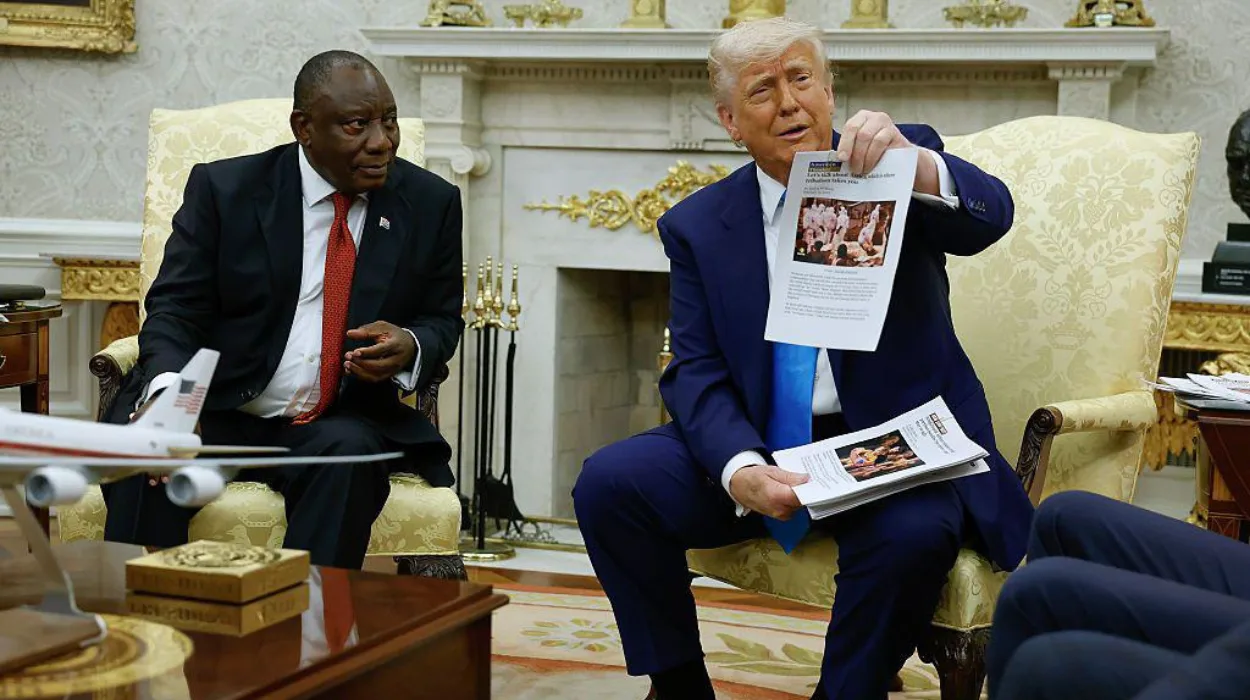
The policy centered on 4,500 Monthly Refugees establishes a structured processing benchmark for white South African applicants within the United States refugee system. According to a February 2026 contracting document, the monthly target translates into an annualized capacity of 54,000 cases, a figure that significantly exceeds the broader global refugee ceiling announced in late 2025. The operational design reflects a shift from diversified resettlement flows toward a concentrated, priority-based intake model.
Implementation accelerated after a December 23, 2025 agreement reached in Pretoria. That arrangement followed disruptions at an earlier site in Johannesburg and enabled the relocation of processing operations to secure premises. The combination of diplomatic accommodation and infrastructure redesign allowed the program to proceed at scale under heightened scrutiny.
Monthly Capacity Versus Global Caps
The 4,500-per-month benchmark operates within a constrained annual refugee ceiling established in October 2025. That ceiling, set at 7,500 total admissions, effectively channels the majority of available slots toward this single cohort. The arithmetic tension between monthly targets and annual caps illustrates how allocation priorities can reshape broader humanitarian commitments without formally altering statutory limits.
From a policy design perspective, the structure demonstrates how operational throughput can redefine the practical impact of headline caps. Even if global ceilings remain unchanged, concentrated processing can influence distribution outcomes across competing refugee streams.
Eligibility Framework and Risk Criteria
The program’s eligibility criteria emphasize claims of persecution related to race, farm ownership, or alleged exposure to targeted violence. Applicants must demonstrate credible risk factors consistent with the program’s guidance, which frames certain security narratives as qualifying grounds.
These standards introduce a specialized evaluation pathway that differs from traditional refugee case profiles. The specificity of the criteria reinforces the program’s distinct positioning within the broader migration framework.
Infrastructure Shift and Security Reconfiguration
Following operational disruptions in late 2025, processing activities were relocated to modular facilities installed on U.S. diplomatic property in Pretoria. The move was designed to ensure continuity after security vulnerabilities emerged at the Johannesburg site.
The infrastructure redesign underscores the interplay between logistics, diplomacy, and data security in high-volume refugee intake systems. It also signals a preference for controlled environments when processing politically sensitive applicant categories.
Johannesburg Raid and Diplomatic Adjustment
Mid-December 2025 authorities in South Africa conducted a law enforcement action at the original processing location in Johannesburg. The incident resulted in the temporary detention of several foreign contractors and diplomatic personnel before resolution through bilateral engagement.
Subsequent communications between U.S. and South African officials affirmed non-interference commitments. A senior U.S. diplomatic representative, Marc Dillard, and South African official Thabo Thage participated in discussions that stabilized operational conditions and cleared the path for continued processing under revised arrangements.
Modular Facility Investment
The new secure infrastructure was developed under a $772,000 no-bid contract awarded on an expedited basis. The prefabricated village enables interviews, biometric collection, and medical screenings within a controlled perimeter.
This investment reflects the administrative priority placed on uninterrupted throughput. By integrating security safeguards with high-capacity design, the program aims to sustain the 4,500 Monthly Refugees target while minimizing external disruption risks.
Policy Drivers and Administrative Prioritization
The current refugee architecture reflects strategic recalibration following the 2025 inauguration cycle. The administration’s broader migration policy reduced overall global admissions while elevating specific humanitarian exceptions. Within that context, the South Africa-focused stream became the dominant component of the system.
President Donald Trump publicly emphasized concerns about alleged targeted violence and discrimination as justification for the program’s structure. Supporters describe the initiative as a response to reported threats, while critics question evidentiary standards and comparative prioritization.
Cap Concentration Effects
When a significant share of limited refugee slots is allocated to one demographic category, the opportunity space for other traditional resettlement populations narrows. Historically diverse flows—including applicants from conflict zones—now compete within a reduced aggregate ceiling.
Organizations such as UNHCR and International Organization for Migration monitor these shifts closely, as global resettlement systems rely on predictable quota distributions to manage vulnerability cases.
Administrative Review and Oversight
The program’s structure includes periodic eligibility reviews consistent with broader refugee governance standards. These mechanisms allow reassessment of compliance with statutory and procedural benchmarks.
Oversight frameworks aim to balance humanitarian objectives with domestic policy priorities. However, concentrated targeting introduces new dynamics in evaluation cycles and interagency coordination.
Bilateral Implications and Regional Dynamics
The agreement reached in Pretoria helped defuse immediate tensions following the Johannesburg site disruptions. It also preserved cooperative channels between Washington and South African authorities, ensuring continuity in applicant mobility and processing access.
South Africa’s government maintained that while it does not recognize genocide claims tied to white farmers, it supports lawful exit pathways. That stance enabled operational continuity without formal endorsement of the program’s underlying rationale.
Trade and Diplomatic Considerations
Refugee policy developments have unfolded alongside broader bilateral debates, including trade frameworks and preferential access arrangements. By decoupling refugee processing from commercial disputes, both sides avoided escalation in parallel negotiations.
This separation has allowed administrative coordination to proceed independently of economic disagreements, reinforcing pragmatic engagement despite policy divergences.
Global Resettlement Rebalancing
The expansion of a single-country focus alters comparative allocation across regions. Traditional resettlement partners observe changes in share distribution, especially as the overall global cap remains comparatively low.
As a result, humanitarian corridors increasingly reflect targeted priorities rather than proportional need-based models alone.
Political Messaging and Domestic Context
The emergence of the 4,500 Monthly Refugees framework aligns with campaign narratives that elevated concerns about white South African farmers during the 2024 election cycle. The policy’s implementation demonstrates how electoral messaging can translate into administrative design under executive authority.
Advocates argue that the program provides protection to individuals facing credible threats. Detractors contend that selective prioritization may complicate international perceptions of neutrality within refugee governance.
Data and Verification Debates
Statistics regarding farm murders and broader violence remain contested between advocacy groups and official sources. These divergences shape the evidentiary backdrop against which eligibility determinations are made.
Policy administrators must therefore navigate varying interpretations of risk while maintaining procedural consistency.
Capacity Sustainability Questions
Maintaining 4,500 monthly admissions requires sustained infrastructure, staffing, and diplomatic coordination. If demand levels fluctuate or annual caps shift, recalibration may become necessary.
The scalability of modular facilities in Pretoria provides operational flexibility, but long-term sustainability will depend on funding continuity and geopolitical alignment.
Strategic Outlook
The prioritization of a concentrated refugee stream within a reduced global cap marks a structural shift in United States resettlement architecture. By channeling a large proportion of admissions toward a specific cohort, the system moves away from broad distribution models toward targeted humanitarian selection.
As December 2026 approaches and policy reviews resume, the durability of the 4,500 Monthly Refugees framework will depend on legislative alignment, diplomatic stability, and public support. Whether this model becomes a template for future demographic-specific processing or remains a time-bound adaptation will shape not only bilateral relations with South Africa but also the broader evolution of global refugee allocation strategies.