Regime Change By Rationale is now a descriptive prism that is used to evaluate the Iran war, initiated by President Donald Trump in early March 2026. What had started as a tightly-knit crusade against nuclear progress has gradually, progressively, and broadly, increased to a larger scope of pursuits that include missile technology, naval might, proxy financing, and eventual regime goodwill itself.
The White House in the initial 48 hours of operations highlighted intelligence reports that Iran was approaching a reduced nuclear breakout time. The officials presented the strikes as defensive and targeted, aimed at demeaning enrichment infrastructure and forcing strategic realignment in Tehran. Deterrence and urgency in language provided the basis of early briefings, which conveyed an impression of limited military action in association with a particular threat.
However, there was a shift to an elastic narrative as the campaign progressed to win. The following briefings added more objectives to the initial assumption distorting not only the opinion of the population but the possible extent of the conflict as well.
Nuclear Deterrence As Foundational Justification
The first legal and strategic argument by the administration focused on counter-proliferation. Authorities quoted intelligence that was given to congress leaders referring to speedy uranium enrichment and installation of more centrifuges. This reiterated discussions in 2025, when there was an argument among policy makers on the issue of using sanctions as the sole means of curbing the behaviour of Iran in the nuclear process.
The administration used the issue of nuclear deterrence, a major concern of the bipartisan world. Even opponents of military buildup accepted that weaponization prevention was a valid security consideration. The refinements of that goal provided the first campaign with parameters in the form of degrade facilities, disrupt enrichment and restore leverage.
Expansion To Missile And Naval Targets
The story of the operation became wider in just a few days. The defense officials started prioritizing the Iranian long-range missile capabilities and naval forces in the Persian Gulf as the key elements of the threat environment. Missile silos, launch platforms, and coastal defense systems were briefed as being under a conventional shield of protection of nuclear facilities.
This change permitted airfield, port, and maritime installation strikes to be presented as logical extensions of the initially planned mission. The more the targeting map was extended, however, the more observers were left wondering whether the campaign was still all about nuclear containment or whether it had become more of a wider campaign strategy involving military degradation.
The Regime Change Turn
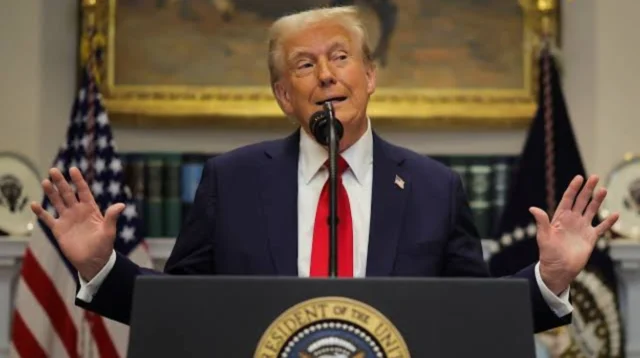
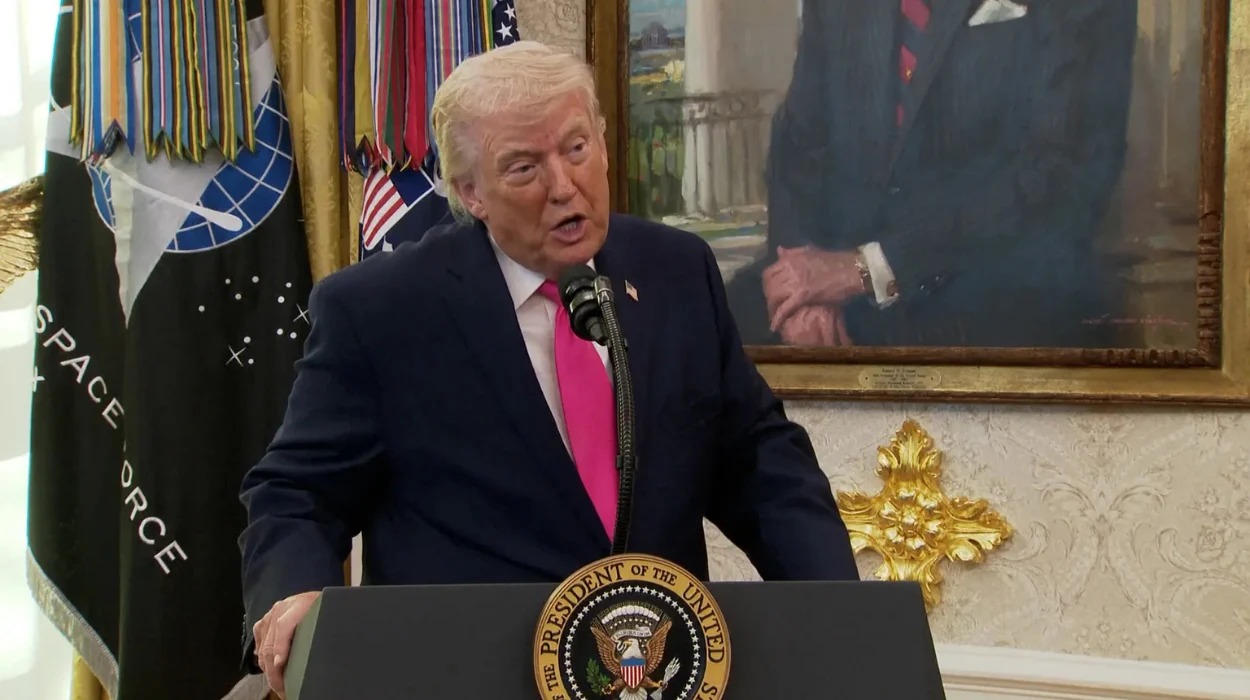
The thing that had the most significant influence was the rhetorical shift when President Trump connected military activity with legitimacy of the regimes. Another televised speech had him terming the leadership of Iran as disruptive of the region and said that they will remain in operation until all their goals are achieved which included nuclear rollback, missile disarmament, naval neutralization, and proxy financing.
This type of language went outside deterrence into the world of political change. The administration successfully increased the winning margin by putting the dispute in terms of diluting regime institutions.
Blurring Tactical And Political Goals
The merging of military and political goals makes it hard to be strategically coherent. Destruction of missile infrastructure is an objective that can be measured. It is possible to measure the neutralization of a navy in quantitative terms. Regime change, in its turn, relies on the internal political processes that can be affected but hardly manipulated by the outside force.
Analysts observe that as goals grow beyond infrastructure destruction to governance deliverables, the time frame of operation is normally open-ended. The management has failed to indicate whether change of leadership is in itself a formal war goal or an expected byproduct of the sustained pressure.
Echoes Of Prior Intervention Debates
It is impossible to avoid historical comparisons. The Iraq war of 2003 started with its weapons of mass destruction as the key theme of the war and then extended to the democratization theme. According to critics, the Iran campaign has a danger of running along the same discursive trajectory, in which a series of shifting rationalizations is used to reset the thoughts, instead of enhancing the strategy.
Proponents respond that the present-day conflict settings necessitate adaptive framing. Since the nature of intelligence and the circumstances on the battlefield are dynamic, they maintain, the goals have to be realigned to maintain the credibility of deterrence.
Congressional And Legal Friction
Regime Change By Rationale has brought an increase in scrutiny on the Capitol hill. Both partisan lawmakers have sought classified briefings to provide clarity at the end state. Others refer to the War Powers Resolution, and focus on the 60-day limit to continued involvement without express approval.
Senator Mark Warner commented publicly that the goals of the administration seemed to have changed four or five times, and it was the concern of coherence at large. These assertions bring out the institutional dilemma between the agility of the executive and legislative checks.
Authorization And Accountability
The administration asserts that Article II powers have adequate powers to permit limited strikes against national security. According to critics, when the goals should be further than merely immediate deterrence to a systemic shift, congressional authorization is inevitable.
The argument indicates unstructured ambiguity in the constitution of the U.S. Even though the armed forces are subject to the command of the president, the congress reserves the rights to declare war and manage funds. These boundaries are often obscured by the elasticity of current military interactions.
Public Opinion And Political Context
According to the polling up to early 2026, the citizenry is not positive about long-term involvement but is optimistic about small-scale deterrence measures. The growth of the mentioned goals would jeopardize that conditional support.
As the midterm elections are close, the administration has incentives to show decisiveness without involving itself in an open-ended battle. Storytelling can be used in subsequent political communications and make it difficult to communicate the long-term strategy.
International Reactions And Coalition Stability
The governments of the allies have taken cautious action to the changing rhetoric. Other regional allies have concerns over the missile capability of Iran, the proxy networks and privately support aspects of the campaign. European capitals have however been concerned about language showing regime destabilization.
In 2025, a number of states in Europe joined the argument of using renewed diplomatic channels to tackle the issue of enrichment. Expanding U.S. missions may complicate coalition creation especially when allies feel that there is mission creep.
Measuring Success Amid Expanding Goals
The meaning of success has been made more complex. In the case that the original benchmark was to stop the nuclear acceleration, some of the measurable indicators would be access to inspection or enrichment limits. These objectives are harder to quantify when they go further to destroy missile forces and undermine structures of governance.
Ambiguity gives flexibility in the strategy and may be a way of losing accountability. In the absence of established standards, it becomes highly biased in determining whether operation is producing desired results or not.
Escalation Dynamics
Every added reason brings about possible new catalysts of continuation. In case of the deterioration of the nuclear facilities and the presence of missile potential, the work may continue. In case the missiles are eliminated and the political leadership is preserved, the regime-oriented rhetoric may contribute to the continued interest.
Such an accrual reasoning is a danger to turning a limited campaign into a cascade of goals, with the attainment of each new one being supported by the partial achievement of the preceding one.
Narrative Stability And Strategic Credibility
The durability of Regime Change By Rationale as a governing framework will depend on whether the administration can consolidate its objectives into a stable articulation of purpose. Military operations operate within physical constraints; political narratives do not. The tension between evolving battlefield realities and consistent public justification is likely to define the conflict’s political trajectory as much as its operational course.
If objectives remain fluid, critics will continue to question whether strategy is driving rhetoric or rhetoric is reshaping strategy. Conversely, should the administration articulate measurable criteria and adhere to them, the campaign may regain definitional clarity.
As the Iran war enters its next phase, the central variable may not be the intensity of strikes or the scale of retaliation, but the coherence of the rationale sustaining them. Whether the administration can anchor its expanding objectives within a disciplined strategic frame will shape not only the outcome in Iran but also the precedent for how future conflicts are justified, debated, and ultimately concluded in Washington’s evolving security landscape.