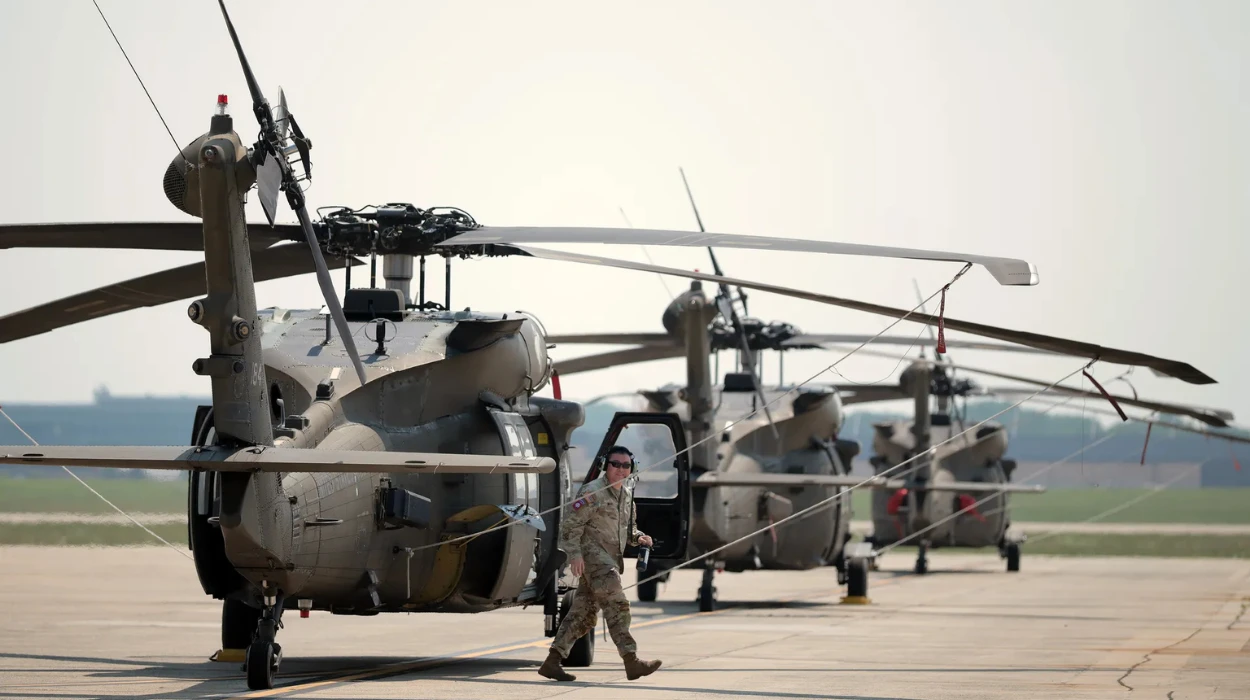
The deployment of elements from the US Army’s 82nd Airborne Division to the Middle East suggests the Iran war is entering a phase in which Washington is relying less on standoff missiles and carrier‑based bombers. The Pentagon confirmed that components of the 82nd Airborne headquarters, along with a brigade combat team, will augment US Central Command’s regional forces, adding several thousand rapidly deployable paratroopers to a force that now numbers roughly 50,000–57,000 troops, the largest US buildup in the region since the early 2000s.
The 82nd Airborne’s designation as an “immediate response force” reflects a qualitative shift in operational planning. These paratroopers can deploy anywhere globally within hours, enabling Washington to execute limited but high‑impact operations. Unlike traditional air campaigns, the division’s presence brings a ground‑echelon capability, signaling that the United States is prepared to act directly if deterrence fails or if strategic nodes in the Gulf come under threat.
Operational implications of rapid deployment
The move reflects a long-running debate within the Biden and Trump administrations over balancing pushback against Iran with the avoidance of a prolonged land-war occupation. While deployment does not equate to a full-scale invasion, it moves US posture closer to a scenario in which on-the-ground action is feasible and proximate. The 82nd Airborne specializes in forcible entries, securing ports and airfields, and conducting rapid raids, making them well suited for strategic nodes such as the Strait of Hormuz or Kharg Island. Their presence therefore demonstrates that Washington is preparing contingency options that extend beyond remote-strike campaigns.
Signaling versus actual operations
The deployment also conveys political messaging. By sending paratroopers into the Gulf, the US reassures allies of its commitment to defend critical infrastructure while signaling to Tehran that escalation may carry consequences beyond missile strikes. The strategic intent is to demonstrate readiness without committing to a prolonged occupation, maintaining a spectrum of options in a volatile regional environment.
What the 82nd Airborne can, and cannot, do
The 82nd Airborne is optimized for speed and high-intensity, short-duration operations rather than sustained occupation. The brigade-sized contingent, roughly 3,000 soldiers, is equipped to secure coastal or desert landing zones, protect critical facilities against sabotage, and conduct targeted raids designed to degrade Iranian missile, naval, or air capabilities. In the Iran war context, these tasks could include reopening or safeguarding the Strait of Hormuz, neutralizing operations at Kharg Island, or seizing temporary control of key airfields or radar installations.
Capabilities aligned with strategic objectives
The division’s profile matches Washington’s focus on rapid, narrowly scoped operations. Paratroopers can deploy quickly, secure vital infrastructure, and withdraw after completing objectives, leaving minimal footprint. This makes them ideal for missions where political deniability, operational precision, and temporal flexibility are critical. Analysts note that the 82nd Airborne’s presence increases the US ability to translate air superiority into actionable ground effects without committing to permanent occupation.
Constraints of airborne operations
At the same time, limitations are evident. The 82nd is not designed to hold large urban areas, conduct prolonged counterinsurgency, or engage in sustained conventional warfare against entrenched forces. Any operation using these troops would need to be tightly scoped, strategically limited, and carefully timed. The deployment thus balances operational readiness with political signaling, assuring Gulf allies of tangible support while signaling Tehran that escalation thresholds are closely monitored.
Iranian and regional responses
Iranian officials have interpreted the arrival of the 82nd Airborne as preparation for a potential ground assault. The Islamic Revolutionary Guard Corps emphasized that US forces remain within the range of Iranian missiles, drones, and naval swarms, warning that any incursion would provoke a “forceful” response. Tehran has framed the buildup of elite US forces as evidence of an intent to target Iran’s strategic infrastructure and nuclear-related assets, positioning the US not merely as a distant-strike actor but as a proximate threat.
Gulf-Arab perspectives
Gulf states have responded with a mix of public support and private caution. Saudi Arabia, the UAE, Bahrain, and Kuwait have praised the enhanced US presence as strengthening deterrence amid renewed Iranian assertiveness. Officials privately note that rapid-response forces such as the 82nd Airborne increase the credibility of Washington’s capacity to reopen critical chokepoints like the Strait of Hormuz. At the same time, concerns persist that the visible deployment of elite ground forces may heighten the risk of miscalculation. Incidents involving Iranian-backed militias, drones, or naval units could be misread as a precursor to broader US ground action, complicating regional security calculations.
Escalation risks and strategic ambiguity
The presence of the 82nd Airborne introduces a calculated ambiguity. Tehran is left to speculate which provocations might trigger limited intervention, while Gulf allies must weigh the stabilizing effect of rapid-response forces against the risk of inadvertent escalation. The deployment therefore functions as both a deterrent and a potential source of tension, depending on how events unfold and how each actor interprets US intentions.
A threshold for escalation that is not yet crossed
Strategically, the 82nd Airborne deployment represents a threshold rather than an active line of engagement. It signals that the US is ready to transition from air-and-naval campaigns to ground-enabled, rapid-intervention options, enhancing the feasibility of sensitive and time-critical operations without committing to full-scale invasion. Operations are expected to be narrowly targeted at facilities, chokepoints, or strategic storage sites, with the objective of maximizing impact while minimizing prolonged footprints.
The psychological and political implications of this deployment are substantial. Even without combat, the presence of paratroopers in the Gulf may redefine perceptions of US resolve, prompting Tehran to reassess its own strategic calculus. The 82nd Airborne’s arrival may therefore mark the moment when the Iran war transitions from a distant-strike narrative to one in which the specter of boots on the ground is operationally credible, introducing a new dynamic of deterrence and escalation for the region.