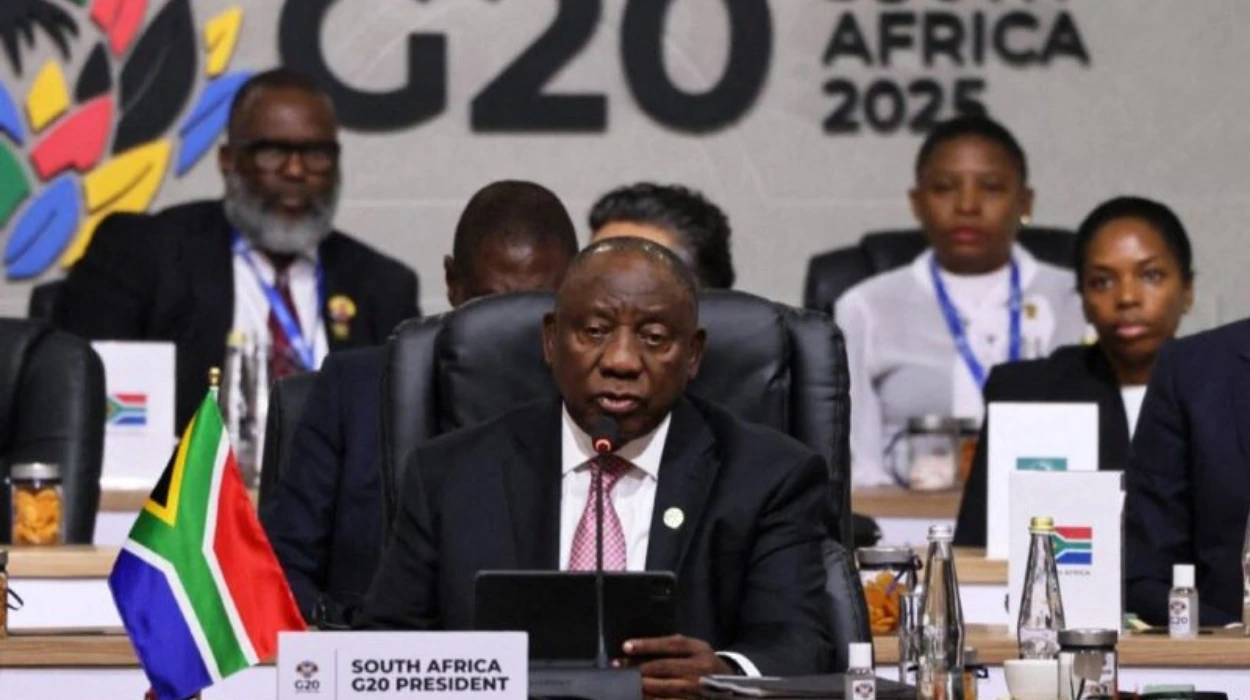
South Africa has long occupied a unique position as a non-member yet frequently invited guest to G7 summits, reflecting Western powers’ perception of Pretoria as an interlocutor for the African continent and the broader Global South. Its invitations to France in 2019 and Canada in 2025, along with Macron’s 2025 announcement of a planned 2026 G7 meeting invitation, suggested a growing recognition of South Africa’s influence. The country’s hosting of the Johannesburg G20 summit in 2025 reinforced its claim as a representative Global South voice, amplifying its ability to engage in multilateral policy discussions.
The abrupt withdrawal of South Africa’s invitation to the 2026 summit, reportedly under sustained U.S. pressure, has challenged this perception. South African officials noted that France informed Pretoria “a few weeks ago” about the disinvitation, framing the decision as a concession to external pressures. The incident underscores the conditional nature of South Africa’s informal inclusion, revealing that representation of the Global South at Western-led forums is contingent and subject to the political sensitivities of dominant powers.
Historical pattern of inclusion and influence
Over the past decade, South Africa’s selective inclusion has allowed it to project policy positions on debt relief, climate finance, and institutional reform. However, its participation has often been consultative rather than decisional. Analysts observing the 2025 G20 presidency in Johannesburg highlight that, while Pretoria and BRICS partners advanced initiatives on multilateral reform, these agendas did not translate into permanent G7 influence, reflecting the limitations of guest status.
Diplomatic signaling through invitations
The 2026 disinvitation signals that guest status is flexible and revocable, particularly when geopolitical friction intensifies. South Africa’s positioning on Israel, its alignment with BRICS, and stances on Indo-Pacific maritime issues in 2025 likely contributed to Washington’s unease. South African officials maintained public composure, emphasizing continued bilateral engagement with France and commitment to dialogue with the United States, illustrating the contrast between diplomatic rhetoric and structural power realities within the G7.
The Global South label as a double‑edged tool
The “Global South” designation has provided South Africa with rhetorical authority but exposes the country to strategic constraints. During the 2025 Johannesburg G20 summit, South Africa advanced agendas on debt restructuring, reform of multilateral development banks, and diffuse security frameworks, aligning with broader Global South aspirations to limit Western dominance. These initiatives demonstrated Pretoria’s ability to mobilize a coalition of developing countries to influence policy discussions.
Tensions between alignment and autonomy
Alignment with Global South positions, particularly on contentious issues such as the International Court of Justice case on Israel, has brought Pretoria into conflict with U.S. preferences. Reporting from 2025 indicates repeated U.S. concerns regarding South Africa’s foreign policy choices, emphasizing that the legitimacy of a Global South voice does not shield a state from exclusion when policy positions diverge from Western priorities.
Strategic value versus political risk
While the label grants international visibility, it also renders South Africa subject to selective inclusion. The disinvitation and subsequent substitution of Kenya, considered a more compliant partner, illustrates how Global South representation within Western forums is contingent on perceived political manageability rather than economic or diplomatic heft.
US–French dynamics and the revocable invitation
Publicly, France characterized the switch to Kenya as a logistical decision to streamline summit participation. Analysts, however, argue that the timing and context point to U.S. influence. In 2024–25, U.S. leverage within NATO and the G7 shaped coordination on Ukraine, China, and Middle Eastern policy, creating structural pressure on France to prioritize American preferences.
Host limitations and power asymmetry
Even as summit host, France faced constraints in extending invitations. The episode highlights how major G7 members exercise informal veto power over guest lists. Kenya’s selection over South Africa underscores a hierarchy in African representation aligned with U.S. strategic comfort, reflecting the uneven power dynamics underpinning purportedly inclusive frameworks.
Implications for South Africa’s diplomatic strategy
South Africa’s challenge lies in balancing the pursuit of independent policy objectives with the need to maintain access to Western-led forums. The 2026 disinvitation emphasizes the costs associated with assertive foreign policy stances, particularly when aligned with BRICS priorities that may conflict with G7 agendas.
The uneven hierarchy of African partners
The substitution of Kenya for South Africa illuminates broader patterns of selective African representation. Kenya’s longstanding security and diplomatic alignment with Western powers contrasts with Pretoria’s more independent posture, which has become pronounced following policy decisions in 2025 on Israel and regional governance.
Rotational inclusion and political calibration
The G7’s rotation of African partners demonstrates that inclusion is contingent on alignment rather than formal credentials. South Africa’s economic and diplomatic prominence does not insulate it from exclusion, signaling to other Global South states that forum access may require political calibration.
Strategic messaging through guest selection
By prioritizing politically accommodating partners, the G7 conveys implicit criteria for participation: states can serve as voices for the Global South, provided they do not challenge the core interests of dominant members. This creates a dynamic where perceived reliability supersedes substantive representation.
Implications for the future landscape of inclusion
South Africa’s experience reflects a broader reality in which Global South states are consulted selectively. The expansion of guest lists in 2024–25, including multiple African and Asian partners, was framed as inclusivity, yet the disinvitation demonstrates the conditional nature of that outreach. Pretoria’s engagement with both Western and alternative multilateral structures, including BRICS and the New Development Bank, signals a hedging strategy that balances participation against autonomy.
The episode invites reflection on the limitations of Western-led forums as venues for South–North dialogue. Global South actors increasingly invest in parallel institutions where they can exercise influence without conditional constraints, potentially diminishing the relevance of G7-mediated engagement. South Africa’s challenge is not simply maintaining visibility but asserting the substantive authority of its Global South voice in arenas where access can be rescinded at the discretion of more powerful states. The unfolding dynamics in 2026 will shape whether such states can reconcile independent policy priorities with the strategic imperative of forum participation, navigating a landscape where influence and inclusion remain inherently precarious.