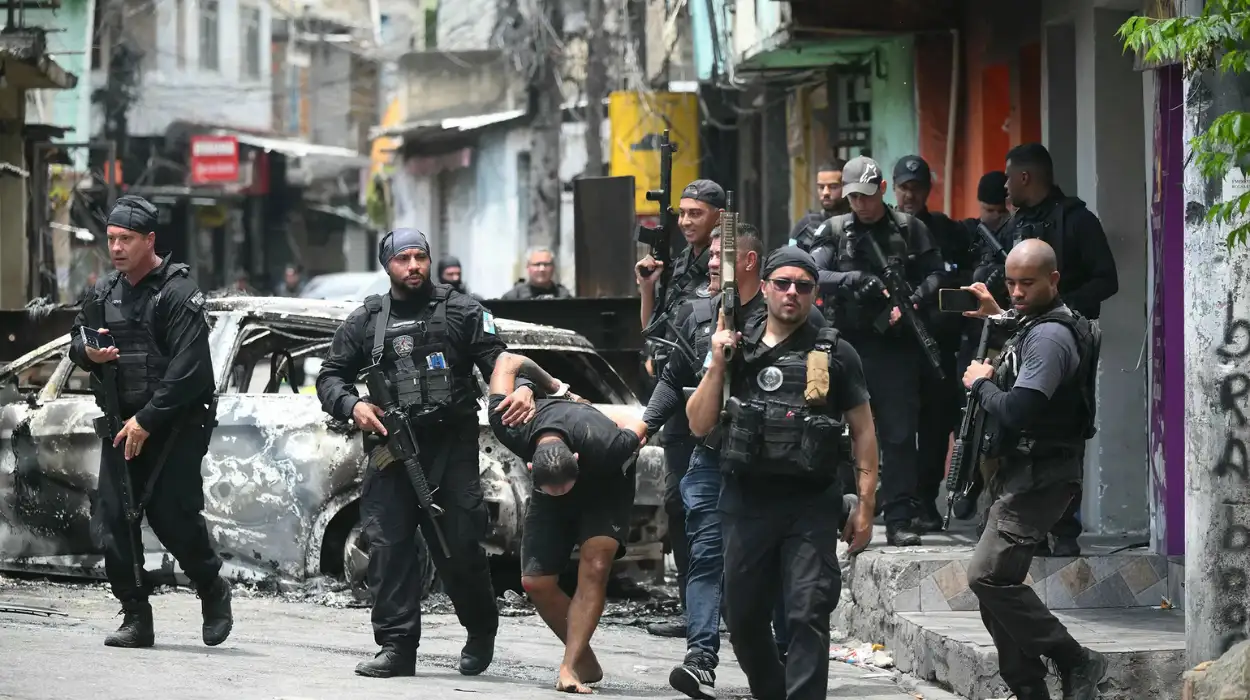
The U.S. government is evaluating a potentially transformative shift in hemispheric security policy: designating Brazil’s two largest criminal organizations, the First Capital Command (PCC) and the Red Command (CV) as foreign terrorist organizations. Both networks have long been characterized as transnational criminal enterprises with deep roots in Brazil’s prison and urban systems. The PCC, based in São Paulo, and the CV, dominant in Rio de Janeiro, generate billions annually from narcotics, money laundering, and illicit commerce, with financial links reportedly extending into the United States. Federal investigations have identified alleged PCC and CV cells in at least a dozen U.S. states, including New York, New Jersey, Massachusetts, and Florida, involved in laundering proceeds from drug operations.
A terrorism designation under U.S. law would trigger asset freezes, travel restrictions, and expanded intelligence-sharing, providing prosecutors and law-enforcement agencies with enhanced tools to pursue network affiliates. The State Department has applied similar designations to Mexican and Venezuelan criminal organizations, framing them as threats to U.S. interests through their transnational networks. Yet applying this model to Brazilian gangs is politically sensitive: the groups operate domestically as organized-crime networks rather than ideologically driven terror actors, raising questions about extraterritorial application and diplomatic fallout.
Legal and strategic implications
The proposed designation would mark a rare instance in which U.S. counterterrorism frameworks target non-ideological, profit-driven criminal groups in a major allied state. Legal analysts note that the move would expand the operational reach of U.S. authorities into Brazil’s financial and logistical networks, potentially enabling sanctions and enforcement actions that are more aggressive than those currently available under traditional organized-crime statutes. Strategically, the proposal signals Washington’s willingness to treat drug-trafficking networks as existential threats to both regional stability and domestic financial integrity, raising questions about sovereignty and precedent in bilateral relations.
The Bolsonaro family’s role
The lobbying for the designation has been closely associated with the Bolsonaro political network. Eduardo and Flávio Bolsonaro, sons of former President Jair Bolsonaro, have repeatedly urged the Trump administration to classify the PCC as a foreign terrorist organization, framing it as a necessary measure to dismantle one of Latin America’s most dangerous criminal networks. Brazilian and U.S. diplomatic sources report that the Bolsonaros have elevated the issue in Washington, presenting it as both a law-and-order priority and a mechanism to strengthen right-wing political messaging ahead of Brazil’s 2026 elections. Flávio Bolsonaro, a leading presidential contender, positions U.S. support for counter-gang measures as a symbolic endorsement of a hard-line security agenda.
Trump administration officials emphasize that the evaluation rests on legal criteria and national-security considerations. They note that the PCC and CV display the hallmarks of transnational threats: complex financial networks, operational sophistication, and capacity to affect U.S. interests. Yet multiple analysts acknowledge that the Bolsonaro lobbying has increased political attention in Washington, shaping how bureaucratic discussions unfold and highlighting the interplay between U.S. security policy and foreign electoral politics. Observers in Brasília note that even a technical designation would likely be interpreted domestically as aligning Washington with a particular political faction, potentially inflaming an already polarized public debate over crime and governance.
Political amplification and timing
The timing of the lobbying effort coincides with an intensifying political campaign cycle in Brazil. By framing U.S. involvement as a validation of a hard-on-crime platform, the Bolsonaro family seeks both international legitimacy and domestic electoral leverage. The strategic objective is not only to target gang operations but also to demonstrate alignment with global counter-crime norms, signaling capability and toughness to voters ahead of the 2026 presidential vote.
Brazil’s sovereignty and security dilemma
President Luiz Inácio Lula da Silva’s government has expressed caution over the U.S. proposal. Foreign Minister Mauro Vieira has emphasized that labeling domestic criminal networks as terrorist entities constitutes an infringement on national sovereignty, arguing that decisions regarding domestic law enforcement and criminal designation should reside with Brasília. Brazilian officials stress that, while the PCC and CV are violent and financially entrenched, they are treated under domestic law as criminal organizations that exploit social and institutional vulnerabilities rather than ideological movements.
At the same time, Brazil is not dismissive of the transnational threat. Cooperation with U.S. authorities on intelligence and financial investigations is ongoing, reflecting shared interest in curtailing cross-border drug trafficking and money laundering. The tension arises from the framing: Brazilian authorities seek to address criminality within a domestic legal and social context, whereas Washington’s terrorism framework prioritizes extraterritorial sanctions and counterterrorism authority. Officials in Brasília warn that adopting the U.S. model could empower domestic political actors to justify militarized approaches while obscuring structural causes of gang proliferation, including inequality, urban marginalization, and prison conditions.
Balancing enforcement and social policy
Brazilian policymakers confront a delicate balance: dismantling criminal networks while preserving legitimacy in the eyes of citizens and international partners. Any unilateral U.S. designation could complicate local law enforcement efforts, potentially creating friction between operational priorities and political narratives. The risk lies not in ignoring criminal threats, but in shaping enforcement practices that may prioritize punitive optics over long-term crime-reduction strategies rooted in social policy and institutional reform.
The domestic Brazilian political battlefield
The terrorism-label proposal has become a flashpoint in Brazil’s 2026 electoral calculus. Bolsonaro-aligned actors emphasize U.S. support as validation for tougher policing strategies and expanded counter-gang tools. Governor Cláudio Castro of Rio de Janeiro has welcomed international backing for sanctions targeting the CV, framing the measure as reinforcement for state-level operations in the favelas and urban security initiatives.
Opponents caution that the measure risks militarizing social problems and amplifying abuses in communities already over-policed and under-resourced. Human-rights advocates argue that a terrorism label could normalize extraordinary powers, including expanded surveillance and preventive detention, with limited checks on political exploitation. The debate is thus less about whether to confront the PCC and CV than about the tools and framework used: Washington-style counterterrorism measures versus Brazil’s own mix of legal, policing, and social-policy interventions.
Electoral messaging and public perception
The proposal’s visibility also intersects with voter perceptions of safety, governance, and international legitimacy. Right-wing actors depict U.S. involvement as bolstering credibility, while critics frame it as external interference in domestic governance. This dynamic illustrates how international security decisions can reverberate through domestic political debates, reshaping discourse on crime, governance, and foreign policy alignment.
A cross‑border definition of threat
The U.S. consideration to label Brazilian gangs as terrorist organizations exemplifies the intersection of law enforcement, foreign policy, and electoral politics. On one hand, it reflects a broader Trump-era tendency to equate powerful Latin American criminal networks with security threats, leveraging the legal and financial instruments traditionally used against ideological terror groups. On the other, it highlights how policy decisions in Washington can influence political contests abroad, especially when politically prominent actors lobby for a designation that aligns with their electoral ambitions.
The long-term impact will likely be measured less in formal sanctions and more in the evolution of how criminality, violence, and governance are framed in Brazil. Whether the label disrupts PCC and CV operations or primarily reshapes political narratives, it underscores the growing entanglement of international security policy with domestic politics and the contested boundaries between organized crime and terrorism.
The unfolding situation will test both U.S. and Brazilian institutions, revealing whether extraterritorial counterterrorism designations can coexist with national sovereignty and whether politically motivated lobbying can recalibrate security policy in ways that extend beyond conventional law-enforcement outcomes. The outcome may redefine hemispheric approaches to crime, diplomacy, and the fine line between security and political influence in complex democratic systems.