G7 trade ministers gathered in Paris on May 5 and 6, 2026, under the presidency of France for the purpose of working together to address increasing vulnerabilities within the global supply chain. As reports surfaced regarding President Donald Trump’s latest tariff threat against European automakers, the group largely avoided discussing the subject, and instead redirected their attention to the issue of critical minerals.
The summit was held against a backdrop of geopolitical tensions, including 20% of the world’s oil supply being disrupted due to the closure of the Strait of Hormuz. This nuancing of transatlantic tensions displays the fragility of their unity and an overall diplomatic tightrope walk.
Ministers from Canada, France, Germany, Italy, Japan, the United Kingdom, the United States, and the European Union Department of Trade Minister, Nicolas Forissier, faced many challenges such as non-market policies, economic coercion, WTO reforms, and e-commerce, but ultimately failed to discuss Trump’s non-market policy threat of increasing tariffs on EU cars from 15% to 25%. Mr. Forissier characterized the negotiations, stating that they would address tariffs “outside of the G7 framework.”
Paris Summit: A Strategic Pivot to Supply Chain Security
The Paris meeting occurred amid an increasing number of global trade disruptions ministers focused on long-term resilience instead of short-term ruptures. Ministers focussed on the issue of critical minerals which are needed for electric vehicles, wind turbines, electronics and technologies used for defence and are dominated by China’s market dominance, thus allowing them to manipulate prices and put pressure on Western competitors.
French Trade Minister Forissier underscored the urgency, declaring,
“I am confident we will achieve substantial advancements concerning rare earths and critical minerals, ensuring our supply chains are secure and that we are not dependent on specific nations.”
After several days of deliberations, ministers issued commitments to address the distortions created by subsidies and state-owned enterprises while expressing disappointment at the results from the recent WTO Ministerial Conference. The joint communiqué, composed of carefully crafted language by the French Ministry of Foreign Affairs, included a commitment to deter economic coercion, particularly in regard to export restrictions on critical minerals and to advance plurilateral agreements to enhance supply chains.
The communiqué further includes a call for WTO reform which calls for the establishment of a permanent moratorium on e-commerce duties, setting the tone for a productive discussion which will take place during the mid-June G7 Leaders’ Summit. However, beneath this veneer of cooperation lies the unresolved tariff rift between the United States and the European Union; demonstrating that the G7’s unity has been tested due to political factors in Washington.
Trump’s Tariff Shadow: From Turnberry Deal to 25% Escalation
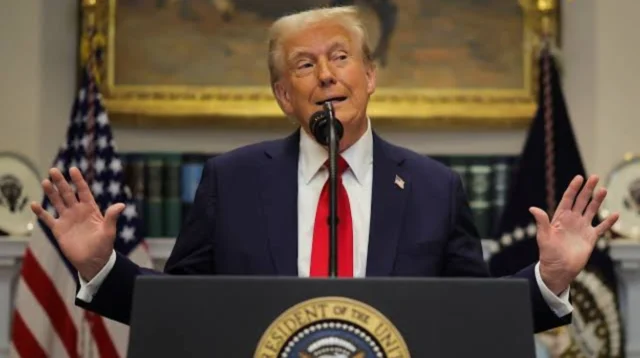
At the heart of the sidestepped drama lies President Trump’s renewed aggression toward EU autos, threatening to elevate tariffs from the 15% cap established in the 2025 Turnberry (Scotland) agreement. That prior pact, forged to avert 30% “Liberation Day” duties, saw Brussels commit to US investments and export boosts in exchange for tariff restraint, a deal EU lawmakers greenlit in March 2026, though full ratification pends. Trump’s proclamation, aired publicly, accuses the EU of violations, positioning the hike as retaliatory justice.
The tariff threat arrives amid Trump’s reelection momentum, with his administration leveraging it to bolster domestic manufacturing narratives. European vehicles, a multi-billion-dollar export lifeline for Germany and others, face potential devastation; a 25% levy could inflate prices, curb competitiveness, and ignite retaliatory spirals. G7 ministers, per reports, acknowledged the rift privately but confined public discourse to minerals, preserving a facade of cohesion.
This tactical omission raises profound questions for transparency advocates: Why exclude such pivotal flashpoints from joint statements? In Washington’s political arena, where trade policy intertwines with electoral posturing, the lack of disclosed negotiations or legal rationales fuels skepticism. The Turnberry deal itself, while publicized, lacked granular transparency on enforcement mechanisms, allowing interpretive disputes that now precipitate crisis.
Critical Minerals: China’s Grip and G7 Countermeasures
Delving deeper into the summit’s core, critical minerals emerged as the unifying battleground, with China’s dominance controlling over 80% of rare earth processing casting a long shadow. Vulnerabilities here transcend economics; they imperil green transitions and national security, as Beijing’s non-market tactics, including export curbs, throttle global access.
The G7 communiqué articulates a multifaceted response: fostering diversified supply chains, collaborative stockpiling, and regulatory alignment to mitigate risks. Ministers pledged transparency in mineral sourcing data, a nod to curbing opacity that plagues commodity markets.
France, as host, positioned itself as a linchpin, convening the talks to “curb” over-reliance, per pre-summit briefings. Statistical underpinnings are stark: China processes 90% of global rare earths, per industry benchmarks, enabling leverage seen in past trade skirmishes. G7 nations, import-dependent, eye alternatives in Australia, Canada, and Africa, but scaling requires investment and coordination—precisely what Paris aimed to catalyze.
“We must ensure our supply chains are secure,”
Forissier reiterated, embedding the quote within broader vows for resilience.
Legal opacity persists: Trump’s tariff authority stems from Section 232 national security provisions, historically expansive and judicially deferred, allowing political fiat over congressional oversight. Political affairs compound this; midterm pressures amplify protectionism, with auto tariffs as voter bait, yet without public impact assessments, accountability evaporates.
Broader Geopolitical Ripples and WTO Impasse
The Paris conclave extended beyond minerals to economic coercion writ large, decrying practices that distort fair competition. E-commerce small parcels, flooded by low-duty Chinese shipments, drew ire, prompting calls for reform. WTO disappointments loomed large; ministers regretted stalled fisheries subsidies and dispute settlement revamps, urging plurilateral progress. Geopolitics intruded via Hormuz disruptions, inflating energy costs and underscoring trade’s fragility.
For Washington’s legal-political transparency, these threads interconnect. US stances, while aligned on China, diverge on tariffs, where executive unilateralism evades G7 multilateralism. Trump’s team, post-inauguration, has wielded trade tools aggressively 25% steel tariffs reinstated, Canada-Mexico reviews reopened often with minimal congressional briefings. Politically, this resonates with base appeals, but legally, challenges mount in federal courts, questioning emergency powers’ breadth. EU counterparts, tariff-wary, recalibrate; Brussels mulls 2025 deal revisions amid threats, per reports.
Implications for Global Trade Architecture
As ministers dispersed, the communiqué stood as a roadmap: deter coercion, diversify minerals, reform WTO. Yet, unaddressed tariffs portend escalation, potentially fracturing G7 cohesion ahead of the leaders’ summit. Statistics paint the stakes: EU auto exports to the US exceed $50 billion annually, per trade data; a 25% hit could slash volumes 20-30%, per analyst models. China’s mineral stranglehold, conversely, demands unity; G7 initiatives like joint procurement could reclaim 15-20% market share over five years.
Transparency deficits in Washington amplify risks. Political opacity tariff threats via social media, not formal channels erodes predictability. Legally, reliance on delegated authorities sidesteps debate, contrasting EU parliamentary processes. For think tanks monitoring these affairs, Paris signals urgency: Mandate disclosures on trade impact studies, enforce congressional vetoes on emergency tariffs, and institutionalize G7 tariff consultations.
The G7 trade ministers’ Paris rendezvous navigated peril with pragmatism, foregrounding minerals while backgrounding tariffs. “Substantial advancements” on supply chains offer hope, but Trump’s shadow looms, demanding greater transparency to safeguard the rules-based order. As geopolitical storms brew, the onus falls on Washington to illuminate its legal-political calculus, lest economic coercion become the new normal.