The United States has introduced its National Counterterrorism Strategy 2026, which is a comprehensive new strategy that is also the first to emphasize that Africa is now a key location in combating terrorism globally. The strategy is intended to focus on a more concise population that would no longer involve U.S. troops in endless wars. However, transparency watchdogs have raised concerns regarding the development of the strategy concerning its language, operational rationale, and legality.
At the core of the 2026 strategy will be the dual commitments of: (1) to prevent jihadist havens from harming the United States, and (2) to protect Christians from jihadist violence. The second objective is a major shift from previous counterterrorism strategies, which have not considered security to be a civilizational or religious cause.
The inclusion of the word “Christians” in the Africa section of the strategy has been criticized by human rights groups and legal scholars, who worry that combining national security with religion will erode the neutral legal standards that should govern the use of force.
The logic of “resurgent terror havens” in Africa
The 2026 strategy highlights many areas of Africa as “resurgent terror strongholds,” indicating that jihadist networks have reestablished themselves throughout the continent. They specifically mention regions of West Africa/Sahel, the Lake Chadian Basin, parts of Mozambique, Sudan, and Somalia as places where ISIS and al-Qaeda affiliated groups are taking advantage of weak governance, ethnic tensions, and porous borders.
The Pentagon’s complementary 2026 National Defense Strategy sharpens this message, clearly stating that preventing Islamic terrorists from using regional safe havens to launch attacks against the United States is the U.S. military’s primary mission in Africa.
This type of language creates a global grid-type battlefield of nodes or “havens” where distance from the U.S. is not measured by how far away from the continental United States an adversary is; rather, it is how much of a threat that adversary is. The strategy clearly establishes a shift from a post 9/11 model of large-scale occupation and “nation-building” towards a more limited strategy of conducting over-the-horizon strikes.
From boots on the ground to “light‑footprint” strikes
One of the most consequential shifts in the 2026 strategy is the formal endorsement of a “light‑footprint” posture in Africa. The document promises to avoid the “nation‑building and interventionist policies of the past” while still ensuring that jihadist groups cannot build permanent bases of operations.
The tools of this new posture are clear: drone and air strikes, special‑operations raids, and intelligence‑driven counterterrorism operations, often carried out through or with regional partners such as Nigeria, Somalia, Kenya, and key Sahel states. AFRICOM’s recent record of drone and air‑to‑ground operations in Somalia and around the Lake Chad Basin is held up as a template for this approach.
The strategy underscores that the U.S. will provide “actionable intelligence” to partner states, train and equip local security forces, and conduct targeted strikes when partners cannot degrade shared threats themselves. This division of labour Washington as the remote sensor‑and‑striker, African governments as the on‑the‑ground executors creates a layered legal and political architecture. Designating the Muslim Brotherhood: a legal and political flashpoint
Perhaps the most legally charged element of the 2026 strategy is the formal designation of the Muslim Brotherhood (MB) as a Foreign Terrorist Organization (FTO), including its Sudanese and Egyptian branches. The strategy vows to follow up with designations of other MB chapters across Africa, framing the Brotherhood as a root‑cause network that incubates and enables jihadist violence.
The FTO designation is not a symbolic gesture; it is a legal instrument that triggers sweeping sanctions, freezes assets, restricts travel, and criminalizes material support. When such a label is applied to a broad ideological movement with deep roots in civil society from universities and charities to political parties its legal and social consequences extend far beyond the battlefield.
The strategy’s assertion that the MB
“remains deeply embedded in African politics”
suggests that the U.S. is aligning its counterterrorism policy with a specific anti‑Islamist worldview, raising questions about due process, evidentiary standards, and the risk of politicizing the national‑security apparatus.
“Protecting Christians” as a national‑security objective
The decision to explicitly name “Christians” as a protected group within the Africa‑focused counterterrorism framework is unprecedented in recent U.S. national‑security doctrine. This rhetorical choice is not a minor flourish; it is a deliberate re‑framing of the conflict as a protection mission along religious lines. The White House text states that the second objective in Africa is to
“protect Christians, who have been slaughtered at the hands of these Jihadi groups.”
The phrasing, echoing long‑running concerns over violence against Christians in Nigeria and parts of East Africa, seeks to anchor the strategy in a moral narrative of rescue and defence.
Yet from a transparency‑and‑legal‑checks perspective, this language is fraught. By singling out a religious community, the strategy risks confusing religious protection with national‑security policy and creating a halo effect around governments that position themselves as “Christian protectors,” even if their own human‑rights records are poor.
Critics argue that this approach may encourage partner governments to amplify religious polarization at home, using the language of “protecting Christians” to justify crackdowns on Muslim‑majority populations or dissenting groups. In operational terms, it also raises the question of what criteria Washington will use to define which groups are “Christian communities under threat” and how it will reconcile those judgments with the universal‑rights framework it still formally endorses.
Presidential statements and the “hell to pay” doctrine
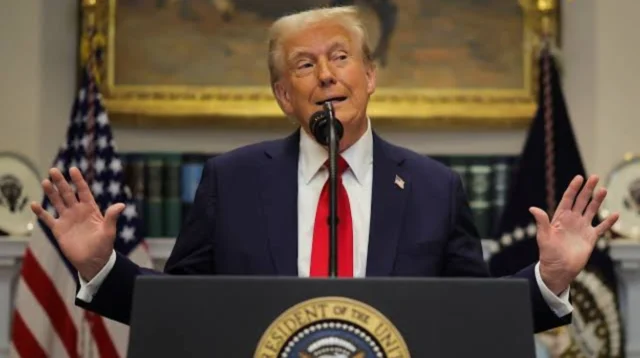
The rollout of the 2026 strategy has been accompanied by a series of high‑octane presidential statements that underscore the administration’s hardline stance. President Trump, addressing the conflict in Nigeria, reportedly told reporters that he had previously warned jihadist groups:
“If they did not stop the slaughtering of Christians, there would be hell to pay, and tonight, there was.”
They sit at the intersection of public messaging, executive authority, and tacit threat‑making, yet they rarely come with clear legal or strategic constraints. How, for example, does the administration define “slaugering of Christians” that justifies a “hell to pay” response? On what legal or evidentiary basis does it determine that a threshold of violence has been crossed? The 2026 strategy does not answer these questions, and that opacity is where the legal and political vulnerabilities lie.
Burdenshifting, trade, and the “security‑as‑trade” bargain
The strategy also candidly frames counterterrorism in Africa as part of a broader “America First” bargain with regional partners. Washington pledges to pull back from large‑scale deployments while expecting its allies and partners to accept a larger share of the burden.
The document describes a model in which the U.S. will “shift burdens” to nearby allies, share intelligence, and demand that partners conduct many of the operations on the ground, all while maintaining a remote‑strike capability. This “burdenshifting” doctrine is framed as a return to fiscal and strategic realism, but it carries clear transparency risks.
The strategy further links security cooperation with trade and economic ties, citing the Trump‑brokered Rwanda–DRC peace deal as an example of how security stability can unlock commercial opportunities. This “security‑as‑trade” logic is attractive to partners seeking investment and market access, but it risks turning counterterrorism into a quid pro quo where security concessions are demanded in exchange for economic benefits.
Oversight gaps, legal seams, and accountability
Despite its sweeping ambitions, the 2026 strategy offers little clarity on how Congress and independent bodies will oversee its implementation in Africa. Drone strikes, partner‑force operations, and FTO designations are all areas where executive power has historically outpaced legislative and judicial scrutiny. The strategy’s authors assume that the existing patchwork of authorisations for use of military force (AUMFs), classified briefings, and security agreements is sufficient, but that presumption is increasingly contested.
European Parliament and civil‑society analyses have already flagged that U.S. counterterrorism operations in Nigeria and Somalia often proceed without robust public reporting on civilian casualties, targeting criteria, or legal reviews. The same briefings note that the tightening of migration and visa policies toward several African states travel bans, deportation deals, and visa restrictions is being framed as a homeland‑security tool, yet its legal and human‑rights implications are rarely debated in open hearings.
A transparency‑focused view from Washington
The strategy’s explicit goals preventing jihadist safe havens and protecting Christians are framed as morally unassailable, but they sit atop a doctrinal and operational structure that is thinly detailed, legally ambiguous, and heavily reliant on executive discretion.
The designation of the Muslim Brotherhood as an FTO, the invocation of “Christians” as a national‑security priority, and the presidential rhetoric of “hell to pay” all point to a counterterrorism paradigm that is more ideologically and politically charged than its dry bureaucratic language suggests.
Without transparent criteria for defining “havens,” for assessing civilian‑impact trade‑offs, and for reviewing the legal basis of strikes and designations, the strategy risks entrenching a pattern of remote, opaque, and potentially unrestrained security operations in Africa. For advocates of transparency in Washington, that is the central challenge: not to demonize counterterrorism itself, but to shine a light on the legal and political wiring that brings it to life.