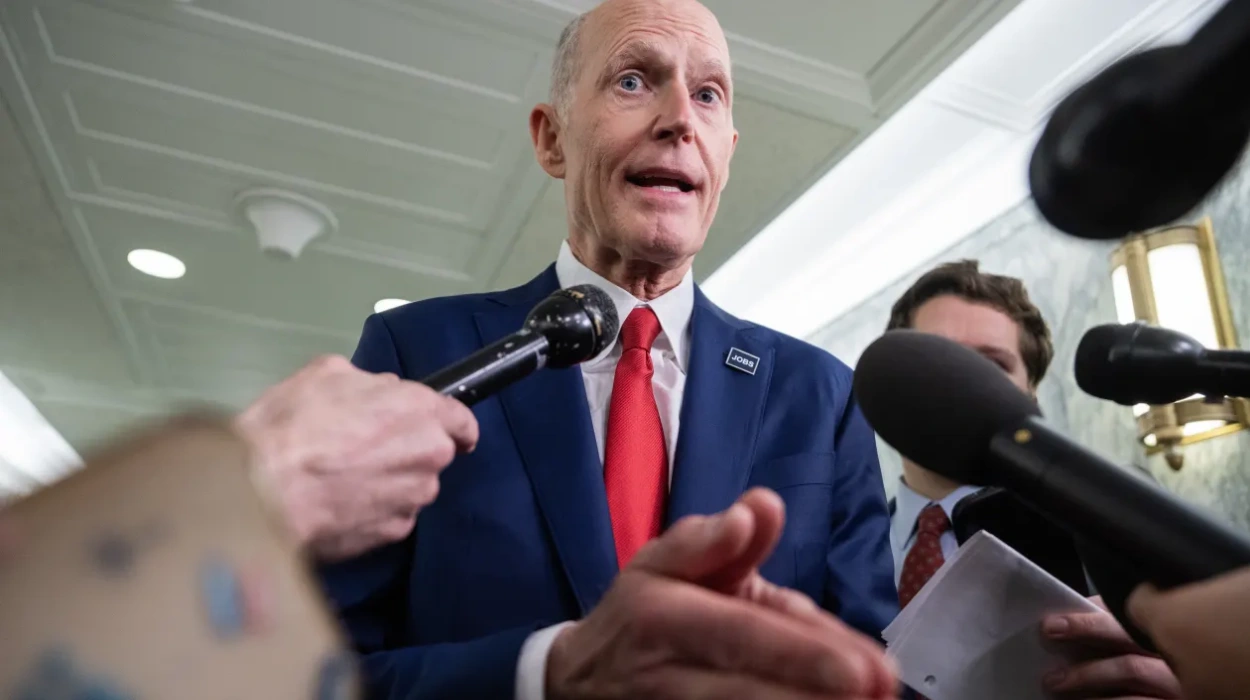
A bipartisan bill introduced in the Senate recently has brought renewed focus to one of the perennial issues in Washington ethics discussions: whether former members of Congress should be able to leverage their political connections for lobbying influence. Sponsors of the legislation include Republican Senator Rick Scott of Florida and Democratic Senator Elizabeth Warren of Massachusetts, and it would impose an all-encompassing prohibition on lobbying by former members of Congress in both its formal and informal incarnations.
This legislation is being introduced at a time when frustration in the general public with the phenomenon of self-interest politics is at an all-time high. As more politicians come out in the open about making money through their political influence, the need for such a legislative act has become pressing, even though it will not be an easy sell in Congress.
Senator Elizabeth Warren, in a post on X, said:
“It’s time to ban members of Congress from lobbying for life.
I have a new bipartisan bill to get it done.”
It's time to ban members of Congress from lobbying for life.
— Elizabeth Warren (@SenWarren) May 14, 2026
I have a new bipartisan bill to get it done. pic.twitter.com/FK1wW2UlWZ
A Broader Fight Over Influence
The intention here is to close off what has been described by some observers as the “revolving door” between service in government and private lobbying. What the act will do is make sure that both former senators and former representatives cannot engage in either formal or informal lobbying that would enable them to exert their influence through back channels. This is an important aspect of the reform, in that many ethics laws have concentrated on formal lobbying alone.
Proponents believe that the difference is important because influence may not necessarily show up on disclosure documents. A retired member of Congress who is not required to register as a lobbyist could still employ his connections and leverage his inside knowledge in crafting legislation that serves the interests of private parties.
This framing of the issue also has implications in terms of its politics as well as ethics. In Washington, where individuals who have served in government before often become lobbyists, consultants, or corporate advocates, there is a perception that such behavior undermines the public’s faith in the workings of government. This particular piece of legislation by Senators Scott and Warren focuses on this issue at its core.
What the Bill Would Do
The proposed law will place a lifetime ban on any member of Congress from being a lobbyist in any way. From the report, any violation will lead to significant monetary fines and even imprisonment. It is worth noting that the sponsors of this law do not see the need for it to only be a mere ethical gesture.
This is because the threat of punishment plays a key role in deterring anyone from violating the law. Many laws on ethics have proven ineffective not because people do not support them but because there is no way of enforcing them. The provision of jail terms and fines in this bill makes it costly to evade.
Both kinds of lobbying, that is, formal lobbying, referring to any kind of officially registered effort to persuade Congress to take legislative action or the executive branch of government to act in some particular manner, and informal lobbying, will be affected by the new rules. That broad terminology gives the proposal an edge over past attempts at reforms.
Why This Moment Matters
This particular piece of legislation faces an environment characterized by an increasing focus on ethics and responsibility within political campaigns. Increasingly, voters see the culture of careerism in Washington as one aspect of a broader suspicion of national institutions, with a distaste for the idea of politicians retiring and then profiting from that retirement.
It is partly for this reason that politicians with divergent views on policy can come together on the issue of stricter post-service lobbying rules. The legislation’s appeal in rhetorical terms is related to its lack of legislative viability. Themes of anti-corruption have a natural resonance among the voting public, so long as they appear self-limiting and not partisan.
Still, the political context cuts both ways. Although the bill is bipartisan, powerful lobbying interests, legal objections, and congressional inertia all make passage difficult. Reform bills in this space often generate headlines but struggle to move beyond introduction, in part because the lawmakers who would have to pass them are themselves the people being asked to impose constraints on future careers.
The Penalties And Legal Debate
The reported penalty structure gives the proposal unusual force. Heavy fines and possible jail time would place former lawmakers under much stricter scrutiny than ordinary ethics violations usually entail. That reflects a view that revolving-door lobbying is not a minor compliance issue, but a structural abuse of public service.
At the same time, this is where legal and constitutional arguments enter the picture. Critics of lifetime bans frequently contend that government cannot permanently bar citizens from lobbying activity without raising First Amendment or due process concerns. Lobbying groups have argued in the past that sweeping prohibitions can infringe on legitimate advocacy rights, especially when former officials are speaking as private citizens.
That tension may prove decisive. Supporters will likely argue that members of Congress voluntarily accept special responsibilities while in office and should not be able to exploit public service for private gain afterward. Opponents will counter that broad bans punish political speech and create overly rigid restrictions on post-government employment. This is why the bill may be popular in principle yet difficult to defend in court or move through Congress unchanged.
Pattern Of Reform Efforts
This is not the first attempt to curb lawmakers’ post-office lobbying careers. Rick Scott has pushed similar ideas before, including a 2019 measure that sought to permanently ban members of Congress from lobbying after leaving office. Other lawmakers have also pressed for tougher revolving-door rules, signaling that this issue has long simmered across party lines.
Recent reform efforts have gone even further in some cases. In 2025, another proposal backed by Rep. Alexandria Ocasio-Cortez and Rep. Joe Neguse sought a lifetime lobbying ban for members of Congress and added stronger restrictions on staff conduct as well. That bill reportedly included steeper financial consequences, showing that the appetite for reform has widened beyond a single bipartisan pair.
These repeated efforts matter because they show the issue is not new, even if the current bill has renewed attention. The persistence of such proposals suggests that ethics reform remains politically appealing, but also that the structural incentives in Congress continue to resist change. Lawmakers may denounce revolving-door politics publicly while still depending on the same post-office career networks the reforms would restrict.
Statements And Political Meaning
The most important political statement behind the bill is simple: public service should not become a guaranteed path to private enrichment through influence peddling. That idea has become increasingly central to reform-minded lawmakers who want to show they are willing to police their own institution.
A fair reading of the proposal is that Scott and Warren are trying to redefine what acceptable post-congressional work should look like. Instead of allowing a former senator or representative to leverage relationships built in office for lobbying power, the bill would say those relationships belong to the public trust and should not be converted into private advantage.
That message has a strong symbolic appeal. It allows lawmakers to present themselves as pushing back against a culture that many voters view as disconnected from ordinary life. It also creates a rare point of bipartisan agreement in a deeply polarized era: the idea that elected office should not be a springboard into a highly paid influence business.
Likelihood Of Passage
Despite its attention-grabbing language, the bill faces a steep path to becoming law. Major ethics reforms often run into procedural hurdles, partisan calculations, and the reluctance of sitting lawmakers to constrain future opportunities for themselves or their colleagues.
Even with bipartisan sponsorship, the proposal may struggle because it targets a system that is deeply embedded in Washington’s political economy. Lobbying is a major industry, and former lawmakers are among its most valuable hires precisely because of their experience and access. That makes the bill politically powerful but institutionally threatening to many interests that influence Congress.
The result is a familiar pattern in reform politics: broad public support, energetic messaging, and uncertain legislative survival. The proposal may nevertheless shape the debate by forcing more lawmakers to publicly state where they stand on the ethics of post-office influence work.
Why Readers Should Care
This bill matters because it goes beyond a narrow lobbying rule and asks a larger question about democratic legitimacy. If lawmakers can leave office and immediately monetize their connections, the public may reasonably wonder whether they were serving constituents or building a future client list.
The debate also matters because it exposes a recurring tension in American politics: reform is most popular when it limits misconduct by others, but hardest when it requires lawmakers to regulate their own class. That is why bills like this often become tests of institutional integrity.
For voters, the practical issue is not just whether former lawmakers can file lobbying paperwork. It is whether public office should come with a built-in private sector payoff. The Scott-Warren proposal answers that question with a hard no, and that alone makes it one of the more consequential ethics bills to emerge in this Congress.