Georgia’s political watchdog has placed renewed scrutiny on one of the state’s most influential evangelical advocacy organizations after allegations that it failed to follow basic disclosure rules tied to election-related advertising and lobbying activity. The case centers on Frontline Policy Action, a conservative evangelical lobbying group with significant access at the Georgia Capitol, and it underscores how closely the line between issue advocacy, lobbying, and election messaging is being policed in one of the nation’s most politically consequential states.
The reason why this particular case carries extra weight and importance is not only because of the significance of the impact of the organization in question but also due to the range of actions that are being accused of. In its complaint, Frontline Policy Action does not accuse the organization in violation of just one rule but in numerous failures in the area of required transparency, including failures in making necessary disclosures, reporting income and expenditures, and making necessary disclaimers. In the environment where spending on politics becomes the core issue of public trust, this case raises even more questions.
A powerful group under scrutiny
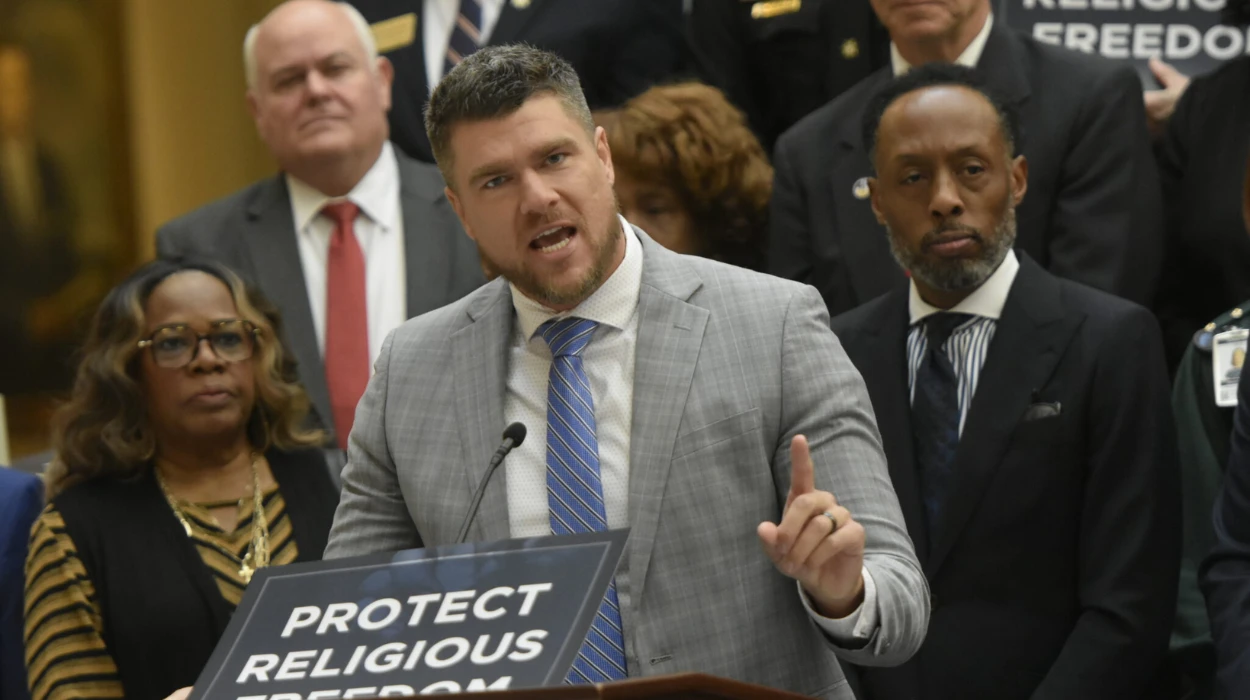
Frontline Policy Action has been identified as an extremely powerful conservative lobbying firm with a religious background operating actively in Georgia politics. The relevance of this group stems from its capability of influencing the policy discussion at the state level, specifically the socially conservative policies. For instance, Frontline Policy Action was claimed to successfully promote several important policy wins in 2025, such as a Religious Freedom Restoration Act and a prohibition of participation of transgender girls and women in women’s high school sports teams. The above examples show that Frontline Policy Action indeed has some political weight and that it is viewed very seriously by legislators and activists. It is this capability that makes the filing of the ethics complaint relevant and significant.
As a group that can potentially impact the creation of legislation and discussions around it, Frontline Policy Action should comply with the disclosure requirements set by the state, especially concerning any communications involving elections or elected officials.
The case therefore is not just about paperwork. It is about accountability for organizations that occupy the space between policy advocacy and electoral persuasion. In modern state politics, that space can be legally complicated, but the expectation of transparency remains central.
The complaint’s core allegations
At the center of the case is the claim that Frontline Policy Action failed to properly disclose advertising and financial information tied to political activity. The complaint says the group did not file the correct disclosure reports for ads connected to Gov. Brian Kemp and Lt. Gov. Burt Jones during the 2022 election cycle. Those ads were not treated as isolated communications; they were presented as part of a broader pattern of reporting omissions.
The accusations do not stop there. The complaint also claims that the group did not report income and expenses that should have been reported in its state reports. More specifically, the report mentions that according to the tax documents filed with the IRS, the group reported receiving $246,831 in contributions and spending $237,311 on lobbying activities in the fiscal year from July 1, 2022, to June 30, 2023, when this information allegedly was not provided to the state ethics commission. This is an important discrepancy since financial reporting can be considered one of the bases for assessing compliance with state campaign and lobbying regulations. Another claim in the complaint was the lack of necessary disclaimer language in some of the advertisements. Disclaimers in election and advocacy law are not some small technical detail; rather, they point out the identity of the sponsor of the advertisement.
How many alleged violations?
Apparently, the complaint described the violations in a well-structured manner. The violations amounted to four due to failure to file the required advertisements, two due to failure to submit financial information such as revenue and expenses, and finally, three violations due to failure to include the disclaimer language in advertisements. This gave a total of nine alleged violations in total. This figure is significant in that it alters the dimension of the case completely. An isolated violation might be treated as a simple administrative matter, but nine alleged violations spanning various reporting requirements indicate a more serious compliance issue, or even a pattern that the regulators will take more seriously.
One specific example cited in the reporting was a 30-second video featuring a transgender swimmer winning a competition, which reportedly ran on Facebook and Instagram. The significance of that example lies in its content and placement: it appears to have been part of a larger messaging effort aimed at shaping public opinion on social issues closely tied to Georgia politics. When such ads are run without the required disclosures, the controversy shifts from ideological messaging to legal compliance.
The group’s response
Frontline Policy Action rejected the implication that the issue reflected meaningful wrongdoing. As quoted in the reporting, the group said
“a non-issue stemming from site technical issues”
[Frontline Policy Action]. That response frames the problem as administrative rather than substantive, suggesting that any failure to file or disclose was caused by technical difficulties rather than an intent to evade the law.
It is a frequently used line of defense in matters concerning political compliance. Organizations responding to allegations of breach of ethics often claim that mistakes have been caused by the use of faulty software or confusion rather than an attempt to hide something. In most cases, the acceptance of this argument will be largely dependent on the extent of the mistakes made, the frequency and consistency of their occurrence, and whether the same mistakes keep happening again and again. At this point in time, the report clearly shows that the ethics committee had not made any new announcement. This implies that what is more significant in this case is the message being sent out through the proceedings.
Why Georgia cares
Georgia has become a national battlefield for campaign finance, lobbying, and ethics enforcement. The state’s politics are intensely competitive, and advocacy groups from across the ideological spectrum have invested heavily in shaping outcomes. That has put extra pressure on the ethics commission to police disclosure requirements in a way that appears even-handed and enforceable.
The case of Frontline Policy Action is set in the same wider context that led to the previous enforcement actions that attracted media attention. In other important cases related to the violation of the campaign finance law in Georgia, the state’s ethics agency took serious action. For example, in one of those cases, the Georgia ethics agency imposed a record-breaking fine of $300,000 for campaign finance violations committed by entities connected to Stacey Abrams. This parallel does not imply the sameness of the cases but rather illustrates the extent to which Georgia’s regulators consider disclosure laws. This leads to the creation of a political climate where transparency laws become more than just regulations. They become the subject of the contest itself.
The bigger issue of influence
The reason this story resonates beyond the statehouse is that it reflects a broader national pattern. Across the country, advocacy organizations increasingly blend lobbying, digital ads, policy campaigns, and election messaging. That mixture creates a challenge for regulators because these groups often insist they are issue-based rather than electoral, while critics argue that their messaging still shapes campaigns and voter perceptions.
Frontline Policy Action appears to sit squarely in that gray area. Its influence on legislation suggests a conventional lobbying operation, but its use of ads tied to public officials and electoral themes suggests something more expansive. That combination is exactly where disclosure laws become critical. Without transparent reporting, the public cannot easily tell whether a message is an issue campaign, a lobbying push, or an election intervention.
For journalists, that is the core tension worth watching. Influence is not the problem by itself; hidden influence is. The point of ethics disclosure rules is to make powerful actors visible to the public, especially when their messages target voters or elected officials.
What the case could mean next
The most important next question is how the Georgia State Ethics Commission evaluates the complaint. If the commission views the matter as a technical problem, Frontline Policy Action may face limited consequences. If, however, regulators determine that the omissions were repeated, material, and tied to political communication, the case could carry broader penalties and reputational damage.
There is also a larger policy implication. A strong enforcement outcome could signal that Georgia intends to apply disclosure rules tightly to advocacy groups that operate like political machines. A weaker response might encourage similar organizations to argue that filing lapses are merely technical errors, even when the public-facing activity is substantial.
Either way, the case is likely to remain relevant because it touches on a recurring political question in Georgia: who gets to influence policy and elections, and under what level of public scrutiny?