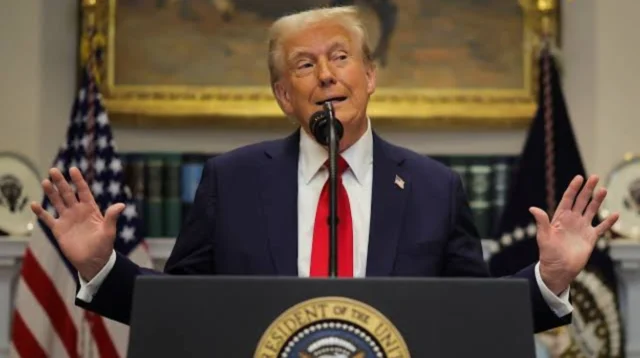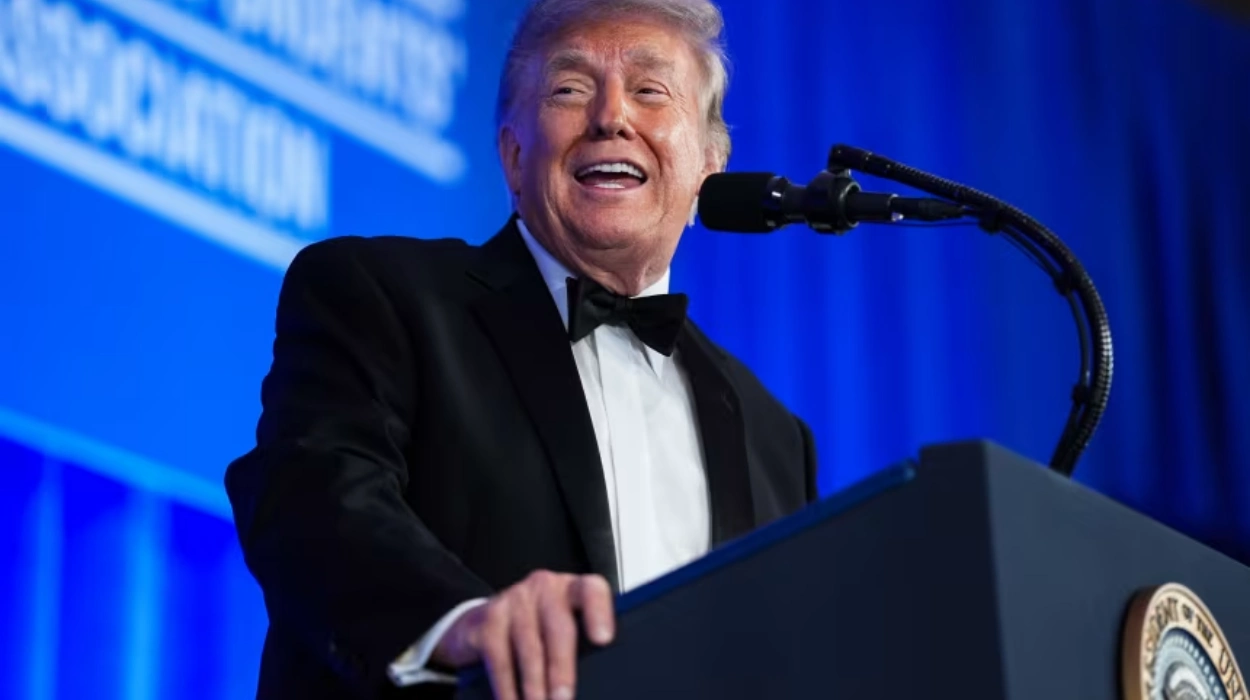
Donald Trump turned the rescheduled White House Correspondents’ Dinner into a long, combative political spectacle, attacking journalists, mocking political enemies, and ending with a red “Trump 2028” cap that revived talk of a possible third-term push. The speech drew mostly stunned silence in the room, signaling that the president’s blend of insults, rallies, and self-promotion landed more like a grievance monologue than a traditional dinner roast.
A dinner turned into a stage
White House Correspondents’ Dinner is generally regarded as an expression of joy about journalism, media freedom and strained but lasting relations between presidents and the media. However, this time Trump took advantage of the opportunity to reopen old disputes, personalize his attacks and have the audience sitting quietly under pressure for the most part of his one-hour-long speech. Reuters and The Guardian pointed out that the dinner has been rescheduled because of the shooting at the previous gathering held in April.
As a result, the night became unusually tense in advance of Trump’s speech. Trump’s attendance of the event itself became historic as The Guardian emphasized that this was the first time that Trump attended the White House Correspondents’ Dinner during both of his presidencies. Thus, the speech became not a regular appearance but a political event on its own. In addition, instead of engaging in self-deprecation, Trump mostly continued his attacks on the audience of journalists.
The speech and its tone
However, the primary perception formed about the reporting was that of awkwardness rather than humor. Various media outlets noted that the room had been dumbfounded at certain points during the speech, as Trump gave his rambling remarks that were a mixture of campaign rhetoric, insults, and jokes, which fell flat most of the time. Deadline reported on an “hour-long speech” consisting of “shopworn rally material” and “leaden one-liners,” whereas CNN reported that
“he bombed and knew it.”
That dynamic mattered because Trump appeared to be watching the reaction as he went. Deadline reported that after one joke drew “crickets,” he complained,
“Does anybody get that? I thought that was actually great. That was actually the only thing I thought was good in this whole frickin’ stupid speech. It was the only good one, and that went down with not exactly great laughter.”
The line captured both the self-awareness and the irritation that defined much of the night.
He also leaned into the idea that the dinner itself had become absurd. Deadline reported Trump saying,
“Tonight’s event is even crazier than the last time,”
and joking that CBS News’s David Ellison had told him the event might be renamed the “Trump White House Correspondents’ Dinner” next year. He then added that changing the name would be
“the only way you’re going to get me back here.”
That remark folded ego, grievance, and self-promotion into one punchline.
Attacks on journalists
Trump’s sharpest and most repeated targets were journalists, especially the press corps gathered in the ballroom. The Guardian reported that he praised journalists for doing an “amazing job” while simultaneously telling the room,
“Don’t believe the fake news.”
That contradiction — compliment in one breath, attack in the next — summed up the larger political theater of the evening.
According to Deadline and The Independent, he had made personal comments about reporters’ looks and targeted reporters for mockery. According to The Independent, he has mocked CNN’s Kaitlan Collins several times telling her to “smile.” At the same time, he had ridiculed CNN’s Jake Tapper referring to him as “Fake Tapper.” According to The Independent, the way he addressed the press could be perceived as sexist and abusive to the press in particular and to women journalists in general as he has done that many times before. At the same time, Trump has compared a woman reporter to a transgender social media influencer. The sources mentioned his use of gendered and personal insults against the press in a way characteristic for his media-bashing style.
Political foes and crude jokes
Trump also mocked political opponents and other public figures, folding them into the same performance. Deadline said he used the dinner to hurl broadsides at members of the press and critics, mixing them with jokes about politicians’ appearance and private lives. When one line about an elderly senator’s sex life failed to get laughs, he responded with visible frustration, which reinforced the sense that he wanted applause, not awkward silence.
The Independent reported that he also hit other figures in the media ecosystem, including Josh Dawsey of The Wall Street Journal, whom he called “unhireable” while complaining about awards connected to coverage of the Trump-Epstein saga. That detail is important because it shows he was not only settling scores with cable-news adversaries but also lashing out at print reporters and investigative work that has embarrassed him.
Trump’s routine also included self-pity and media-business commentary. The Independent reported him saying,
“Sometimes I really do think that some of you don’t like me,”
before claiming he gets “93 percent negative publicity.” He then warned that
“When I’m gone, you’re all going to be broke,”
casting the press as both adversary and dependent beneficiary of his political celebrity. The result was less a roast than a long complaint about status, coverage, and power.
The Trump 2028 signal
However, the most theatrical gesture took place at the very end of the event as Trump pulled out a red hat with “Trump 2028” on it, saying that he would be running again. Media coverage called this gesture part joke, part provocation, and political message without an actual campaign move, which is perfectly consistent with the long-standing pattern of the president’s attempts to use symbols to provoke reaction. As the Guardian said, the hat was part of the joke about the third term of the president’s presidency, but NBC, among others, mentioned that he jokingly talked about the possibility of his fourth term of office.
However, this does not mean that he actually declares anything; this just means that the story about how Trump likes to make boundary-pushing statements publicly remains relevant. In practice, the hat had more to do with showmanship than with politics.
Reaction in the room
What made the night memorable was not simply what Trump said, but how little he seemed to get back from the audience. CNN’s description of the speech as a bombed performance captured the broader media reaction, while Deadline and The Independent both emphasized that even many Republicans appeared stunned by the tone. The silence mattered because it undercut the normal rhythm of a comedic dinner, where timing and audience response are supposed to complete the performance.
There were a few moments of laughter, especially when Trump turned briefly self-deprecating or mocked the struggling economics of media organizations. But those were exceptions, not the rule. Most of the speech came across as a reminder of how much Trump prefers confrontation over wit when he is speaking to journalists in a public setting.
This speech is important because it demonstrates that Trump continues to view public appearances at high-profile civic events as chances for warfare, branding, and even vengeance. The White House Correspondents’ Dinner should represent a symbolic representation of the relationship between the press and the president under democratic standards, but Trump transformed it into a display of antagonism, domination, and media grievances. This in itself says a lot about the status of political communication during his presidency. It is also important because the speech explains why Trump continues to be such a disruptive force in journalism coverage. He did not only attack the press; he did it personally, with mockery and contempt in front of those who he attacked. And, finally, he ended the speech with the “Trump 2028” cap.