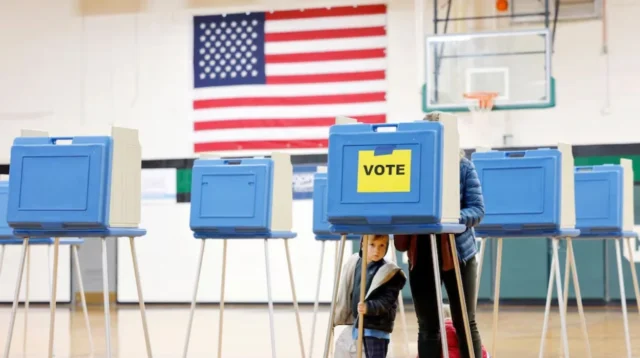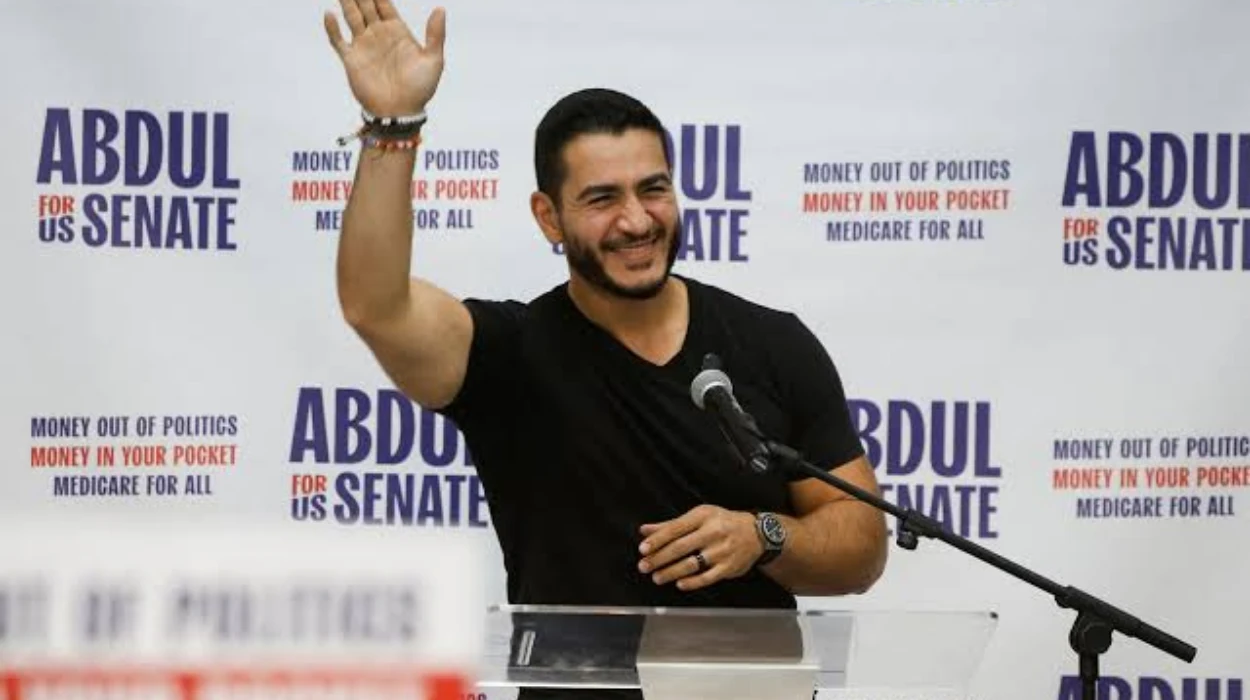
NBC News projected El-Sayed to be the winner, as USA Today also did based on its projection through NBC News and Decision Desk HQ. The magnitude of the contest helps explain the rapidity with which this result became a matter of national interest; the contest was not just about winning the Democratic nomination to the U.S. Senate, but also about which approach Democrats ought to take to their presidential campaign: whether they should focus on their progressive insurgency or adopt a more centrist, establishment-friendly image. There were also practical ramifications to this result: Michigan’s Senate vacancy, opened up by the retirement of Sen. Gary Peters, is one of the most crucial Democratic target seats of the 2026 election cycle, with El-Sayed running against Republican former Rep. Mike Rogers in the fall.
How the race was framed
Ideology played a key role in this primary right from the beginning. El-Sayed came in as the progressive former public health official backed by Bernie Sanders and other leftist personalities, while Stevens came as the more moderate candidate who was part of the lane supported by the establishment wing of the party. The difference could not be clearer: one side wanted a more radical approach to politics, while the other wanted a more pragmatic approach. This made the race a perfect case study for the debate going on within the party on its approach. The victory of El-Sayed shows that, at least in the Michigan primary, there was enough anti-establishment sentiment to overcome the structural advantage of the more established candidates.
Money, backing and pressure
One of the most striking features of the race was the financial imbalance. NBC News said El-Sayed overcame a “huge advertising disadvantage” and a “nearly $65 million onslaught of outside money” that had largely lined up behind Stevens. The Detroit News reported that about $60 million in outside spending flowed into the race, with roughly $54 million benefiting Stevens and $5 million helping El-Sayed.
That spending gulf made the outcome politically meaningful beyond the simple vote count. It suggested that money, while still decisive in shaping the air war, was not enough to override the mood among many Democratic voters who appeared willing to reward a more openly ideological candidate. It also raised questions about the limits of institutional support when it is disconnected from the mood of the primary base.
The endorsements reflected the same split. AP reported that El-Sayed was backed by Sen. Bernie Sanders, while Stevens had the support of Senate Democratic leader Chuck Schumer. In many ways, that endorsement map mirrored the race itself: insurgent progressive energy versus party establishment confidence.
What the numbers showed
Prior to the projection of the race, the vote counts were incredibly close. The Michigan Advance noted that with 89 percent of the votes counted, El-Sayed had a slight edge of 48.9 percent compared to Stevens’ 47.1 percent. The Associated Press also noted that it was a race that was too close to call, at that point. The New York Times live tracker also displayed the same story: El-Sayed was at 671,341 votes, which accounted for 48.9 percent, and Stevens at 645,797 votes, representing 47.1 percent from a total of 1,372,183 votes. However, what was critical was the shift in the lead that occurred as mail-in ballots continued to be counted, since El-Sayed had an edge of close to 30 percent at one time during the night. This shift was important since it indicated two different coalitions. The New York Times pointed out that El-Sayed performed significantly better with in-person votes while Stevens fared much better with mail-in votes, both accounting for almost the same margin.
A race that divided Democrats
The primary became a public reflection of the wider Democratic dilemma: whether the party’s future lies in ideological boldness or electoral caution. The New York Times described the contest as “acrimonious and expensive,” while AP called it a closely watched Senate primary with big stakes for the party’s majority ambitions.
El-Sayed’s supporters saw his campaign as a response to grassroots frustration with Washington politics. Coverage from BBC described him as a left-wing outsider tapping into discontent, while CNN noted that he was backed by Sanders, Alexandria Ocasio-Cortez and other prominent progressives. Stevens, by contrast, presented herself as a reliable, battle-tested Democrat capable of winning statewide in a politically mixed state.
That tension was also visible in debate coverage. The New York Times said the candidates showcased their “wildly different ideological stances,” with El-Sayed accusing Stevens of serving corporate interests and Stevens arguing that El-Sayed wanted the Senate as a launchpad for personal fame rather than for Michigan. Those attacks helped crystallize the race into a referendum on authenticity, ideology and political judgment.
The Israel factor
The Israel-Palestine conflict became one of the key fault lines in the campaign. Various media sources portrayed El-Sayed as a prominent critic of Israel and a figure whose positions have become a target for attacks by those who criticized and opposed him. While the Times of Israel labeled El-Sayed as an anti-Israel candidate in the Democratic party, other articles stated that Stevens enjoyed the backing of pro-Israel organizations and outside spending related to that part of the issue. This issue was not secondary to the campaign; rather, it was included into the narrative concerning the future political coalition of the Democratic party. To some people, El-Sayed’s positions reflected principles and departure from the usual donor-centered politics in Washington. However, to others, there were doubts about the impact of such views on the prospects of Democrats in a general election fight against a Republican in the state of Michigan.
What El-Sayed stood for
El-Sayed’s campaign, as described in reporting, emphasized progressive rhetoric. His positions, according to news coverage, included universal healthcare, abolition of ICE, and ending U.S. aid to Israel. Additionally, he positioned himself through a focus on public health and aggressive rhetoric in the race. In this way, his win is not only personal but also a policy signal. The win by El-Sayed indicates that the national party of Democrats can successfully run a left-populist campaign to victory in a Senate primary despite being outspent and opposed by the establishment.
With the general election, we can see if the same message that was successful in winning the primary will succeed in bringing an overall statewide victory come November. On their side, the opponent will probably paint El-Sayed as being too liberal for Michigan, particularly when it comes to foreign policy and other areas. For his part, El-Sayed’s campaign is going to try to use his victory in the primary as evidence that the Democratic party wants to move even further away from corporate politics. It is clear that the race is not just about Michigan. NBC characterized the victory as a “beachhead in the Midwest” for the progressive left, which says it all about why this particular race is significant on a national level.