The Trump administration’s plans for a sweeping transformation of the White House complex have grown into a construction programme worth at least $900 million, with the overall cost potentially reaching approximately $927 million, according to confidential contracts, budget records and documents reviewed by The Washington Post.
This number is much higher than previous public estimates and poses new challenges for government transparency, congressional oversight, and the numerous statements made by President Donald Trump that taxpayers would not have to pay for the White House ballroom that he had announced. The total cost includes a range of construction projects, including construction and security projects at the White House site and adjacent federally owned property. These include the East Wing ballroom, security structures below ground level, helipad on the South Lawn, renovations of Lafayette Square, new visitor screening structure, and others. The results reveal a large increase in the scope of funding required for the implementation of Trump’s White House redevelopment plans.
The ballroom had been originally introduced as a project requiring about $200 million worth of investment. Public estimates were subsequently growing to $250 million, to $300 million and, finally, to approximately $400 million.
Internal estimates cited in earlier reporting placed the ballroom’s cost as high as $600 million, with taxpayers potentially responsible for more than half of that amount. The latest figure of $900 million or more is therefore not simply a revised ballroom estimate. It reflects an entire construction programme being developed around the White House during Trump’s second administration.
From private ballroom to public construction programme
When Trump announced the ballroom, the White House said the project would be privately financed. The administration described the proposed facility as a long-awaited event space that would address the White House’s shortage of capacity for large diplomatic and ceremonial gatherings.
The White House said in July 2025 that Trump and private donors had committed to funding the approximately $200 million structure.
“President Trump, and other patriot donors, have generously committed to donating the funds necessary to build this approximately $200 million dollar structure,”
the White House said in its official announcement.
Trump subsequently insisted that the project would not impose a financial burden on the public. He said the ballroom would be funded through private contributions from corporations, individuals and his own finances.
“Not one penny is being used from the federal government,”
Trump said, according to previous reporting. He also described the project as a “GIFT” to the country and claimed it would require “ZERO taxpayer funding.”
However, the process of funding has grown more complicated. It has been reported that the government has moved hundreds of millions of dollars from various federal departments to the White House Repair and Restoration Fund. These people claim that such funding represents tax money financing, despite the fact that the building itself is being constructed using private funds. This aspect plays an important role in the controversy. According to the Trump administration, it is private money that is financing the building itself. Their opponents believe that the government is financing the security, infrastructure and other facilities necessary for construction of the building.
Where the money is coming from
The records reviewed by the Post indicate that $875 million was transferred into the White House Repair and Restoration account after Trump took office. The account traditionally received only a few million dollars each year. One set of records placed its annual funding at approximately $2.5 million, underscoring the scale of the new transfers.
The reported breakdown is significant. Approximately $500 million came from the Secret Service and the White House Military Office, while $305 million came from private donations. The source of another $70 million was not identified in the documents cited by the Post.
The numbers indicate that the greatest portion of the funding is likely that provided by the federal government. While a total of $875 million was deposited into the account, public agencies provided around 57 percent, private known donations accounted for roughly 35 percent, and the rest of the $70 million remains unaccounted for. These numbers should be taken as a snapshot of the financing process rather than an audited report of expenditures. The sum of $875 million deposited into the account does not entirely coincide with the estimated cost of the projects amounting to $927 million. Also, it is not quite clear what part of the public funding has been designated for use specifically on the ballroom and what has been allocated for other projects such as security and maintenance works. This is among the key points of the story since the administration did not provide an itemized report containing detailed information on the sources of each dollar, awarded contracts, the donors themselves and the link between private donations and federal funding.
Projects beyond the ballroom
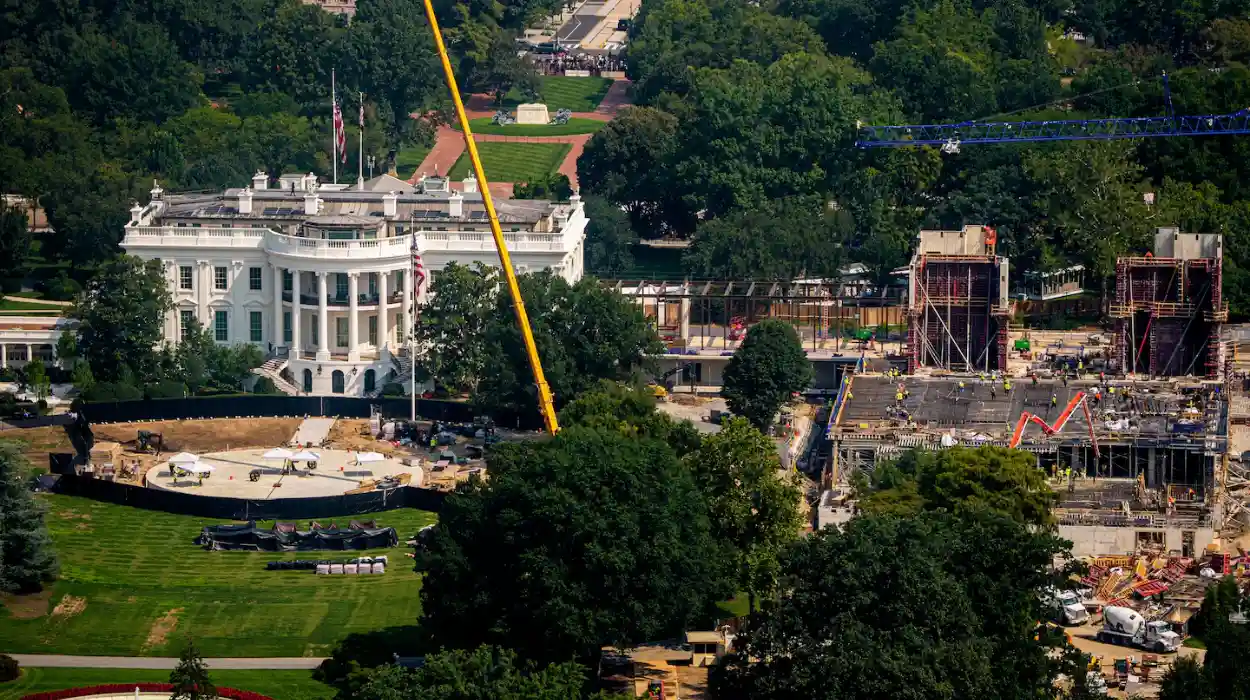
Even as the ballroom is still the most prominent aspect of the construction work, the wider program has other aspects that have not attracted much attention in the media. The planned ballroom would sit at the location where the former East Wing had been demolished. The demolition of the historic building was done by the administration in late 2025 to make way for the ballroom. It is claimed that the ballroom will give a secure place to host state dinners and other large functions that cannot fit into the current White House rooms. Construction of the underground and security structures has also taken place in addition to the ballroom.
The underground structures consist of a bunker, medical facilities and security structures meant to protect the President and other officials from drones, missiles and any biological attacks. Construction of a helipad has also taken place on the South Lawn. President Trump says the helipad is important because the newer versions of the Marine One helicopters are powerful enough to destroy the South Lawn. He claims that Sikorsky – the manufacturer of Marine One helicopters through its subsidiary of Lockheed Martin – would pay for the helipad.
The helipad project has already generated controversy after construction workers began installing a large presidential seal and later removed it after Trump reportedly objected to the slope of the lawn. The changes have added to criticism that the administration is undertaking projects rapidly and altering them during construction.
The wider plan also includes improvements to Lafayette Square, a new visitor-screening facility and other work related to access, security and the White House grounds. Some of these projects may be justified as routine federal security or preservation work. Their inclusion in the broader construction programme, however, makes it more difficult to separate ordinary executive-mansion maintenance from the administration’s highly personalised architectural agenda.
White House and donor defence
The White House has defended the ballroom and said private donors remain responsible for the central construction cost.
“President Trump and generous American patriots are funding the ballroom to the tune of approximately $400 million, which will be a secure and appropriate venue for Presidents for generations to come,”
White House spokesman Davis Ingle said in response to earlier criticism.
The administration says that any efforts towards security cannot be completely divorced from the ballroom construction project. Since there would be the need for a new place for presidential functions, there will be a need to put in place security measures. For these reasons, the use of money for security by the federal government cannot be said to be at odds with the fact that donors are paying for the ballroom.
Private donors include major firms and rich individuals. In an earlier report, tech firms and other large firms were some of the identified funders. Alphabet, the parent company of Google, was reported to have made a $22 million donation in connection with a settlement to a charity associated with the construction of the ballroom and National Mall.
The arrangement has also raised ethical concerns because some donors have business before the federal government. Documents reported by Reuters indicated that the fundraising agreement allowed donor anonymity and limited certain conflict-of-interest safeguards.
That secrecy has fuelled concerns that private contributions could create opportunities for influence-peddling or preferential access to the president. The administration has said that foreign contributions are prohibited, but the public still lacks a complete financial picture of the fundraising campaign.
Congressional and legal challenge
The financing issue is taking place amidst another issue involving the legality of the administration moving forward on its own without Congressional approval. Congress refused the administration’s funding request for $1 billion worth of taxpayers’ money to build the ballroom and enhance its security. In lieu of obtaining one lump sum of money from Congress, the administration collected funds through internal allocations from different agencies, private contributions, and funds allocated for the executive mansion. This method of financing has been put up to litigation. On August 7, a divided federal appeals court decided that the administration should halt any above ground construction of the ballroom since there was no Congressional approval for the project.
The majority held that the executive branch could not use its own authority to carry out a major structural change to the White House without congressional authorization.
“Whether or not a massive ballroom should be constructed is for Congress to decide and is not a matter for Executive self-help,”
the court said.
The ruling did not permanently prohibit the ballroom. It halted above-ground work while the legal dispute continues. Underground construction connected to bunkers and national-security facilities was allowed to proceed, and the administration was given time to seek further review, potentially including intervention by the Supreme Court.
The lawsuit was brought by historic-preservation advocates, who argued that the administration had failed to comply with congressional and preservation requirements before demolishing the East Wing and beginning construction.
Why the $900 million figure matters
Beyond its implications for the architecture of the White House, the latest estimate calls into question the ability of an administration to leverage the budget and administration of agencies to push a project that Congress failed to finance. This question has relevance with respect to the extent of presidential authority over federal property. The White House may be occupied by the president, but it is a federal property that is funded through public dollars. Large-scale renovations have legal and preservation implications, in addition to separation of powers considerations.
The plan has also taken on additional meaning insofar as it symbolizes the Trump administration’s philosophy and style. Trump has styled himself as a “builder” and has embarked upon a major renovation effort at the executive mansion, which includes gold interiors and a paved Rose Garden.
Supporters see the projects as overdue improvements that will modernise the White House, strengthen presidential security and create a venue suitable for large diplomatic events. Critics see them as an expensive personal imprint on a historic public building, funded partly through opaque arrangements and government accounts that were not originally intended to finance a presidential ballroom.
There may be more costs to come. Large-scale construction projects tend to evolve as designs are reworked, security demands become greater and prices for materials and labor rise. The ballroom’s own projections have already doubled their initial $200 million price tag to about $400 million, while others have hit the $600 million mark. The single biggest remaining unknown is whether the administration will be able to keep their promise of “no taxpayer dollars” in light of hundreds of millions of dollars that are being moved through federal agency coffers into the accounts used to build up the White House grounds.