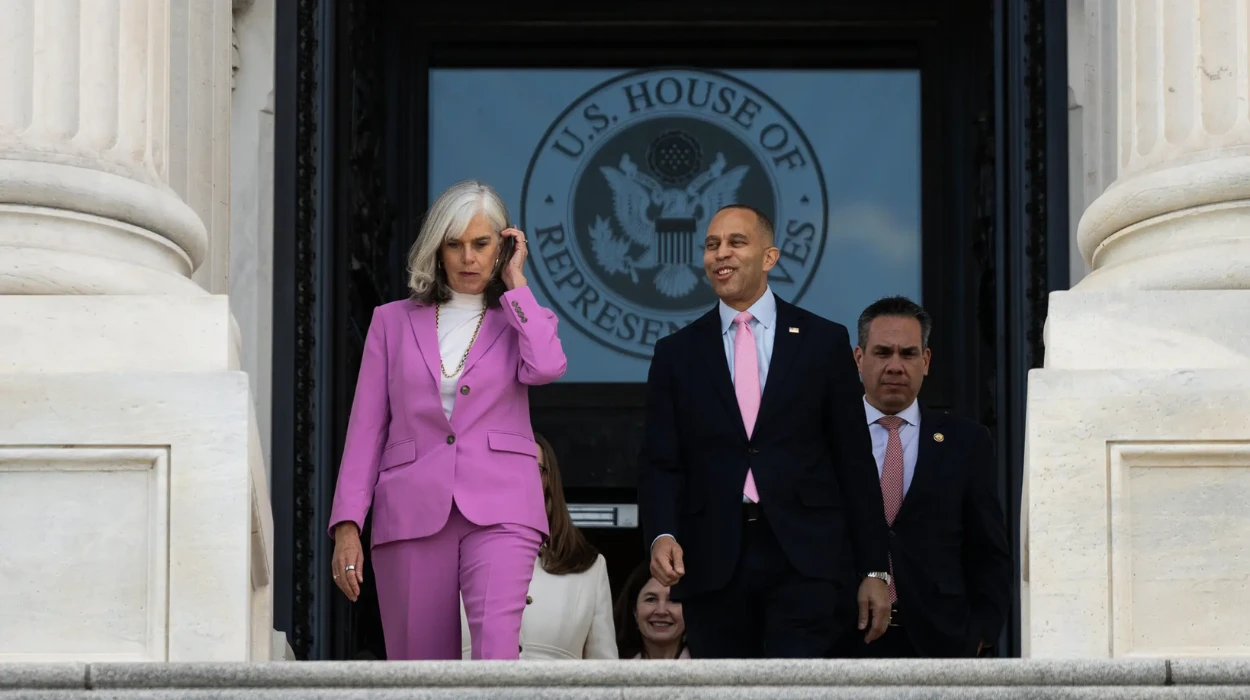
The decision by AIPAC to quietly shut down its online fundraising portal for a group of House Democrats marks a sharp escalation in the struggle over U.S. policy toward Israel inside the Democratic Party. The move targets members whom AIPAC had previously endorsed and helped finance, but who recently backed an amendment that would have ended American aid to Israel, including roughly 3.3 billion dollars in annual assistance. It is not just a technical adjustment to a website. It is a deliberate act of political discipline that turns the group’s donor infrastructure into a weapon against dissenting Democrats.
In practical terms, these politicians awoke to find that while their name, picture, and “pro-Israel” labels were still prominently displayed on AIPAC’s candidates’ page, the big buttons which enabled them to receive contributions for their campaigns had been conspicuously removed. For those politicians who had previously benefited from millions of dollars worth of bundled contributions and other support from AIPAC in previous election cycles, such a change is a hard hit to take. For the rest of the caucus, it sends a message that crossing AIPAC on issues such as unconditional aid to Israel will carry real costs.
The Amendment That Triggered AIPAC’s Response
The Massie Amendment and Its Numbers
The battle took place when a Republican Representative of Kentucky, Thomas Massie, introduced an amendment to a State Department and Foreign Operations Appropriations bill that sought the removal of all U.S. aid to Israel from that bill. This would amount to the cancellation of about 3.3 billion dollars in aid which has long been the backbone of American policy in support of Israeli security and military capabilities. In the House, 104 lawmakers supported the amendment; 103 were Democrats while Massie himself, as the lone Republican, was the other supporter. About 314 House members rejected the amendment while 10 others voted “present”, meaning that they were neither in favor nor opposed. The level of support from Democrats – almost half of the whole caucus – was shocking.
For years now, the United States’ aid to Israel has been a matter of stable and automatic bipartisan agreement. All of a sudden, there emerged over a hundred Democrats willing to take the step toward ending it because of the conflict in Gaza and the human rights abuses of Palestinians.
Within that 103‑member group were 18 Democrats who had been formally endorsed by AIPAC, 15 of whom were actively featured on the group’s fundraising portal with live donation links. The amendment’s failure did not blunt its political impact. Instead, it became the trigger for AIPAC’s rapid and targeted retaliation.
Who Was Targeted and How the Portal Changed
Fifteen Endorsed Democrats Lose the Donate Button
The core of the story is not that AIPAC criticized the vote; it is that the organization turned off money flows. Among those affected were a mix of rank‑and‑file members and high‑profile figures, including House Minority Whip Katherine Clark of Massachusetts. Other names reported as losing their donation links include Jake Auchincloss and Richard Neal of Massachusetts, Joe Neguse and Brittany Pettersen of Colorado, Pat Ryan of New York, Bill Keating of Massachusetts, Seth Magaziner and Gabe Amo of Rhode Island, Glenn Ivey of Maryland, Steven Horsford of Nevada, Josh Harder and Laura Friedman of California, Maggie Goodlander of New Hampshire, and several others from competitive and solidly blue districts.
Prior to the vote on the amendment, individuals supporting AIPAC’s “pro-Israel” candidates could visit its website where the following Democrats would be found along with positive language regarding their stances on the U.S.–Israel relations and, importantly, an opportunity to make contributions to their campaign funds. Following the vote, the basic information about the legislators in question stayed up – there was no purge of the images and names associated with them – but the donation links were disabled. This is the key difference when it comes to the policy followed by AIPAC as two Democrats who abstained from voting for the measure, Shontel Brown and Sarah Elfreth, still have their donation links enabled. It seems that AIPAC draws a clear boundary between the affirmative “yes” to cutting aid and a more cautious stance taken by some Democrats.
AIPAC’s Message: Support Israel or Lose Support
Pro‑Israel Branding Versus Vote‑Based Sanctions
In its public discourse, AIPAC has always maintained that it backs candidates “of any party” that “stand with Israel” and advocate substantial U.S. support to Israel. Within the corridors of power, the power of the group lies in its proven ability to raise money, fund allied PACs, and fund opponents of incumbent politicians in primaries that do not demonstrate enough commitment to their cause. By closing the funding pipeline for certain endorsed Democrats, who have supported the Massie amendment, AIPAC is making an implicit statement about the votes in favor of U.S. assistance becoming a litmus test. The signal sent by the group is clear. One can still describe the politician on its website as “pro-Israel” according to previous comments and votes, but will be closed access to the fundraising system if that politician does not back U.S. support for Israel.
In coverage of the episode, the move has been framed as a direct financial punishment. One widely cited description captures the intent in stark terms:
“AIPAC, the powerful pro‑Israel lobbying group, appeared on Friday to have cut off contributions on its political web portal to House Democrats who voted this week to end U.S. aid to Israel, punishing them financially for a stance it strongly opposed,”
a line that underscores the organization’s readiness to translate policy disagreement into monetary consequences. The quote situates AIPAC not simply as an advocacy group but as an enforcer of a particular foreign‑policy orthodoxy inside the Democratic Party.
Democratic Fissures Over Israel and Gaza
A Historic Vote and a Changing Party Base
The core vote provides a very unusual quantitative indicator of how much the landscape has changed for the party’s foreign policy elites. The vote of 103 Democrats in favor of an amendment to cut off military aid to Israel is, on its own, remarkable. In the past, even those Democrats who were frustrated about settlement expansion or the Netanyahu government’s treatment of Palestinians would never dare to go that far. In this case, however, facing constant images of destruction in Gaza as well as growing international complaints about human rights violations, a significant number of people made the decision to cross that red line.
Progressives and their supporters see the vote as a breakthrough, asserting that it marks a new direction in the views of the party’s voters. To them, the move is simply the result of being outraged by Israeli violence against civilians, breaches of international humanitarian law, and the way Israeli soldiers have acted with impunity. From this point of view, the rejection of the amendment is not what is important – what is significant is the fact that the number of Democrats feeling responsible for their progressive base has increased.
On the other side of the internal divide, many centrist and leadership‑aligned Democrats opposed the amendment, invoking both U.S. strategic interests and Israel’s security concerns. They argue that cutting aid altogether would dangerously weaken a long‑time ally, embolden hostile actors, and erode American leverage in the region. In that camp, conditioning aid or using it as a punitive tool is seen as destabilizing rather than constructive. AIPAC’s move aligns squarely with this latter view, reinforcing the idea that support for full funding is not merely advisable but mandatory.
The Role of Campaign Finance in Enforcing Foreign Policy
AIPAC’s Donor Network as a Disciplinary Tool
Beyond the individual names, the episode is a case study in how interest groups wield campaign finance structures to discipline members of Congress. Over recent cycles, AIPAC and its affiliated network have steered substantial sums to favored candidates, both directly and via bundled contributions. Estimates suggest that the Democrats who supported the amendment have collectively attracted around 11 million dollars in AIPAC‑linked support over time, an investment that has helped fortify them in primaries and general elections.
In terms of its ability to regain some of that leverage, the abrupt closure of the door to the portals is invaluable. While AIPAC cannot recoup any money that has already been donated in the past, it is certainly possible to restrict future donations significantly. Swing districts, where budgets for elections campaigns are very well aligned with the costs of running an ad campaign, mobilizing voters and making contact with potential voters, will have to change something – either find other sources of funding, engage with new advocacy organizations or change their message in order to attract donors.
For the entire caucus, the message is unambiguous. A legislator considering a vote in accordance with the Massie Amendment must take into account not only their personal moral and strategic convictions, but also the threat of being financially penalized immediately after that. It is particularly true for Democrats representing competitive districts, where funding mechanisms are highly national and vulnerable to changes.
Leadership, Symbolism, and the Cost of Dissent
Katherine Clark and the Reach of AIPAC’s Warning
The inclusion of figures like House Minority Whip Katherine Clark among those losing donation links adds a layer of symbolism to the story. Leadership positions typically enjoy special status with major interest groups, both because they control agenda‑setting power and because punishing them can carry reputational risk. AIPAC’s willingness to treat a senior Democrat in the same manner as back‑bench members suggests an intention to apply the rule uniformly: on aid votes, rank does not confer immunity.
That message extends to other endorsed Democrats not seeking re‑election but still influential in party politics. Former Speaker Nancy Pelosi, as well as Julia Brownley and Julie Johnson, backed the amendment despite having previously received positive praise on AIPAC’s site for their support of Israel. In the wake of their votes, that laudatory text was reportedly removed, even though donation buttons were never in place for these figures. The adjustment is largely symbolic, but it reflects a consistent pattern: the organization is retroactively reshaping its own narrative about which Democrats exemplify “pro‑Israel” leadership.
Strategic and Electoral Implications Going Forward
Chilling Effect or Catalyst for Realignment?
It is difficult to say what the long-term effects will be of AIPAC’s decision, but there are several possibilities. First, it could chill the issue; Democrats, especially those in marginal seats, might decide that taking a vote to reduce or restrict the aid money is simply too risky, and they will back off in the next discussion. This would mean that the Massie amendment would be a one-off event, with the punishment having the desired effect of deterrence. It could also accelerate an existing trend; legislators who have already taken the plunge may now try to build relations with other groups who can give money and who take a more critical view of Israel.
In time, this might result in AIPAC losing its role as the gatekeeper for pro-Israel policies within the party, and in a widening of the range of acceptable positions. The 103 “yes” votes are a critical mass – this is no small splinter group, but a significant bloc which may refuse to back down.
For campaign‑season coverage, this conflict is likely to resurface in primaries and in general election messaging. Challengers backed by AIPAC or affiliated groups may argue that incumbents who voted to end aid endangered Israel’s security and harmed U.S. interests. Incumbents, by contrast, may stress civilian protection, international law, and accountability as core themes, framing their vote as a necessary break with “blank‑check” policies. The absence or presence of AIPAC’s fundraising links will quietly reflect which narrative the organization is prepared to underwrite financially.
A New Line in the Sand on U.S.–Israel Policy
The removal of donation buttons from AIPAC’s portal might appear, at first glance, to be a minor digital change. In reality, it represents a visible line in the sand drawn by one of the most influential foreign‑policy lobbies in Washington. By targeting Democrats it had previously endorsed — including members of leadership and long‑time allies — AIPAC has clarified that support for continued, substantial aid to Israel is no longer just a preference, but a non‑negotiable condition for enjoying its backing.
For the Democratic Party, the episode crystallizes an internal struggle that has been building for years. The Gaza war, evolving voter attitudes, and the rise of a more assertive progressive wing have pushed Israel policy from a quiet consensus issue into a front‑line ideological battleground. In that context, the decision by over a hundred Democrats to vote against aid, and the swift financial retaliation that followed, form two halves of the same story: one about changing convictions, and one about the power structures determined to hold them in check.