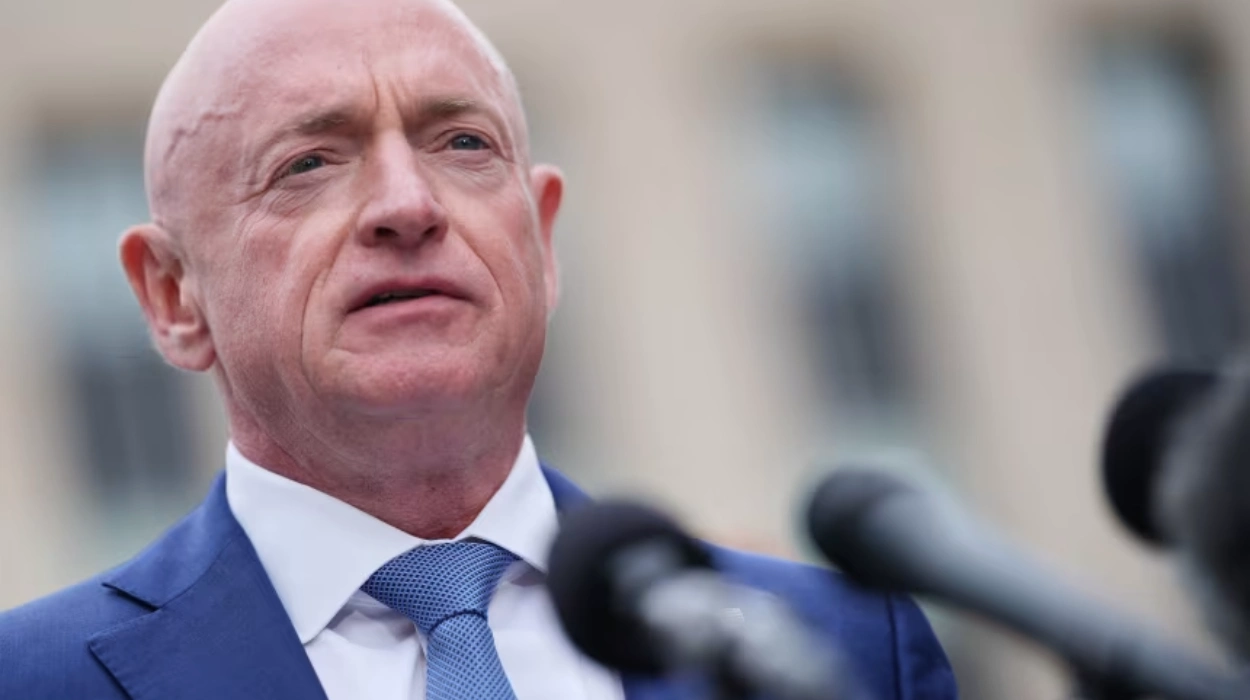
Pete Hegseth, Defense Secretary, has roused further controversy as he demands another Pentagon investigation of Senator Mark Kelly, but this time because of his dire statements regarding the depletion of America’s weapons cache. This call came on Sunday, May 10, 2026, in another attempt to stir up trouble for the retired naval officer who is now serving as a U.S. senator.
Kelly, who sits on the Armed Services and Intelligence committees of the Senate, had recently been seen on CBS’s “Face the Nation,” where he described the state of America’s ammunition stockpile after his classified briefing in a very negative light. The quick reaction from Hegseth suggests that the statements made by Kelly could possibly be construed as irresponsible leaks of classified information.
The most recent feud is only the latest in a string of disputes that started at the end of last year. Hegseth, an old hand at Fox News and a die-hard supporter of Trump who was recently confirmed to be Defense Secretary in 2025, has put himself out there as a defender of military order amidst all of the ongoing discourse about preparedness in the United States. Kelly, a decorated Navy aviator and astronaut, has not hesitated to criticize the government’s policies.
“Captain” Mark Kelly strikes again.
— Pete Hegseth (@PeteHegseth) May 10, 2026
Now he’s blabbing on TV (falsely & dumbly) about a *CLASSIFIED* Pentagon briefing he received.
Did he violate his oath…again? @DeptofWar legal counsel will review. https://t.co/mPBZHxZqpr
His comments on Sunday zeroed in on critical munitions like Tomahawks, ATACMS missiles, and Patriot interceptor rounds, which he described as
“shocking how deep we have gone into these magazines.”
Kelly emphasized,
“We’ve expended a lot of munitions. And that means the American people are less safe,”
linking the depletion to broader risks in potential flashpoints such as a conflict with China.
Roots of the Current Firestorm
The impetus for Hegseth’s request for an inquiry stemmed from the television interview conducted with Kelly, during which the senator made his case based on Pentagon briefings regarding what he believes is an area of vulnerability that has been highlighted by recent spending on military operations. The arsenal, according to Kelly, had been “hit hard,” something that has also been used to criticize the tactics employed by President Trump concerning Iran and other trouble spots. In his comments, Kelly made it clear that resupplying the arsenal would require “years,” reflecting ongoing concerns among Pentagon officials about their industrial base capabilities.
The reaction of Defense Secretary Hegseth to Kelly’s remarks came quickly and sharply. According to comments made by the official and picked up widely in media reports, the Defense Secretary harshly criticized Kelly’s handling of possible sensitive information, considering Kelly’s position as a retired military officer under the jurisdiction of the Pentagon.
This is more than a personal attack on Kelly because, as Secretary Hegseth has indicated, he ordered the Pentagon to conduct an investigation regarding the issue because of the need to protect classified information procedures. It reflects a general government policy that prominent officials who hold security clearances need to walk carefully in such circumstances.
Echoes of the First Investigation
This is far from the first time that Hegseth has investigated Kelly, which adds weight to the claims of politically motivated attacks coming from Democrats. The first investigation was launched last November, when Hegseth demanded that the Navy investigate the connection between Kelly and an incendiary video shot by Kelly and other Democratic lawmakers. During that video, the participants were calling for active military personnel to disobey what they termed as “illegal orders.”
The review quickly escalated into a full “command investigation” by mid-December 2025, placing Kelly’s retirement rank and pension at risk under federal statutes that allow the recall and discipline of retirees.
Kelly did not hold back but sued the Pentagon in January 2026 regarding the alleged retaliatory threats that were meant to silence him. Documentation in this case made reference to Hegseth’s letter, where Kelly was mentioned along with the other participants of the video and threatened with serious repercussions. In this case, the senator was supposed to respond within 30 days, a period that stretched until the beginning of 2026 because of the legal disputes. Although it is still unclear what came out of the lawsuit, it created a precedent of direct challenge on the part of Kelly.
But now, with the help of the second probe, there is something coming through which is very predictable for those who have been studying Washington bickering for years. According to Hegseth’s office, the first investigation is labeled as “escalating,” just like what Pentagon spokespersons would use to indicate increased scrutiny. However, according to Kelly and others, the senator’s remarks regarding the arsenal were not classified.
In a Senate hearing, Hegseth had conceded that restoring some stockpiles would indeed require “years,” a concession Kelly leveraged to argue,
“the war is coming at a serious cost.”
This overlap fuels Democratic claims that Hegseth is less concerned with security breaches than with muting congressional oversight.
Key Figures and Potential Fallout
The story features two individuals with backgrounds that are poles apart yet interrelated. Pete Hegseth, aged 45, graduated from serving in the Army National Guard in Iraq and Afghanistan before emerging as a notable conservative media personality. Hegseth’s appointment as Secretary of Defense in early 2025 is considered by Trump loyalists as an end to the “woke” Pentagon that they abhor, although he is criticized for not having enough experience as a high-ranking commander. Under Hegseth’s leadership, efforts have been made to improve procurement and lethality, among others, while dealing with China, despite ammunition shortages resulting from support to Ukraine and Israel.
The Senator’s credentials cannot be questioned: over 50 combat operations in the Gulf War, command of the Space Shuttle Endeavour, and NASA’s first Jewish astronaut. He was elected in 2020, and re-elected in 2022, chairing crucial sub-committees for emerging threats and space policy. As someone who chairs two committees of the kind, Mark Kelly receives regular briefings, which lends credibility to his arguments. However, being a retired military officer, he is still bound by the Uniform Code of Military Justice. Therefore, a probe into him could lead to him being demoted or even stripped of his pension; yet, such an outcome is unprecedented for a sitting senator.
The munitions at stake are no abstractions. Tomahawk cruise missiles, ATACMS long-range systems, and Patriot air-defense rounds form the backbone of U.S. power projection. Pentagon estimates, echoed in unclassified reports, indicate drawdowns from sustained operations and ally support. Kelly’s “shocking” depiction aligns with broader analyses: a 2025 Congressional Research Service report warned of multi-year replenishment timelines, while Hegseth himself has publicly advocated for $50 billion in new production funding.
| Munition Type | Role | Reported Depletion Concern |
| Tomahawks | Long-range strike | Deep magazine drawdown; years to rebuild |
| ATACMS | Tactical ballistic missile | Heavy use in regional conflicts |
| Patriot Rounds | Air defense interceptors | Stockpiles strained by ally aid |
This table illustrates the stakes, where delays could imperil deterrence against peer competitors like China or Russia.
Stances and Broader Implications
Kelly’s defenders frame his comments as a clarion call for accountability, not indiscretion.
“These are facts from briefings anyone on the committees has seen,”
allies quote him saying, positioning the senator as a whistleblower on readiness gaps. Democrats have rallied, with Senate Leader Chuck Schumer decrying Hegseth’s moves as “authoritarian overreach” aimed at cowing oversight. Republicans, meanwhile, back Hegseth’s vigilance, arguing that Kelly’s platform amplifies risks in an era of information warfare.
Hegseth’s stance is resolute: retirees like Kelly must not “bash” or disclose details that could aid enemies, as he put it in response to Kelly’s prior video. This second probe, ordered directly to Pentagon investigators, could span weeks or months, mirroring the first’s trajectory. Legal experts note that while Kelly’s active-duty status ended decades ago, recall authority under 10 U.S.C. § 688 remains a potent tool—though invoking it against a senator risks constitutional clashes over separation of powers.
The feud’s ripple effects extend to Capitol Hill dynamics. With Trump back in the White House since January 2025, Hegseth’s aggressiveness signals a Pentagon less deferential to congressional Democrats. Budget battles loom for fiscal 2027, where munitions funding will be central. Kelly’s plight could galvanize opposition, potentially stalling nominees or probes into administration lapses.
A Feud That Defines an Era
In the end, the Hegseth-Kelly imbroglio epitomizes the divisive national security discussion of 2026. In one corner, a Defense Secretary exercising his investigatory powers to instill discipline; on the other, a distinguished military veteran senator relying on his duties to reveal the weaknesses in the country’s defenses. As the investigation into the Pentagon by the second panel is set in motion, it puts the freedom of speech of those who are cleared under scrutiny, the involvement of the Pentagon in American political affairs, and readiness of the U.S. for a new breed of war, which might prove more costly than previously thought, according to Senator Kelly.