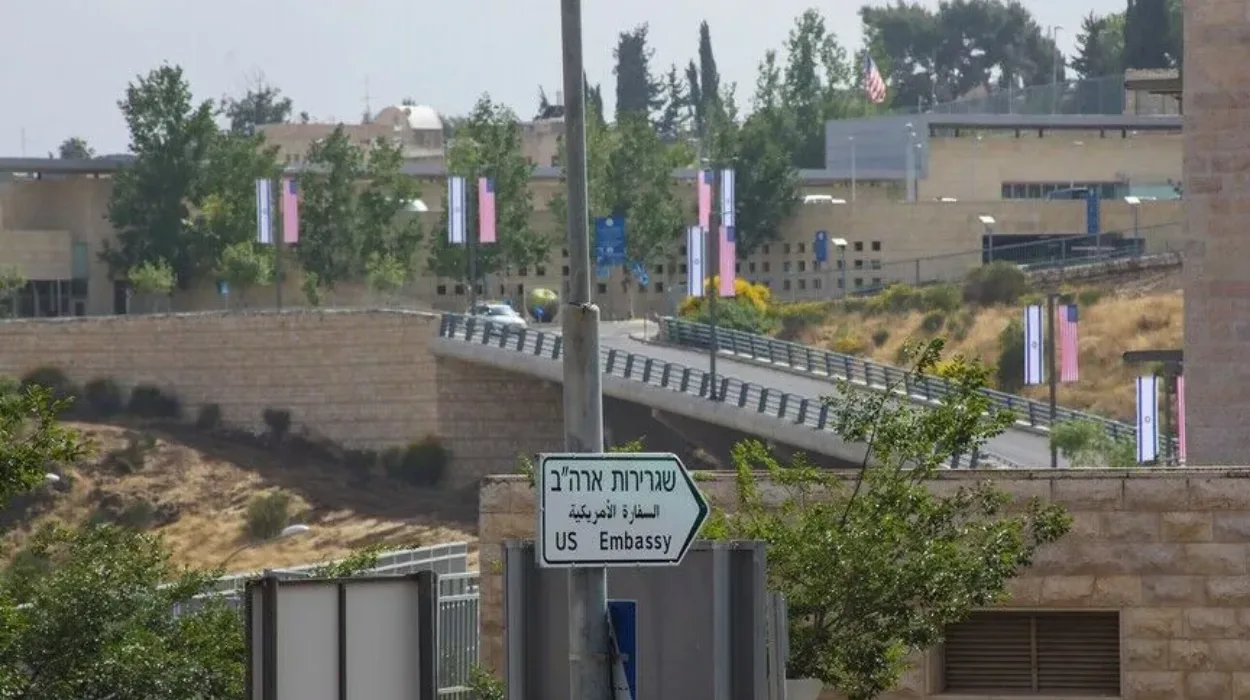
A new diplomatic arrangement between Israel and the United States has drawn sharp criticism because it places a future U.S. embassy complex on land described by rights groups and reporting as confiscated Palestinian property, leased for only $1 over 99 years. The deal is being framed by critics not as a routine land transfer, but as a political act that deepens the long-standing dispossession of Palestinians and strengthens Israel’s control over occupied Jerusalem.
It’s not just about the symbolic cost either. It’s about the legal and ethical implications of building a diplomatic mission on disputed territory that was reportedly appropriated from Palestinian families in a city that is one of the main unsettled questions in the Israeli-Palestinian dispute. For opponents, such a development legitimizes appropriation, pays off occupation, and converts an unsettled historical wrong into a diplomatic good.
Why the deal is controversial
The piece of land in question was once in the possession of Palestinians who had it confiscated from them by the Israelis. It has now been leased to the US embassy as part of the construction of their permanent embassy for a period of 99 years and for a fee of $1. This is an issue that has created uproar since, in essence, it seems like it will be legalizing a move based on confiscated land. As per the allegations, if the land was confiscated then leasing the same piece of land for embassy construction does not make the earlier move right. Instead, it makes it worse.
Jerusalem and occupation
Jerusalem is not a dispassionate real estate market. This is a city that is embroiled in international legal disputes, occupation, and sovereignty issues. The eastern portion of this city has been recognized internationally as occupied Palestinian territory. The importance of this lies in the fact that a country does not obtain the full rights of property over territory it conquers through force. This is the reason why Israel has been described by its critics as an occupation state in this case. According to its critics, Israeli control of the Palestinian territories in Jerusalem is not an act of transferring sovereignty; rather, it is the outcome of occupation and settlement expansion in the area.
UN law and legal concerns
The deal raises serious questions under the UN framework and international humanitarian law. The UN Charter prohibits the acquisition of territory by force, and this principle is central to the post-1945 international order. If land is taken during conflict or occupation, its transfer cannot be treated like ordinary state property.
There are also restrictions imposed on the powers of the occupying force with regards to appropriation of private property under the Fourth Geneva Convention. The international laws regarding property rights ensure that private property located in an occupied territory shall remain protected, and any such appropriation as done here goes against the principles of international law. The Hague Regulations are also very strict when it comes to ensuring respect of the private property rights and that the property cannot be appropriated arbitrarily. Hence, what is being questioned here is not only whether or not the lease has been executed correctly, but rather if this piece of property itself can be used in such a manner at all.
Washington’s role
America is not just a bystander in all of this. Through the tacit acceptance of using land that has been accused of being expropriated from Palestinians, America is perceived as adding credibility to the occupation regime that it has always denounced. Thus, the whole process of relocating the embassy becomes more of a geopolitical message than simple planning. For some people, this is America letting Israel know that there are no consequences for occupying the Palestinian lands of Jerusalem. This carries huge symbolism. Instead of demanding accountability, America is strengthening its strategic alliance with Israel through occupying contested lands. This is why $1 is significant.
Israeli justification and response
The Israelis perceive this agreement as an indication of their close relationship with America. The Israelis have expressed themselves in such a manner that they sound confident of the victory rather than wary or apprehensive about the legality of the act. According to one reported statement, it was a manifestation of the “unbreakable alliance” between the two countries. However, it is this celebration of the event that forms the essence of opposition from the critics. The opposition says that friendship cannot be above law and no amount of stolen land can make up for the disregard for Palestinians’ rights.
Palestinian rights and historical dispossession
The central figures of the narrative are Palestinian families who owned their land before 1948 and then had it confiscated. Such a background is important because it demonstrates how the land on which the embassy will be constructed is not just “vacant land.” In other words, the plot is more complex than what the official rhetoric suggests. From the Palestinian perspective, such stories are not an exception but rather the rule. In fact, such narratives demonstrate the pattern through which land is stripped of its Palestinian ownership and ownership and used for the purposes of the state and then is introduced internationally as legitimate city development or the land of the state.
Political symbolism of $1
The nominal price of $1 is not a minor detail. It is a political symbol. In ordinary legal and commercial terms, land worth diplomatic significance would never be transferred for such an amount unless the real purpose were not financial but political. That is why critics see the price as proof that the arrangement is not about fairness, compensation, or market logic.
The one-dollar lease effectively signals that the U.S. is not paying for land in the conventional sense. It is accepting a political gift—or, from the critical perspective, accepting the benefits of confiscation at a token cost. That symbolism deepens the argument that the arrangement is both morally troubling and legally suspect.
Broader international message
The agreement is sending out a wider signal from Jerusalem. If seized land is turned into an American embassy, then other countries will think that occupation gives diplomatic ground. This will weaken the idea that land gained by force is not something that should be rewarded. Also, the message will send out a negative one about international law. If big countries are able to blur the lines between legal property and occupied land, then international law becomes selective. Weak countries and the people living under occupation have to accept the law while strong powers are able to change it using politics.
What critics are really saying
The criticism is not merely that the deal is controversial. It is that the deal is structurally unjust. It involves an occupying power’s control over Palestinian land, the use of that land by a foreign government, and the apparent disregard of international legal protections that are supposed to guard against exactly this kind of outcome.
Critics also argue that the U.S. is compromising its own claims to neutrality. By building on land alleged to be confiscated from Palestinians, Washington appears to side with the occupying power rather than with law, history, or human rights. That choice weakens American credibility in any future role as mediator.
The acquisition of this embassy land must be seen as a political and legal dispute rather than a standard administrative transaction. The claim that the transaction was conducted in the form of a 99-year lease at one dollar, on land said to have been illegally appropriated from Palestinian territory, effectively embeds the United States in an even larger framework of occupation, dispossession, and competing claims to sovereign authority. For this reason, this transaction is rightly condemned as illegal, unfair, and highly symbolic of how power prevails over principle. The international order means nothing if the UN Charter, the Geneva Convention, and the general principle of prohibiting acquisition of land by force are optional.