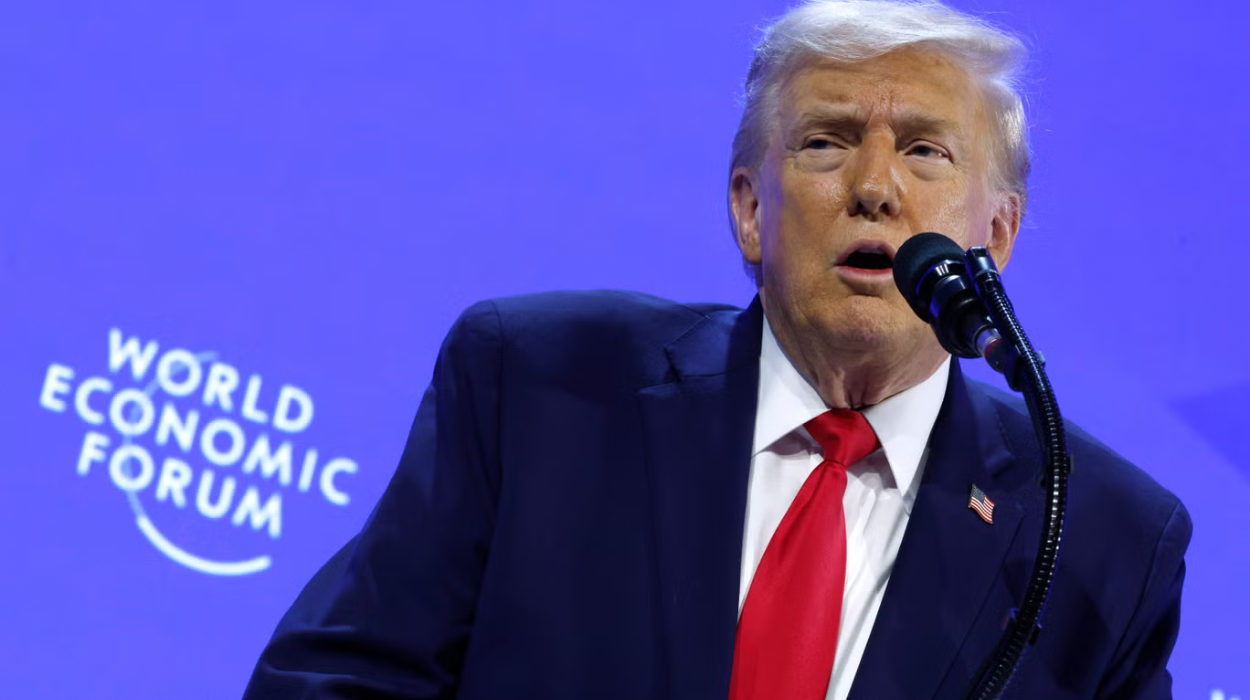
In the speech he made at Davos during the World Economic Forum held in January this year, Trump seemed to compare Greenland and Iceland, which are two very different places. At one point, he claimed that European nations “are not there for us on Iceland,” which shows he mixed up two very different places during a controversy regarding Greenland.
Further, it is worth noting that while Greenland is a semi-autonomy territory of Denmark with a population of around 56,000 inhabitants and significant mineral value to the Arctic region of the world, Iceland has a population of around 390,000 inhabitants and is an independent nation allied with NATO. Such misstatement evoked complaints from European leaders who emphasized that “Greenland belongs to its people.”
Trump’s Greenland Ambitions and Arctic Geopolitics
Mr. Trump has long advocated the acquisition of Greenland by the US, even before his return to the White House. He stated the acquisition was a matter of national security in the wake of increased activity by both Russia and China in the region. The region is a prime geopolitical flashpoint due to the opening up of shipping routes by the ice cap and the presence of strategic minerals such as rare earth minerals, cobalt, and nickel used in defense technology and renewable energy.
According to the US Geological Survey, the region hosts an estimated 13 percent of the world’s undiscovered oil reserves and 30 percent of the world’s undiscovered natural gas. China considers itself a “near-Arctic state” and has built up its infrastructure; Russia has expanded its military bases and icebreaker fleet. Against the backdrop of such strategic tensions, Trump’s comments may be seen as part of a larger US national concern about the region – with his apparent geographical errors fostering an air of uncertainty.
White House Denial and Political Damage Control
White House Press Secretary Karoline Leavitt denied the accusation that the former President had inaccurately called Greenland by the incorrect name of Iceland. His false attribution of the two locations does not seem to have been admitted by the administration. It makes one wonder if his foreign policy is guided by purely political considerations.
Iceland Turns to Washington Lobbyists
According to a report from The Bulwark, Iceland’s ambassador to the United States, Svanhildur Hólm Valsdóttir, has hired the lobbying firm Brownstein Hyatt Farber Schreck to represent them in matters of engagement with the US government. The US Department of Justice filing disclosed this as a contracting agreement for six months at a rate of $150,000 for a monthly retainer of $25,000.
The firm is expected to bring Icelandic officials into contact with U.S. policymakers and to help policymakers navigate what emerging policies may look like, reflecting a sense of concern that U.S. rhetoric may eventually have unforeseen consequences.
Timing Raises Concerns Over US Intentions
Although there is nothing in the filing that explicitly connects the lobbying effort with Trump’s Davos speech, the timing is suspicious. The agreement was finalized just days after Trump’s speech, as well as remarks by Trump’s ambassador nominee to Iceland, Billy Long, in which the representative joked that Iceland could be the “52nd state.”
Long later explained the remark, saying it had been intended as a joke; however, from an analytical standpoint, such comments contribute to an environment of ambiguity for the small countries of the Arctic, who are already apprehensive about the great power rivalry in the region.
Arctic Anxiety Among Smaller States
For the case of Iceland and the rest of the Nordic countries, the US rhetoric on the issue of territorial gain, particularly in the context of military rivalry, is not merely empty rhetoric because of the strategic position of the island regarding NATO infrastructure, as well as its position, which can define the GIUK gap, an important naval chokepoint between Greenland, Iceland, and the UK.
Suggestions of territorial ambition or geopolitical confusion will unsettle alliances and erode trust between NATO partners, who are now considered to be at their most cohesive and necessary in resisting Russian and Chinese gains.