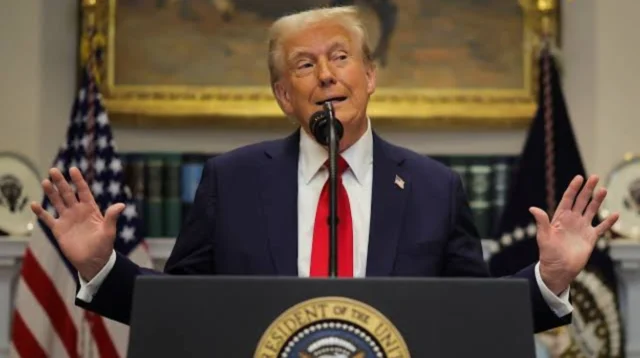
In a remarkable turnabout that has left both Washington and Silicon Valley stunned, President Donald Trump has suddenly withdrawn a historic executive order governing the regulation of artificial intelligence just hours prior to his planned signing of the order, set for Thursday, May 21, 2026. The sudden change of heart came following the urging of industry insiders and the president’s own advisor for matters relating to artificial intelligence, David Sacks. It is perhaps a testament to the raging controversy surrounding the regulation of artificial intelligence that an executive order of such importance has been pulled at the last possible minute.
This executive order would have been intended to create a voluntary review system for state-of-the-art AI models, with an expectation that businesses would inform the government 14 days prior to releasing advanced AI technologies. But this plan received intense criticism from some of the most influential tech CEOs in the world, who maintained that any form of regulatory oversight, voluntary or otherwise, would undermine America’s competitive advantage against China in the highly competitive race of developing advanced AI systems. The executive order had reportedly been “derailed” just as it neared its final implementation phase due to a surprise call placed to Trump by his AI czar David Sacks.
Maxime Fournes, AI safety advocate and CEO of PauseAI in tweet said:
“An executive order that would have required pre-release review of frontier AI models was just killed by last-minute industry lobbying. Musk, Zuckerberg and Sacks lobbied Trump directly and the EO was pulled within hours. A new win for AI labs, a new loss for every human on this planet.”
An executive order that would have required pre-release review of frontier AI models was just killed by last-minute industry lobbying.
— Maxime Fournes⏸️ (@FournesMaxime) May 22, 2026
Musk, Zuckerberg and Sacks lobbied Trump directly and the EO was pulled within hours.
A new win for AI labs, a new loss for every human on this… pic.twitter.com/CztxNEnvSj
The Key Players Behind the Decision
The opposition to the AI order did not come from just one individual’s phone call. According to reports, both Elon Musk, who co-founded xAI and Tesla, and Mark Zuckerberg, CEO of Meta Platforms Inc., threatened to undermine American technological supremacy by personally lobbying President Donald Trump to cancel the order. They were able to do so through a reported negotiation between the two parties, with the former being made up of the top people from Silicon Valley. This is an indication that today’s tech leaders have access to the inner chambers of power like never before.
According to sources, David Sacks, an ex-PayPal executive named White House AI and crypto czar by President Donald Trump, was perhaps the most influential figure in the failure of that proposed executive order. When Sacks called the president early in the morning for discussion of the order, which he did without prior consultation with any other member of the administration, he was able to stop the order from ever becoming law. This shows just how much influence some advisers have in the decision-making processes of the US government, especially when dealing with matters involving technology.
What the Abandoned Order Would Have Required
The executive order that never made its way into action would have set up a structure for voluntarily reviewing AI models. Companies creating frontier AI technologies would be required to submit any information regarding safety issues to the federal government before releasing their product to the public. The two-week advance warning that the companies were given was much shorter than the three-month period originally suggested by the administration. This would be a compromise between the need for safety on one side and the desire for speed on the other.
The proponents of the directive from the industries claimed that this would help retain America’s superiority in AI technology as well as maintain minimum safety requirements. On the other hand, the critics who were in the Silicon Valley suggested that even this minimal regulation would cause delays and would provide chances to competitors such as China to outpace American technological supremacy. As for the compulsory aspect of the directive, corporations had a choice to avoid implementing the directive, which, however, could have led to further penalties.
Silicon Valley’s Unified Front Against Regulation
The opposition to the AI order from Trump showed a highly unusual level of unity by the most influential members of the Silicon Valley community. These companies included OpenAI, Google, Anthropic, Meta, Microsoft, and xAI, all of which agreed not to have the oversight process even though they might compete with each other in the same field. This level of unity was based on the understanding that, whatever measures were taken, they could help rivals become more competitive internationally. The effort to change Trump’s stance on this matter took many months of campaigning.
The industry’s argument leaned largely on the use of security concerns, with the regulation of artificial intelligence presented as an issue that threatened U.S. competitiveness vis-a-vis China and not as a safety concern. This approach was particularly appealing to Trump, whose presidency has been characterized by a heavy emphasis on competing with China economically, over any other issue. As such, by arguing for American superiority over safety concerns, the tech CEOs were able to shift the discussion towards an argument that the President cared about much more.
Trump’s Shifting Stance on AI Governance
The move away from the order by President Trump marks a departure from the policies he has pursued regarding AI regulation since coming into power. As soon as he came into office in January 2025, Trump had revoked Biden’s order on AI safety and replaced it with an approach aimed at lifting “red tape” off the tech industry. The president’s AI policy set out in July 2025 promised that no obstacles will be placed in the path of tech firms. The May 2026 order is therefore a marked departure from the president’s stance.
This example is an illustration of Trump’s ability to switch gears rapidly if presented with arguments that resonate with him.
“I pulled the order at the last minute so as not to interfere with America’s competitive advantage in the artificial intelligence field”
is a comment made by the president to reporters, and it is clear how easily he switched to using arguments about national security and competitiveness rather than sticking to his earlier position on AI regulation.
Industry Statements and Reactions
The tech industry’s response to the cancellation was immediate and celebratory. Elon Musk took to X (formerly Twitter) to praise the decision, though specific statements from his account were not publicly detailed in immediate coverage. Mark Zuckerberg reportedly expressed relief that the order was scrapped, with sources indicating he had personally lobbied Trump extensively on the issue. The unified industry position became clear through coordinated messaging emphasizing innovation and competitiveness over safety concerns.
White House AI and crypto czar David Sacks did not issue a public statement about his role in killing the order, but his actions spoke volumes. Jensen Huang, CEO of Nvidia, had earlier told Trump in an Oval Office meeting that state-level AI regulations
“posed a significant risk to technological advancement in the United States,”
setting the stage for the federal order’s rejection. Meanwhile, anonymous White House officials frustrated by Sacks’ unilateral action provided the only internal criticism, with one source stating
“He called POTUS this morning unbeknownst to anybody, his own staff included, and derailed it”.
Critics Sound Alarm Over Oligarchic Influence
The cancellation drew sharp criticism from AI safety advocates and researchers who had hoped the order would establish basic guardrails. The Future of Life Institute issued a scathing response, calling the decision
“a boon for Silicon Valley oligarchs leveraging influence to protect themselves from accountability”.
Critics argued that the episode demonstrated how wealthy tech executives can wield disproportionate influence over federal policy, effectively blocking even voluntary safety measures that would not meaningfully impede innovation.ft
The broader implications extend beyond AI policy to questions about democracy and corporate power. When a handful of technology CEOs can successfully lobby the president to abandon a policy initiative hours before its announcement, it raises fundamental questions about who actually governs in Washington. The episode suggests that Silicon Valley’s influence has reached a level where it can override even staff recommendations within the administration itself, operating through direct channels that bypass traditional policy-making processes.
What This Means for Future AI Regulation
By putting the brakes on the issuance of this AI order, the US government finds itself with no regulations on AI safety at all, despite the increasing worries regarding fast-paced development in this sector. State-level attempts to develop guidelines, especially those of California, are blocked by President Trump due to fears that such measures may deprive states with “onerous” AI regulations of the financial support from the government. This lack of regulation comes while everyone agrees that some regulation is needed.
The case also creates a precedent for future AI policy discussions. It is highly unlikely that there would be any meaningful government regulation if tech corporations were able to stop voluntary mechanisms of scrutiny at the eleventh hour. The recent executive order of December 2025 on the limits for AI regulation by states underlines the intention not to regulate that is likely to persist during the remainder of Trump’s presidency. Nonetheless, the contradictions are not resolved, given the continued rapid progress of technology.
The Broader Political Implications
This flashpoint represents something larger than a single policy dispute. It illuminates a dividing line within Republican politics about the appropriate relationship between government and tech companies, with some officials supporting oversight and others, like Sacks, aligned with Silicon Valley interests. The episode also demonstrates how individual advisors with direct presidential access can wield outsized influence over policy outcomes, potentially bypassing traditional governance structures and accountability mechanisms.
This reversal of President Trump’s AI executive order is clearly a major win for Silicon Valley’s efforts at deregulation, but there are still many important questions around what kind of governance should be implemented in an age when technology provides great opportunities, yet great threats as well. As AI becomes even more advanced and integrated into everyday life, the need for some type of governance will become increasingly pressing. How the U.S. manages to establish a proper regulatory approach will prove to be one of the most crucial policy issues of the modern era.