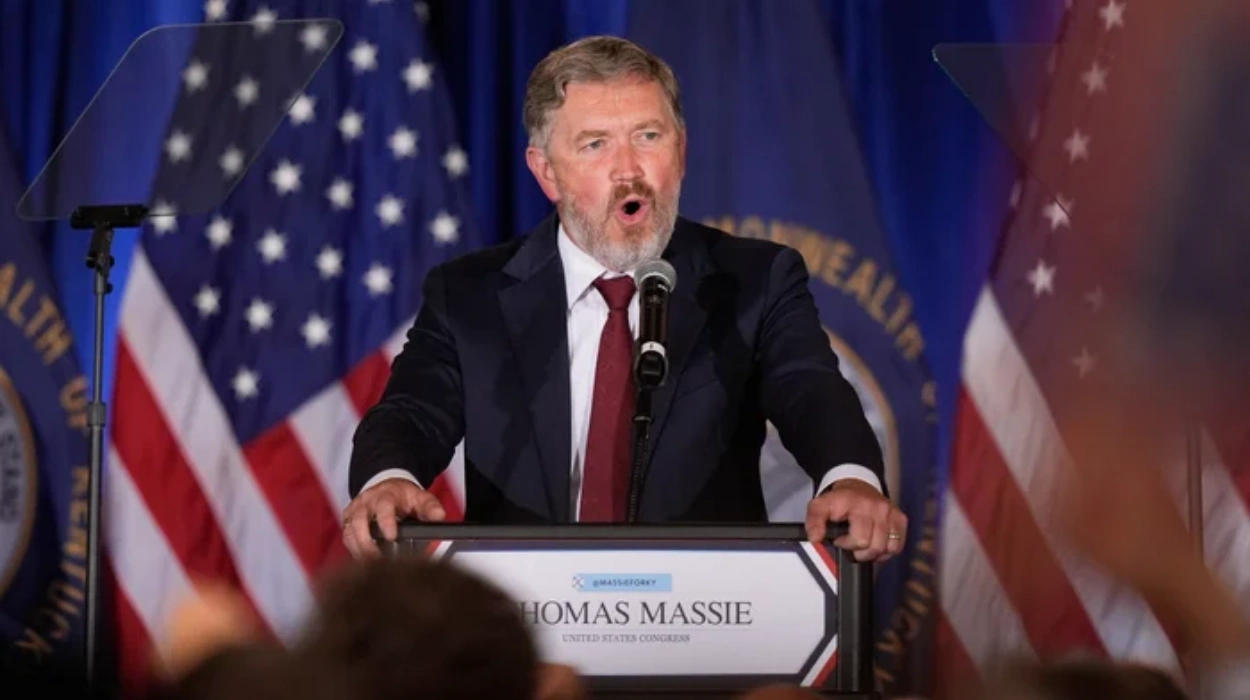
A political earthquake is shaking the Republican Party, with seven-term incumbent Representative Thomas Massie losing his seat in the Kentucky Republican House primary held on May 19, 2026. Ed Gallrein, a former Navy SEAL personally recruited and endorsed by President Donald Trump, emerged victorious. This primary election is not only an important result for a specific district but also serves as a clear indication of whether President Trump still holds sway over the Republican base.
The climate of the primary was characterized by unparalleled tension. Massie is a representative for Kentucky’s 4th Congressional District in Northern Kentucky, and he has never had to contend with a real challenge from within the primaries for the past eight years. This particular district has not voted for a Democrat in twenty years, meaning that Gallrein’s win in the Republican primary virtually ensured his election to Congress. What made the implications of this primary so significant were the very reasons why it happened.
Kevin Landrigan, journalist/reporter with NH Press Assn in a post on X said:
“Don’t tug on Superman’s cape. Again @POTUS takes revenge as AP confirms Kentucky Rep. Tom Massie loses GOP primary to Navy Seal Ed Gallrein. #nhpolitics.”
Don't tug on Superman's cape. Again @POTUS takes revenge as AP confirms Kentucky Rep. Tom Massie loses GOP primary to Navy Seal Ed Gallrein. #nhpolitics
— Kevin Landrigan (@KlandriganUL) May 20, 2026
The Candidate Suppose: Massie’s Libertarian-Conservative Uniqueness
In his political career in Washington, Thomas Massie made a distinctive place for himself by becoming known as a Republican who was always against the party on issues related to foreign policy and civil liberties. A mechanical engineer from MIT, Massie offered a unique point of view on matters of Congress that did not always sit well with the Democratic or Republican leaders. In fact, Massie’s voting history includes voting against censuring Rep. Ilhan Omar, voting against pro-Israel resolutions, and casting the sole vote in Congress in 2019 against recognizing Russia’s annexation of Crimea.
Above all else, however, Massie’s foreign policy views clashed on a basic level with those of the more aggressive approach taken by President Trump. In March of 2022, for example, Massie was among just three representatives to vote against supporting Ukraine’s sovereignty after Russia invaded. He did not support the “One Big Beautiful Bill Act,” nor did he support disaster relief funding, leaving him out of step with the rest of his own caucus. Massie also opposed the EPA and took positions that were closer to being anti-immigration even as he received criticism from pro-Israel organizations because he did not receive money from AIPAC.
The libertarian inclinations of the congressman towards civil liberties made matters even more difficult for him in relation to the party’s base. The congressman claimed that a motion against antisemitism was tantamount to censorship. This angered both the Jewish community and moderate Republicans. While the libertarian stance appealed to a minority within the party, it ultimately became his undoing in the primary.
Trump’s Direct Intervention: The Decisive Factor
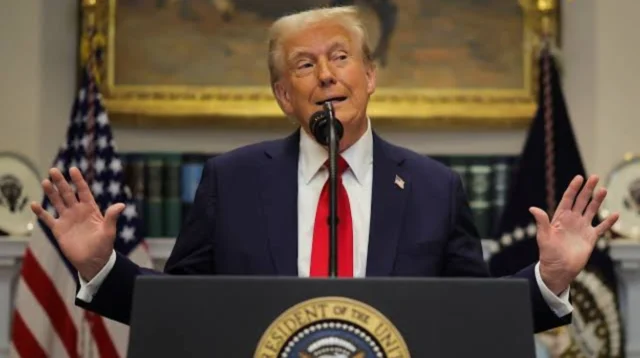
The participation of President Donald Trump in this particular primary was exceptional compared to other primaries. The president did not just give an endorsement, which he usually does in such instances. In this case, Trump personally recruited Ed Gallrein, the Navy SEAL, who won the seat vacated by Massie. This shows that Trump wanted to get rid of Massie since she was among his greatest critics in Congress.
The president’s campaign rhetoric was characteristically aggressive. Trump claimed that Massie
“voted with him like 85% of the time,”
attempting to minimize the ideological differences between them. However, Trump’s staff and surrogates focused heavily on Massie’s request for the release of Jeffrey Epstein files—a position that Trump appears to have taken personally. The Epstein files issue became a focal point for Trump’s retaliation, with the president viewing Massie’s insistence on transparency as a personal affront.
Massie’s Confident Predictions and Reality Check
Throughout the campaign, Thomas Massie maintained unwavering confidence in his ability to defeat the Trump-backed challenger. His confidence stemmed from his historical performance in the district and his belief that his constituent relationships would prove stronger than any presidential endorsement.
“I’m going to win. I normally win 80 to 20,”
Massie stated with characteristic assertiveness, reflecting his understanding of his historical dominance in the district.
However, Massie’s confidence also included a nuanced acknowledgment of how the race might have played out under different circumstances. He noted that
“if the president had merely endorsed a warm body… is a warm body from central casting, I would have won 60-40,”
suggesting that Gallrein’s qualities as a candidate mattered significantly beyond just the Trump endorsement. This statement revealed Massie’s understanding that Gallrein’s background as a Navy SEAL and his personal recruitment by Trump created a uniquely difficult challenge.
As the results came in, Massie’s confidence appeared misplaced. He acknowledged that his opponents “decided to buy the seat,” referencing the significant outside spending that flowed into the race. This comment highlighted the growing role of external money and political infrastructure in congressional primaries, even in safe Republican districts.
Foreign Policy and War Powers: The Core Conflict
The core conflict became based on basic differences regarding the nature of America’s place in the world and the distribution of war powers between the presidency and Congress. Massie was one of the rare Republicans who dared question Trump’s unilateral military actions and voted alongside the Democrats to check Trump’s war powers without Congressional authorization. This stance put him at odds with Trump’s preference for presidential power in military affairs.
This foreign policy issue was particularly controversial for Massie. He was one of the few Republican members who were opposed to war with Iran during the tenure of the Trump administration. Voting against resolutions that supported Israel also meant that he was at odds with the neoconservative faction of the Republican Party, which had begun to align with the foreign policy stance of President Trump.
It was not just a matter of policy disagreement. It was a fundamental difference in the philosophy of America’s position as a superpower. The approach adopted by Massie was isolationist in nature and in line with the libertarian conservative ideology, whereas that of President Trump was nationalistic and selectively interventionist.
The Meaning of Party Loyalty in Modern Republican Politics
Massie himself characterized the race in stark terms, noting that it had become
“a referendum on party loyalty, foreign policy and outside political spending,”
encapsulating the three forces that ultimately defeated him. The “party loyalty” dimension proved most decisive in the primary electorate, which increasingly viewed dissent from Trump’s positions as disloyalty to the party itself.
This is an entirely different kind of Republican party loyalty that signifies a complete shift in American politics. The seven terms served by Massie showed that he could run his election campaigns effectively under the old-fashioned Republican definition of party loyalty. This outcome shows that the Republican Party has completely realigned itself along the lines of Trump’s personal power, making it almost impossible for any independent-minded conservatives to make it through their primaries.
This outcome is definitely a frightening reminder to all congressional Republicans about the consequences of defying President Trump on the issues. After all, even a seven-term incumbent congressman with strong constituent support could lose his seat due to ideological differences with the president.
Gallrein’s Victory and the Future of Kentucky’s 4th District
The success of Ed Gallrein is a manifestation of the rise of a new type of Republican: the one who is endorsed by the veterans and recruited by Trump himself. As a former Navy SEAL, Gallrein possesses credentials which can strongly appeal to conservative Americans who attach high importance to military credentials and national security issues. This type of candidate is favored by President Trump.
Gallrein’s success means that Northern Kentucky is experiencing a complete shift of its political landscape since the Republican who is about to become its congressman in the general elections is likely to be quite different from Massie because of his strong loyalty to the president.
Broader Implications for the Republican Party
The defeat of Thomas Massie carries implications that extend far beyond Kentucky’s 4th District. ABC News correctly noted that Gallrein’s victory
“reaffirmed [Trump’s] dominance within the Republican party,”
demonstrating that the former president’s influence over congressional nominations remains as strong as ever. This result validates Trump’s strategy of actively recruiting and campaigning for candidates who demonstrate personal loyalty.
The primary also serves as the latest symbol of Trump’s influence over his party, with Forbes correctly characterizing Massie’s loss as
“the latest symbol of President Donald Trump’s influence over his party,”
This symbolism matters because it demonstrates that Trump’s power extends beyond his base of support to actively reshape the party’s congressional delegation.
The End of an Era for Independent Conservative Voices
The loss of Thomas Massie signals the end of an era for a certain kind of conservative politician in the United States Congress. The specific blend of libertarian values, technical expertise, and a willingness to take on members of both parties on a variety of issues allowed Massie to carve out a niche in politics that may not work anymore in today’s Republican Party under President Trump. The main consequence is that the GOP can no longer tolerate ideological independence, especially if it contradicts Trump’s foreign policy.
Looking forward, other congressional Republicans who have maintained independent positions must now calculate whether their ideological convictions are worth the risk of primary challenges backed by Trump’s political machine. The Massie primary provides a clear warning: in the current Republican Party, loyalty to Trump has become more important than policy consistency or constituent relationships when it comes to surviving primary challenges.
The political earthquake in Kentucky’s 4th District will be studied for years as a defining moment in the transformation of the Republican Party from a coalition of conservative principles into a vehicle for Trump’s personal political authority. Thomas Massie’s defeat represents more than the loss of a single congressman—it signals the consolidation of Trump’s power over the GOP and the marginalization of conservative voices who refuse to align completely with his vision.