The Trump administration’s removal of the remaining commissioners at the Election Assistance Commission has triggered one of the most consequential election-administration fights of the second Trump term. The move leaves a small but influential bipartisan federal agency without commissioners at a moment when states are deep into preparation for the November midterm elections, intensifying concerns about federal oversight, technical support, and the broader direction of U.S. election governance.
A sudden blow to election administration
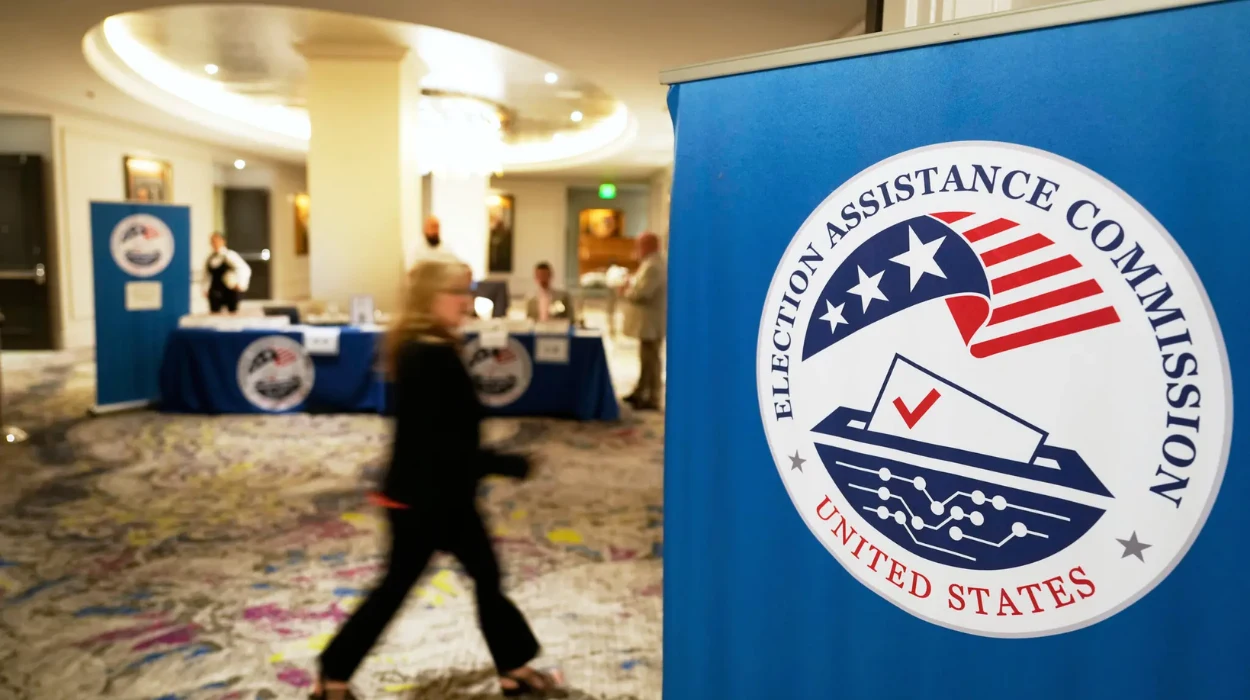
While the EAC is not a term that most people know of, in the world of American politics it holds some importance. The Commission provides support and advice to states and local authorities regarding elections and voting system certification. In other words, the stability of the organization in the election year is of high importance. From the reports on the dismissals, it follows that the Administration fired the last three commissioners who were left in the independent and bipartisan organization.
As a result, now there is no commissioner and thus no functioning Commission, meaning that it cannot carry out some of its core responsibilities. What is interesting about it is that the impact of this move will not become apparent immediately because of the nature of the Commission’s activities. This is to say that the EAC does not organize elections; it helps those who do.
Why this matters now
It is precisely the timing that lends the episode its political meaning. The ousting occurred in early July 2026, a mere few months prior to the November midterms, which are bound to determine the direction in which both the control of Congress and the implementation of Trump’s second-term agenda will proceed. The matter of election administration is usually sensitive on its own; but when the federal government moves to interfere with the independent agency responsible for election administration, things become even more complicated. Media outlets reported that this ousting was part of Trump’s efforts at reforming the system of election administration prior to the upcoming midterms. This has fueled fears among Democrats and election reformers that these ousters may be interpreted as yet another attempt to gain greater influence over the electoral process from the side of the federal government.
What the EAC does
The EAC was created after the disputed 2000 presidential election to help modernize and support election administration. Its responsibilities include issuing voluntary guidance, maintaining certification standards for voting equipment, and serving as a federal resource for state and local election officials. It is designed to be bipartisan, which is central to its legitimacy and to its usefulness in a politically polarized environment.
That bipartisan design is why the removal of its commissioners has drawn such attention. If the agency cannot act because it lacks commissioners, the consequence is not merely administrative inconvenience. It may also create a vacuum in federal support at the very moment states are finalizing ballots, testing equipment, training poll workers, and preparing for emergency contingencies. For election offices already dealing with staffing and budget pressure, that loss of support could be significant.
The personnel breakdown
From the report, the two Democratic commissioners were sacked while the one Republican commissioner either resigned or was sacked, leaving the EAC without any commissioners at all. This fact is crucial as it indicates that this is not a normal case of turnover but a case of total overhaul of leadership. The lack of this leadership is important as some of the functions performed by the agency cannot be achieved without commissioners being present. As a result, the EAC will not be able to make decisions, certify or approve decisions, and ensure continuity, which is crucial for election officials. It is also a crucial period due to the already fragile trust in the election administration.
The political message behind the move
The Trump administration’s critics see a clear political message in the firings: the White House is willing to pressure or dismantle independent bodies that stand between presidential power and election administration. Washington Post coverage said the action accelerates Trump’s push to overhaul election administration before the midterms. Reuters similarly framed the move as happening ahead of the midterms and leaving the commission empty.
That interpretation is politically potent because independent election bodies are supposed to function as technical, not partisan, institutions. When the administration removes the people running one of those bodies, opponents are likely to argue that the White House is trying to centralize control over election infrastructure. That argument does not require proof of direct interference in vote-counting to be politically damaging; the symbolism alone is enough to fuel concern.
Reactions from Democrats and election experts
Democrats and election-related activists were alarmed, fearing that such moves would undermine the neutral mechanism of support needed by states. Reporting on this incident, media outlets noted that the attempts by the president to involve the federal government in the electoral process point to an overall strategy aimed at influencing the independence of the process of elections. Votebeat noted that the move made the Election Assistance Commission devoid of commissioners, pointing to the importance of this event. Election officials and access organizations usually regard the EAC as a silent yet very important partner, and the dismissal of its leadership is likely to be understood not just as a matter of personnel management. For the opponents of the administration, the main problem lies not in who was fired, but in what these dismissals mean.
Legal and constitutional stakes
The firings also sit inside a larger legal fight over the president’s power to remove leaders of independent agencies. Earlier court disputes involving removals at other federal agencies have raised the possibility that this administration is testing, and possibly expanding, the limits of executive authority.
That makes the EAC episode more than a political story. It may become part of a broader constitutional contest over how independent agencies are insulated from presidential control, especially when their work touches politically sensitive areas like elections. If legal challenges emerge, the key questions will likely involve statutory authority, agency structure, and the degree to which the president can remove commissioners at will.
The Supreme Court and lower courts have already been central to similar disputes involving independent agency leadership. That legal backdrop gives the EAC firings additional weight, because they are not happening in a vacuum. They are unfolding in an environment where the boundaries of presidential power are being actively contested in court and in public debate.
What happens next
The immediate problem is the ability of the EAC to operate without its commissioners. The lack of a quorum might result in the inability to make certain decisions and will thus delay the provision of help for the states in the process of preparing for elections. Even if the normal work of the agency’s employees continues, the lack of commissioners causes problems because of the uncertainty in terms of the direction and leadership. The long-term institutional problem is related to the possibility that the act of the current president may become a precedent for the future presidents who will gain more control over such organizations in the future.
There is also a political downside for the administration if the move is widely seen as overreach. Midterm elections are already a referendum on the president’s party, and actions that appear to undermine election independence can energize opponents, mobilize litigation, and deepen public suspicion. In modern American politics, trust is a resource; once lost, it is difficult to rebuild.