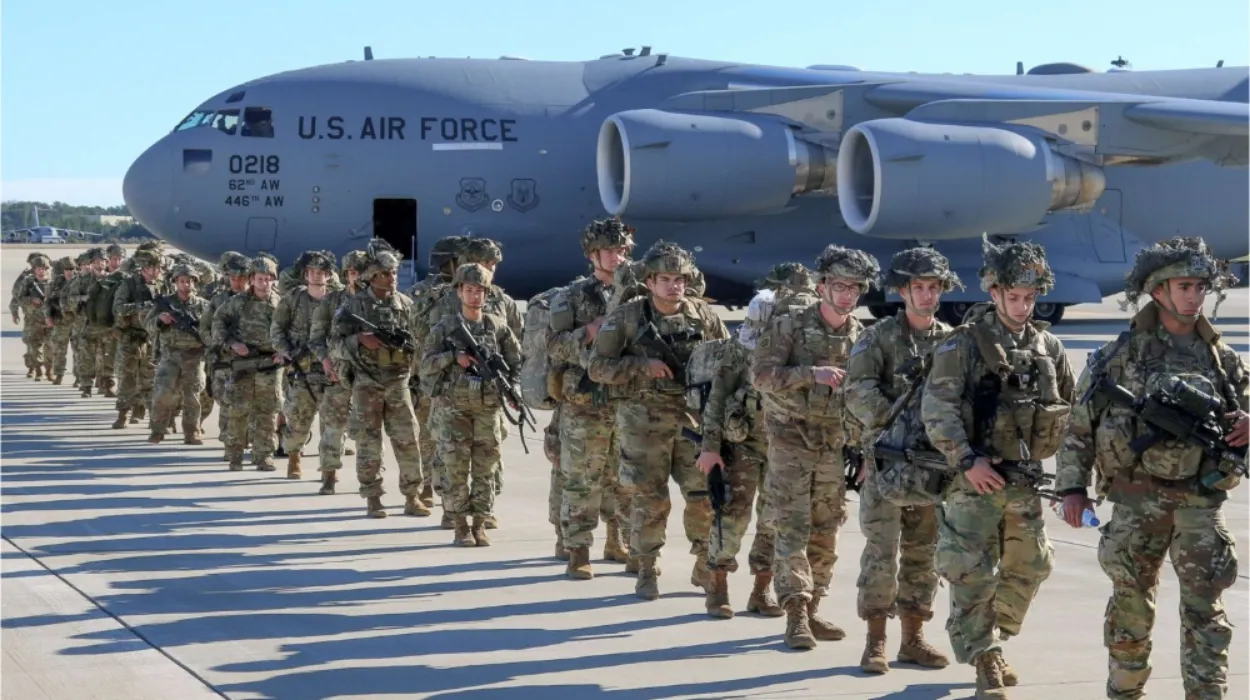
The United States has deployed thousands of additional troops to the Middle East, expanding its regional presence to roughly 50,000–57,000 personnel, the largest buildup since the early‑2000s Iraq and Afghanistan wars. The surge encompasses approximately 3,500 Marines and sailors aboard the USS Tripoli amphibious ready group, a second Marine Expeditionary Unit, elements of the Army’s 82nd Airborne Division, a brigade of roughly 3,000 paratroopers and Special Operations Forces including Navy SEALs and Army Rangers. This augmentation of rapid‑response and ground‑capable units represents a departure from the primarily remote-strike operations that have characterized US policy in the region, establishing a posture designed to enable limited ground operations if politically authorized.
The Pentagon has characterized the deployment as a “force‑posture adjustment,” aimed at reinforcing deterrence, safeguarding regional allies, and protecting strategic infrastructure such as the Strait of Hormuz and Iran’s principal oil-export terminal at Kharg Island. Officials maintain that the surge does not indicate a commitment to large-scale invasion, but rather positions highly mobile units to respond quickly to scenarios ranging from the securing of ports and airfields to targeted strikes on Iranian military or energy infrastructure. Coming after weeks of intensified airstrikes and missile exchanges, the timing of the surge underscores Washington’s intent to hedge against deeper escalation, including potential closures of the Strait of Hormuz or disruptive attacks by Iran and its proxies on Gulf-based or US-linked facilities.
Strategic and operational context
The cumulative effect of adding airborne, amphibious, and special-operations units is to provide the president and regional commanders with a wider menu of options. Unlike previous deployments focused primarily on standoff airpower, this surge enables US forces to act decisively on the ground, swiftly securing chokepoints, ports, and critical infrastructure, while leaving the majority of offensive pressure in the hands of air and naval assets. This integration of ground and expeditionary capabilities represents a recalibration of US deterrence posture in the Gulf, reflecting both operational pragmatism and the political constraints of avoiding a protracted occupation.
How the 82nd and Marines change the equation
The introduction of 82nd Airborne paratroopers and Marine Expeditionary Units recalibrates the operational landscape of the Iran war. The 82nd Airborne, a unit trained for rapid global deployment, specializes in forcible entries into contested areas, capable of securing airfields, ports, and coastal zones to facilitate follow-on operations. Marine units, particularly amphibious-ready groups, provide power projection from the sea, enabling expeditionary operations without dependence on distant continental bases. Both forces are strategically suited to scenarios involving the Strait of Hormuz, where control over shoreline radar and missile sites, small-boat swarms, and offshore facilities could decisively influence maritime security. Operations around Kharg Island, which handles the majority of Iran’s crude exports, are similarly within the scope of these rapid-reaction forces.
Rapid, limited operations versus occupation
Analysts stress that deploying these forces does not imply a commitment to seizing or holding large swaths of Iranian territory. Instead, the deployment enables limited-scope, time-bound operations aimed at degrading Iran’s capacity to disrupt Gulf shipping or threaten regional stability. Both 82nd Airborne and Marine units are optimized for high-intensity, short-duration missions, not prolonged counterinsurgency or urban occupation. The operational focus is therefore on disabling key nodes—energy facilities, radar installations, or naval chokepoints—while minimizing the footprint of US forces.
Implications for escalation
While this model reduces the upfront risk of a broad land war, it also elevates the stakes of ground-force use. Even brief incursions could provoke Tehran to retaliate against US-linked targets or harden its strategic posture in the Gulf. Military strategists emphasize that the deployment is as much about signaling deterrence as executing operations, conveying to both allies and adversaries that the US is prepared for limited on-the-ground engagement while avoiding entanglement in open-ended occupation.
Iranian and regional readings of the buildup
Iran has interpreted the US surge as preparation for potential ground operations, even as Washington frames the deployment as defensive and contingency-oriented. The Islamic Revolutionary Guard Corps has warned that any incursion into Iranian-influenced territory, including critical chokepoints and energy infrastructure, would prompt a “forceful” response. Tehran emphasizes that US forces in the Gulf remain within range of Iranian missiles, drones, and naval swarms. Officials in Tehran argue that the arrival of 82nd Airborne and Marine units signals an American intent to degrade Iran’s regional influence and energy infrastructure, not merely conduct short-duration air campaigns.
Gulf-Arab perspectives
Regional responses have been mixed but generally supportive. Saudi Arabia, the United Arab Emirates, Bahrain, and other Gulf states view the US surge as reinforcing deterrence against Iranian missile and asymmetric capabilities. Officials acknowledge that airborne and amphibious forces enhance the credibility of Washington’s commitment to protect critical waterways, including the Strait of Hormuz. However, some strategists caution that deploying ground-ready units visibly increases the risk of miscalculation. Iranian proxies, naval units, or drones probing the edges of US security perimeters could prompt rapid responses, escalating tensions unintentionally. Overall, Gulf-based assessments suggest the surge stabilizes deterrence as long as the US avoids entrenchment in a protracted land war, but may become destabilizing if ground forces are deployed without clear limits.
What the surge signals for the war’s next phase?
The significance of the US troop surge lies in its signaling effect. By assembling a combination of airborne paratroopers, Marines, Special Operations Forces, and robust air-and-naval support, Washington moves beyond a distant-strike posture to a capability for limited on-the-ground operations if political decisions dictate. This does not constitute an open-ended invasion plan, but it enables far more intrusive operations than airstrikes alone.
For Tehran, the deployment conveys that certain red lines such as sustained closure of the Strait of Hormuz or major attacks on Gulf-based Western-linked facilities could provoke ground-force involvement. For regional actors, it demonstrates that US protection is backed by troops capable of immediate engagement. The deeper question is whether political and military costs of limited ground operations align with feasible strategic objectives, and whether this surge is likely to facilitate de-escalation or elevate the conflict to a new plateau in the Iran war.
The presence of highly mobile ground forces has shifted the Iran war from a primarily distant-strike campaign to a conflict where the specter of rapid, targeted boots on the ground is a tangible factor. How Tehran interprets the threshold for escalation, how Gulf allies balance reassurance against risk, and how the US calibrates operational use will shape the next months of the conflict. With forces now in place, the calculus of deterrence and escalation is no longer theoretical but operationally immediate, raising questions about both the limits of military action and the broader stability of the Gulf region.