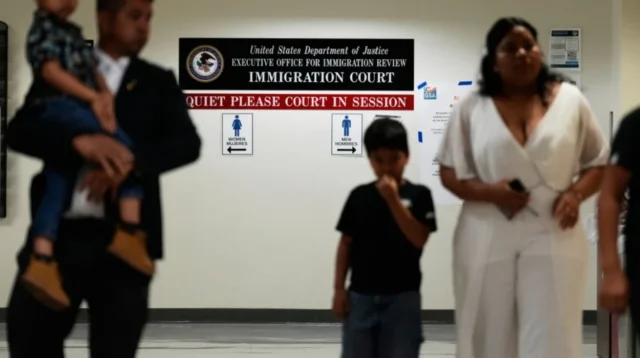
A new measure introduced by the US government on immigration issues is causing a wave of anxiety for thousands of immigrants already residing in the US, hoping to become permanent residents without having to leave the US. According to the recent news report, many immigrants applying for green cards will have to do so outside the US under the auspices of the State Department.
Fundamentally, the policy entails a more stringent application of procedures involved in acquiring permanent resident status for individuals who have entered the United States on a temporary basis. Rather than permitting a greater number of individuals to transition from being a temporary visa holder or a temporary legal resident to becoming a permanent resident from within the U.S., the policy sends these individuals abroad to apply or complete the process at a U.S. embassy or consulate. This effectively transforms what was a procedural matter into an insurmountable obstacle for many individuals.
What the reported change means
This particular guideline impacts immigrants residing in the US and hoping to change their immigration status in order to obtain a green card. Instead of processing such applications within the United States, they now have to submit them through a process known as consular processing. This involves traveling out of the country and then undergoing an interview in a foreign jurisdiction.
It is more than just updating one’s address on an application. It may cause significant disruption in the life of many applicants since it involves organizing international travel, additional costs and months-long waiting for a consular interview. As far as the immigration process goes, the requirement is bound to create even more complications.
Moreover, there is a crucial difference between the eligibility and the process in question. The mentioned reports do not imply that green cards are going to be stripped from immigrants in question. The requirement seems to only refer to the location at which a person files the application. Still, the difference is significant from the point of view of the immigration process.
Official stance behind the move
The stance taken by the government according to the reports is that the move is consistent with both immigration policy and court rulings. As stated by the reports, a non-citizen who is in the country on a temporary basis and wishes to have a green card should do this by returning to his country of origin to apply for the card, except under extreme conditions.
“An individual who is temporarily present in the U.S. and desires a Green Card must return to their nation of origin to submit an application,”
USCIS and DHS were reported as saying.
While an exception for extraordinary circumstances exists, indicating that the policy is not entirely rigid, the burden appears to lie with applicants who must demonstrate their reasons for being an exception.
Moreover, the policy of the Obama Administration is also indicative of an immigration enforcement stance that is being adopted by the government. The policy will result in more people going through consular processing and hence less adjustments taking place in the US. While supporters believe that this measure reinstates order in the system, critics maintain that it creates unwarranted hurdles for law-abiding immigrants.
Who is most affected
By far, the greatest effect will be felt by individuals who are residing within the United States legally but on a temporary basis. This involves foreign students, employees, travelers, and others temporarily residing in the country who will eventually meet the requirements for becoming residents through employment, family connections, and similar avenues.
Students are likely to bear the brunt of the practical effects brought about by the policy shift. Someone who is established and working towards a degree in the United States is required to return to his or her country, which may lead to disruptions in education and work. Workers, especially sponsored workers, will face similar issues regarding their work arrangements.
In addition, it may have implications for those who come from nations in which travel is expensive, consulates have long wait times, or in which U.S. visa interviews are difficult to arrange. In this case, the requirement could add several months onto an already long process. On this level, the policy shift will mean more than just extra paperwork.
Why aid groups are alarmed
Aid groups criticized the move because it creates a harsher path for people who are already inside the U.S. and trying to regularize their status. Their concern is that the policy adds delay, expense, and instability without necessarily improving fairness or efficiency. For organizations that assist immigrants, the decision is likely to increase demand for legal guidance and emergency support.
“This is going to make a difficult process even more difficult,”
is the kind of criticism the policy is drawing from advocacy circles, which argue that forcing people to apply abroad can expose them to more uncertainty.
For some individuals, there may be apprehension about the possibility of problems with re-entry into the country or even losing their jobs and schooling opportunities because of leaving the country.
Furthermore, critics argue that this decision is another form of restriction of entry instead of simplifying legal immigration processes. Despite the legality of the policy, aid organizations may analyze policies in terms of its effects on people rather than legality. The main argument against this policy is that there is already congestion and stress in the immigration process, which might be exacerbated by the policy.
Legal and practical background
It has always been two main ways of obtaining a green card through adjustment of status if you are physically present in the country and through consular processing, which is done outside the country. What is important about the announcement is that there seems to be a change in how certain individuals will adjust their status.
It is important to note that when it comes to immigration proceedings, adjusting one’s status within the country is always preferred over consular processing since it is easier as compared to waiting for appointments at the embassy and traveling out of the country for a visa interview.
The tension here is between legal theory and lived reality. Even if the government says the policy follows established law, applicants experience it as a major change because their previously expected route is no longer available in the same way. That is why the news has quickly drawn public attention: it changes not only where the case is handled, but the entire strategy families and employers may use.
Likely consequences ahead
The initial effect will probably be confusion. There will be applicants, as well as employers and immigration lawyers, who will need to find out whether the new rule applies generally or just to certain groups of individuals. With such unusual situations being referred to in the reports, the parameters of the rule will be extremely important. Individuals will probably try to figure out from the guidance of USCIS, State Department and legal interpretation whose case would be required to leave.
There will also most probably be delays. Consular processing will usually take much more time than domestic filing, particularly when large numbers of cases are processed by consular officers. There will be document revalidation, medical examinations, lengthy interviews, and reentry issues for the applicants to cope with.
There may also be a chilling effect. Some people may decide not to pursue permanent residence if the process now requires travel that could risk their current work or family stability. Others may delay filing until they better understand the policy. In that sense, the change could reshape behavior even before it is fully implemented or legally challenged.
Broader political meaning
This story is larger than one immigration instruction. It reflects a political choice about how hard it should be for a foreign national already inside the U.S. to transition into permanent status. Supporters of tighter enforcement may view the policy as restoring order and limiting in-country adjustments. Opponents will likely see it as a discouraging step that makes lawful immigration more difficult than necessary.
The policy also fits into a wider debate over whether the U.S. should prioritize flexibility for people who are already contributing as students, workers, or family members, or whether it should insist on stricter departure-and-return procedures. That debate has long divided policymakers. What makes this particular move important is that it affects the transition point where temporary presence becomes permanent residence — one of the most consequential moments in immigration law.