After appearing to introduce President Donald Trump at a New York event, New York Giants quarterback Jaxson Dart has become embroiled in an expanding debate, receiving intense criticism for the decision from his teammate, Abdul Carter. From being part of an eye-catching occurrence to becoming part of a much bigger issue, the involvement now moves outside the realm of just professional football and becomes a much larger issue for the sport of football.
What makes this story particularly significant is not that a rookie quarterback was seen on a political platform but rather that the criticism was delivered directly by his fellow teammate. Through the medium of social media, Abdul Carter has made clear his feelings toward Jaxson Dart’s choice.
What happened at the New York event?
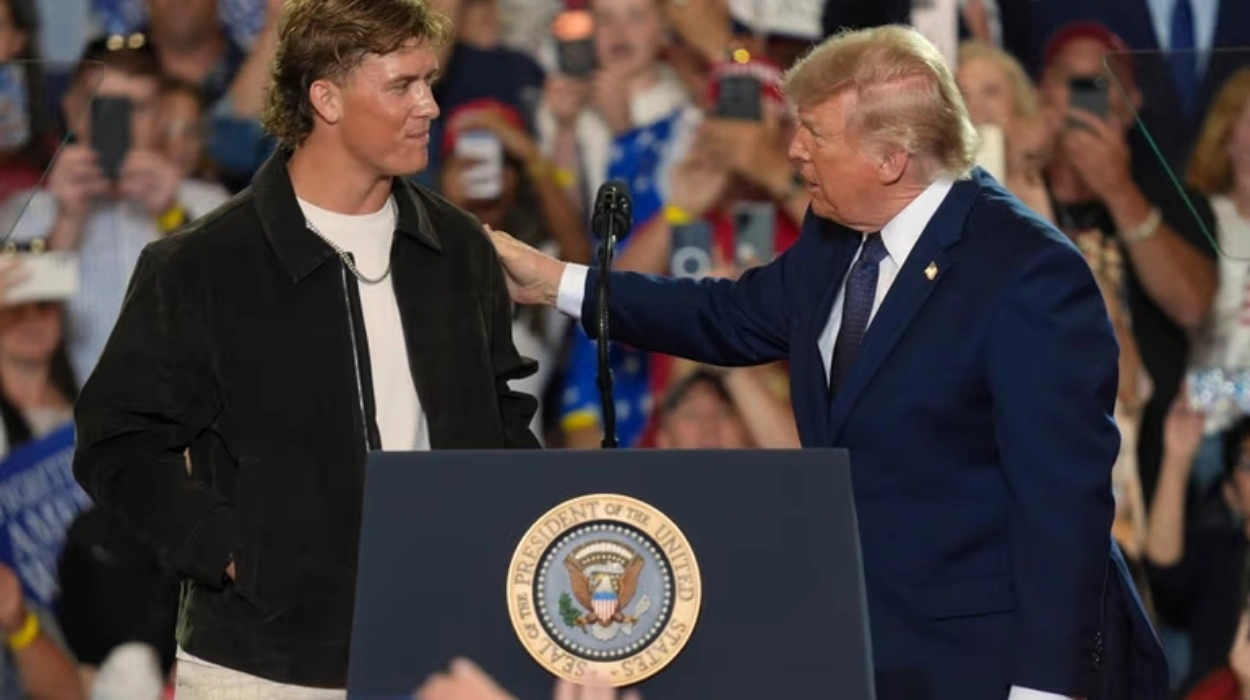
In an unexpected move, Jaxson Dart attended one of the Donald Trump rallies in New York and introduced the former president to the audience. The news indicates that the rally occurred in Rockland County and it had links with a political event where Republican Rep. Mike Lawler was expected to speak. The involvement of the young man on such an occasion was especially important due to the fact that he did not only attend the rally, but also used the opportunity to greet Trump.
Specifically, according to the reports, Dart referred to the event as a great privilege and honor for him, which was followed by a loud “Go Big Blue” slogan shouted by the audience before turning the floor over to Trump.
Image is important when it comes to events like that. This rookie quarterback, who is establishing himself in the league, has chosen to appear at a very political event and has taken center stage in doing so. It was clear to many that this was not just about making an appearance but it was all about sending a message. In New York, such an image will always make people react.
Why did Abdul Carter react publicly?
Abdul Carter’s response is what transformed the story from a one-off headline into a full-blown controversy. Carter appeared to question Dart’s decision on X, reportedly writing, “Thought this sh!t was AI”, followed by “What we doing man”. Those remarks were not a formal statement, but their tone was unmistakably skeptical and dismissive.
Not only do the words make Carter’s reaction meaningful but also the context in which it was said. In the event that one member of a team shows surprise regarding the political participation of another teammate, this automatically implies some things with regard to how the members of the team feel.
As for the fact that Carter did not give a detailed explanation, this may also have played a role in the fast spread of his message. In today’s sports world, social networks play an important role, and sometimes a short post is enough to create a buzz around something.
What did Dart say about Trump?
The statements that Dart made during the event point to an attitude of support and respect towards Trump. According to him, he found it an honor to introduce Trump to the people gathered there, and many accounts describe him as having made a warm and enthusiastic introduction. In what would be one of his memorable statements, he called Trump the 45th and 47th presidents of the country.
This kind of introduction does not remain impartial. In essence, it shows that not only is Dart there as a spectator; he is also participating and endorsing the idea. This would mean that those who support Dart would view this as just an exercise of his right of speech, while those who dislike him would see this as endorsement of himself with all its ramifications.
What makes Dart’s appearance even more remarkable is the fact that he is very much in the beginning of his professional football career. The young players usually have to struggle hard to maintain their image before others. As such, taking a step in such a controversial issue as politics, he was aware of what he would be getting into.
How does this affect the Giants?
This case is significant considering the stature of the Giants. This is one of the most recognizable teams in the NFL, and its players always find themselves under constant scrutiny from the media. Any move made by an important player can easily turn into a team story, especially when it involves political implications.
The reaction from Carter indicates that Dart’s visit was not well-received by all members of the team, especially the players. Even though the issue at hand might not be too serious, the fact that it received public attention will leave the perception of tension between certain members of the team.
There is also a fan dimension. Giants supporters are not politically uniform, and New York itself is a politically complex and highly opinionated sports market. A quarterback introducing Trump is likely to energize some fans and alienate others. That split reaction can follow a player into the season, especially when it becomes attached to his name in a news cycle.
Why did this spread so fast?
It became very popular because it includes many elements which sports media is always quick to emphasize: a well-known athlete, a previous president, a connection to New York City, and an athlete’s response to the situation. It is interesting not only from the perspective of sport but also politics.
The key was social media. By making a post about what had happened, Carter made the situation one where people could easily discuss a response rather than a report of the event itself. After the quote was published, the story changed from “Dart attended an event by Trump” to “one Giants athlete is challenging another.”
There is also the timing factor. At this stage in Dart’s career, every public appearance carries outsized meaning because he is still shaping his reputation. A single event can become a defining reference point in early media coverage, especially when it involves a polarizing political figure like Trump.
What are the facts and figures?
A number of specifics make the account credible. According to reports, the incident occurred either on May 21 or 22, 2026 in Rockland County, New York. According to a report, Dart introduced Trump to the fans, and another report mentions that he made a “Go Big Blue” chant prior to introducing him.
Another detail is that according to some sources, both Dart and Carter were drafted in the first round in the year 2025. What is peculiar about this fact is that both of these players, who happen to be young and famous, are involved in politics, not the sport anymore.
Trump was introduced as the 45th and 47th president in Dart’s remarks, which reflects the current political context surrounding the event. That detail is important because it shows the introduction was not accidental or vague; it was a deliberate and clearly framed political appearance.
How should this be interpreted?
In this case, it must be viewed as an example of public relations regarding identity issues in professional sport. While Dart’s participation was not against the law, scandalous, or unprecedented, athletes sometimes attend political events. However, the specificities of this case must be considered, including the fact that the Giants compete in a city that is always interested in how well the team performs.
Carter’s reaction does not prove that there is an internal conflict in the locker room, but shows that this incident hit home. One must admit that his words demonstrate some disbelief and irritation rather than thoughtfulness and caution. In other words, Carter’s comments have a natural and genuine flavor, which is why everyone took notice.
What must be kept in mind is the fact that modern athletes are not evaluated for performance only. Their actions in general can become a factor affecting public opinion about them. Considering this fact, one must note that the case with Dart was not just an innocent joke.
The immediate next question is whether the Giants address the matter internally or publicly. In many cases, teams prefer to keep these issues quiet unless they begin affecting performance or discipline. But if the story continues to circulate, reporters will likely keep asking whether the appearance created friction among teammates.
Dart may also be asked to clarify whether the appearance reflected a political position or simply a personal introduction at a public event. In the current media climate, silence can be interpreted in multiple ways, so even non-comments may shape the story.
For Carter, the reaction may fade as another social-media flare-up, or it may remain attached to the story as the clearest counterpoint to Dart’s appearance. Either way, the episode has already done what such moments often do: it has turned a routine political appearance into a sports conversation with wider cultural implications.