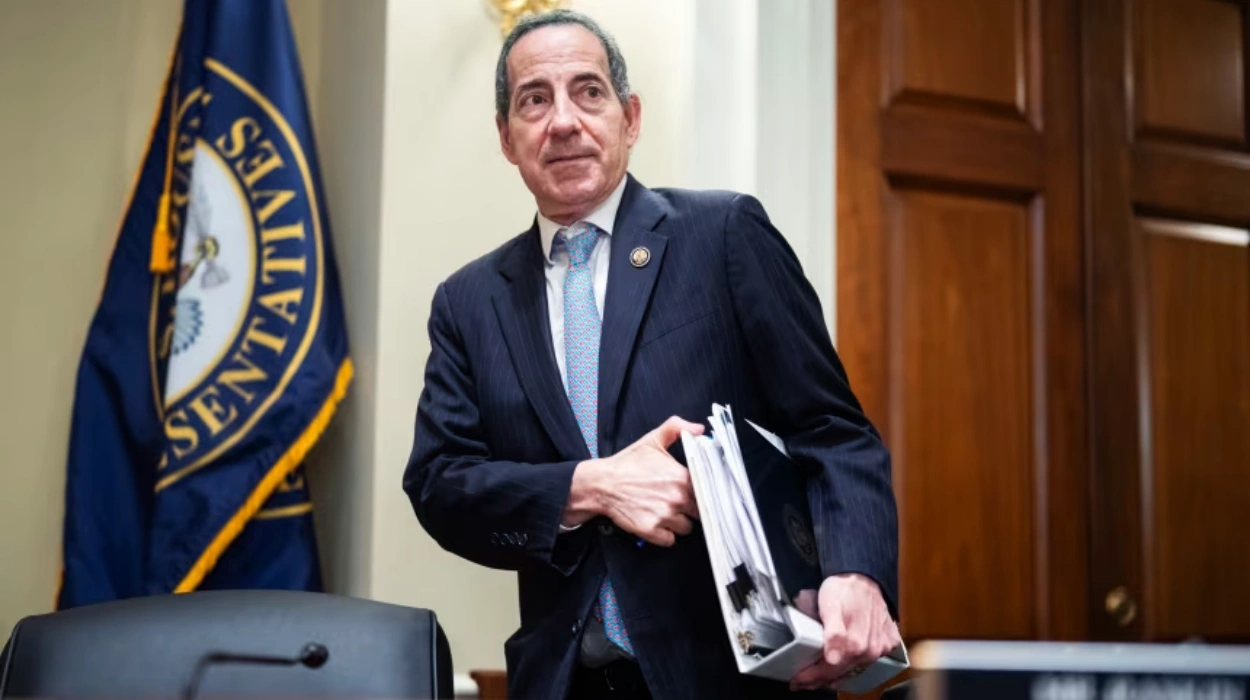
House Democrats have launched a new inquiry into whether Jeffrey Epstein may have acted as an unregistered foreign agent, framing the effort as part of a broader push to understand the late financier’s ties to powerful governments and political figures. The move was led by Rep. Jamie Raskin, who says newly reviewed emails and other documents raise “substantial evidence” that Epstein advanced the interests of several foreign states while never registering under U.S. foreign-agent rules.
Why This Matters
This research is significant due to the fact that it takes the Epstein story from the usual discussions about criminal behavior, powerful friends, and documents release to potential foreign interference activities. Should Democrats manage to prove even a small portion of the allegations, the story would bring additional worries regarding the way in which Epstein worked in politics and diplomacy for years without being officially regarded as a foreign lobbyist or agent. At the moment, the allegation is just an investigation, not a legally confirmed one.
What Raskin Is Claiming
Raskin’s letter to the Justice Department, State Department, and intelligence community says available records suggest Epstein “acted to advance the interests” of the Saudi Arabian and Kuwaiti governments, advised the Russian government, and served as a consultant for a former Israeli prime minister. He also argues that Epstein’s extensive personal and professional contacts with foreign officials posed security risks precisely because Epstein was never registered as a foreign agent.
“Our examination of available evidence has already revealed damning indications of Mr. Epstein’s activities on behalf of foreign states,”
Raskin wrote. He also said,
“Despite having such extensive, well-documented personal and professional contacts with officials of foreign governments, Mr. Epstein never registered as a foreign agent,”
underscoring the core legal concern behind the investigation.
The Evidence Being Cited
Contrary to being founded on one “smoking gun,” the new investigation rests on a series of materials that have already been disclosed by the Justice Department and the House Oversight Committee. As per Raskin, such materials, including emails, are sufficient to warrant an investigation into whether or not Epstein functioned as a foreign influence lobbyist as opposed to a financier with foreign connections. In addition, he is looking to obtain any documents from the Justice Department regarding Epstein’s dealings with foreign officials and to ask whether the department had ever investigated him as a foreign agent.
A very critical background factor here is the unanswered question regarding the number of documents regarding Epstein which remain unreleased in the government’s possession. According to Raskin, there are close to 2.5 million documents regarding Epstein which have not yet been made public by the Justice Department.
Political Setting
The political atmosphere surrounding the Epstein case is already highly charged, and this new investigation has found its place within the larger conflict. CNN notes that Raskin’s request for information in the GOP-controlled House is expected to go unheard from DOJ, State, and the intelligence community; hence, the investigation will serve more as a statement of intentions for what Democrats will do once they are back in power. The investigation is thus both an investigation into facts and a political message concerning the future plans of the committee. The Republicans, on their part, have continued to claim that Democrats are engaging in selective use of Epstein documents for partisan gain. In a statement made by the chairman of the Oversight Committee, Jim Comer, the Republicans were undertaking “a thorough review,” while the Democrats were “manufacturing yet another anti-Trump hoax.”
Foreign-Ties Questions
The theory of foreign agent is particularly problematic due to the implication that there exists more structure and strategy involved than mere socialization. Epstein could have just been hanging out with the foreign representatives without any lobbying activity or being under the direction of a government. In Raskin’s reading of the material, it seems like he thinks the documents show some kind of influence and that is why he raises the question of foreign agent. It’s noteworthy that the list of countries involved includes not just the United States and Israel, but also Saudi Arabia, Kuwait, Russia and former Prime Minister of Israel, which means that the inquiry is wider than just a connection to one country.
This is important since it shows that Democrats are trying to find out if Epstein played the role of an international lobbyist or negotiator rather than working for one country. However, such a broad list of connections means that the burden of proof is higher for each separate claim.
Survivors And Transparency
While the debate over the foreign agent status is at its peak, the Epstein documents are inseparable from issues surrounding the need to release documents and survivor justice. Both Democrats and some Republicans have pressed for wider disclosure of the documents related to Epstein, as it would give an understanding to the people about how the case was managed and by whom. \
This pressure will keep on building on the Department of Justice and House Oversight Committee regardless of the politically-charged nature of the evidence pack. However, according to the report, the Democrats consider the remaining documents to be vital, and if they contain any communication with the foreign government, finances, or directions by state actors, then it would support Raskin’s hypothesis or contradict it. At present, what is unknown holds more value than what is known.