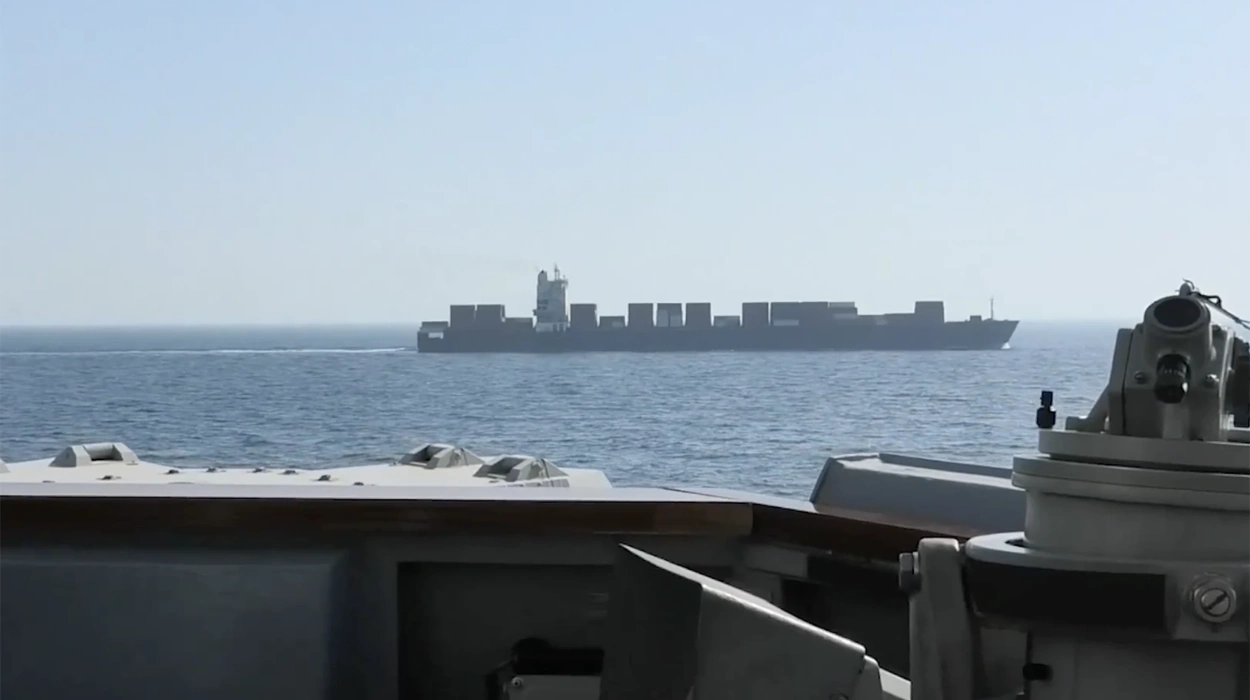
Iran and US Threat of Retaliation Amid a Tenuous Truce demonstrate how ceasefires may be temporary breaks rather than permanent peace-making efforts. The naval incident of April 2026, triggered by the US confiscation of the Iranian ship, Touska, demonstrates how the tenuous peace agreements can be easily upset by operational means of enforcement. The US defended the seizure as an enforcement of the violation of sanctions, and Iran denounced it as a violation of the ceasefire, which continues to reflect the divergence between legal and strategic views.
This is after the 2015 dynamics where low level strikes and retaliatory rhetoric were exchanged and a state of cold war was the result. Instead of terminating conflict, ceasefires appear to take time. Each side takes advantage of the moment to build pressure up, and thus we find ourselves in a scenario where the war is fought in spurts.
Maritime enforcement as a peacemaking point.
One of the main factors of escalation is sea operations. The takeover and detention of the Touska by the US navy is an indication that the blockade will continue even amid the truce. To the US, this is maintaining the pressure on Iran but still technically considered to be within the deal whereas to Iran it is the pressure being applied in a different form.
The maritime aspect is also delicate, as it is more salient and urgent. Sea accidents have tangible outcomes that can readily spiral out of control. Patrols on the contested waters by the navy increase the chances of seemingly peaceful enforcement approaches being perceived as bellicose.
Measured retaliation and signalling.
The recent actions by Iran, whereby it has launched drones to attack US navy boats, are a factor in an escalation strategy. This would deter the escalation to open war, but it would show Iran the potential and determination, and leave de-escalation options open. These actions recall 2025, when smaller scale attacks were launched to strengthen deterrence but not to engage in the full-scale war.
There are two purposes of such measured actions. They offer domestic credibility in the form of defiance signalling, as well as assuring the opponents that escalation can be handled. However, the net effect of a series of limited steps is that the ceasefire becomes weaker, with every incident exerting increased pressure on the truce.
Major battle over the Strait of Hormuz.
The Strait of Hormuz is the centre of Iran and US Retaliation Threats Under a Fragile Truce. The Strait is a treasure trove, a carrier of a significant portion of world energy resources, and, therefore, a bargaining chip and a possible provoking factor.
The need to ensure the Strait remains open as seen in the demand during the ceasefire reflects its significance. However, the absence of a robust system of monitoring provides the two parties with an opportunity to understand the compliance with the ceasefire in their own way aligned with their strategic interests, which also leads to uncertainties that give rise to tensions.
Changing control and policy reversals.
The changing attitude of Iran towards the freedom of Strait is a reaction to both domestic and international processes. The naval activity in the Strait indicates a more aggressive approach, although diplomatic reports assure ongoing freedom of passage since the ceasefire. These discrepancies indicate a lack of unity in the implementation of the policies as different institutions that share similar, yet not necessarily consistent, objectives are involved.
This presents diplomatic difficulties. To the US, this leaves doubt on what the intentions of Iran are. To Iran, law enforcement by US forces does not advance ideas that increased maritime access is not restrained.
Economic leverage and international implication.
The control of the Strait provides economic power to both parties. Any risk of interference in or actual interference in the Strait impacts the world energy price, insurance fees and sea routes. The incidents occurring at the beginning of 2026 resemble those of 2025 when even temporary disruptions to shipping resulted in price spikes and heightened geopolitical anxieties.
This increases the significance of each incident. What appear to be tactical actions have strategic consequences, which increase the impacts of localised events on the international systems.
Stalemate in diplomacy as confrontation escalates.
Interrelations have been directly influenced by the Iran and US Retaliation Threats, although there is a shaky Truce. Diplomatic work, even via proxies such as Pakistan, has struggled to keep up with the military.
Both parties indicate in their public statements the necessity of negotiations, but their actions reveal a complementary approach of affecting the negotiation process by pressure. This phase of the process has been marked by this two-track strategy.
Contradictory negotiation signals
The remarks of the US and Iran indicate varied attitudes towards the negotiations. The officials of America emphasize on the importance of big concessions in nuclear matters and regional policies whereas their Iranian counterparts emphasize on small steps and mutual moves.
Mixed messages further confuse these views. An announcement of a stop in the war or of a gain in negotiations is often preceded by deeds which contradict these announcements, so that it is uncertain just what is really happening in the negotiation.
Intermediaries role and mediation limits.
Third party attempts to keep negotiations alive are getting harder. The process of negotiation requires some form of trust in the relationship but this is compromised by acts such as seizing ships and counter-attacks.
In 2015, mediation was demonstrated to be able to offer de-escalation, but it is only when there is some structural change that these efforts are effective. The setting in 2026 also suggests the mediation is employed to hold back the escalation and not the resolving of problems.
Instability of deterrence and changing thresholds.
Dual Iran and US Defiance Threatening a Tenuous Truce highlight the fragility of deterrence in the absence of limits. Deterrence involves credible responses and the current activities are indicative of probing by both parties.
This cultivates the chances of miscalculation. Signalling actions in such a setting may be perceived to be escalatory leading to unintended consequences.
Future uncertainties and strategic outlook.
The Iran and US Retaliation Threats Under a Fragile Truce is on a path that infers that the current ceasefire is no longer about a resolution of the conflict but rather a mechanism of handling conflict. Although it minimizes short-term risks, it fails to tackle structural aspects that contribute to confrontation.
The future will probably hinge on the ability of both sides to change their pressure-based engagement to structured negotiation. In the absence of such a change, the pattern of restraint and retaliation can be perpetuated, and a condition of constrained instability can be maintained.
The bigger picture is that ceasefires, as they exist, might more and more become instruments of strategic pausing, as opposed to resolution.