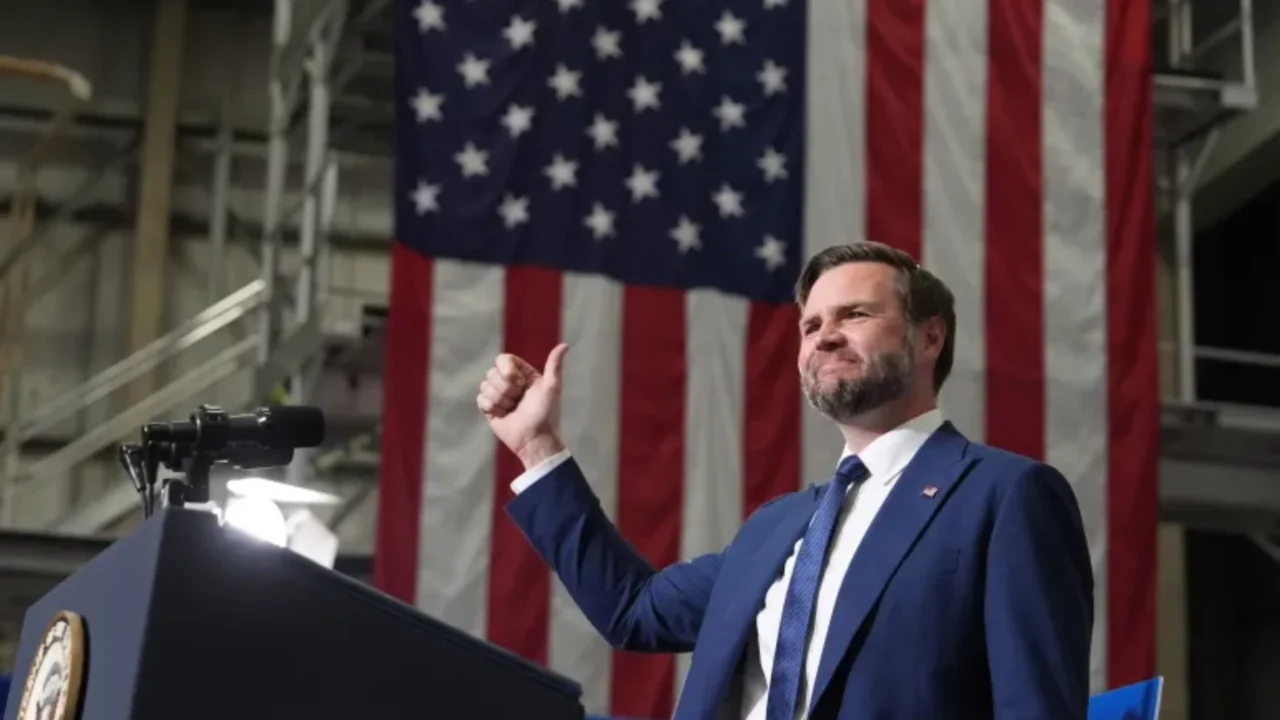
US Vice President JD Vance has thrust Jeffrey Epstein back into the center of a volatile political and media debate by suggesting that the late convicted sex offender had connections to American and Israeli intelligence. The remarks, made during a lengthy interview on Joe Rogan’s podcast, added a fresh layer of controversy to an already toxic subject that has long fed public suspicion, conspiracy theories and political suspicion across the United States and beyond.
Vance did not produce any documentation or verifiable information to back up his claims in the media reports that have been reported so far, but the way he used his language ensured that his statements were rapidly disseminated. He characterized Epstein as an individual who might have had connections well above those of the usual underworld criminals, since he seemed to be connected to powerful organizations and the “Israeli deep state.”
This choice of words is important since it shifts the focus of the debate from one which concerns the crime committed by Epstein to one which has political overtones in the form of the possible intelligence connections that he had. It thus amounts to a politically explosive statement which cannot be verified without supporting information. What makes Vance’s statements so significant is not just the man himself, but the fact that they were made by the vice president of the United States.
What Vance actually said
During the interview, Vance said Epstein “seemed to be connected” to elements of the “Israeli deep state” and also claimed he had ties to the “highest levels” of American intelligence and Israeli intelligence, according to the reporting. He also suggested that Epstein was not operating in isolation, but rather within a much wider ecosystem of influence that included political, media and institutional circles.
The phrasing is important. Vance’s use of “seemed to be connected” leaves room for interpretation and signals that he was not offering a completed evidentiary case. At the same time, the stronger claim that Epstein had ties to the “highest levels” of intelligence agencies elevates the issue from speculation to a sweeping accusation. That combination makes the remark especially newsworthy: it is cautious enough to avoid a direct factual assertion in one part, yet bold enough to invite intense scrutiny in another.
As per the report, Epstein’s links were not limited to just one political side of America but included both Republican and Democrats. This is quite a common trait among the reports about Epstein because he was a person who maintained contacts all across the spectrum of elite networks, providing him with a lot of social legitimacy. However, making a leap from social to intelligence connections is an entirely different ballgame altogether.
Why the remarks matter
The comments are significant for various reasons. Firstly, the comments are made by the vice president of the USA, and not some random congressman, senator or commentator. This gives weight and credibility that only very few people in the US political spectrum could achieve. Secondly, the issue here is Epstein, a name that stands for unexplained suspicion, the immunity of the elites and disturbing criminal activity. Thirdly, the comment addresses issues such as Israel, American intelligence services, and the term “deep state”, terms which are very politically-charged and may spark off debate outside of the context of the current situation. These are the reasons why the comments will receive widespread support and coverage. The comments appear in an atmosphere where the audience is prepared to be convinced that powerful structures conceal negative information about themselves.
Epstein’s case had been one of the most fertile soil for that belief due to the peculiar mixture of wealth, popularity, contacts and suspicions against him. By mentioning intelligence services, Vance made a transition from scandal into politics.
There is also a timing element. The remarks arrived amid renewed public attention to the Epstein files and to the Trump administration’s handling of that material. In that environment, any comment from a senior official was bound to be amplified, but a statement linking Epstein to intelligence services was almost guaranteed to dominate headlines.
Context around the Epstein files
The broader backdrop is the continuing controversy over the Epstein files and how the Trump administration handled public messaging around them. Vance himself said the administration
“absolutely screwed up the comms”
around the files, a remark that shows he was not simply repeating a conspiracy theory for effect, but also criticizing the government’s own handling of the matter.
This is a critical point to make because it places Vance in the controversy, not outside of it. It is not only that Vance is commenting on the situation; he is one of the top-ranking officials whose administration is being accused of failing in communication. Vance’s words are thus multi-faceted – they serve both as accusations against Epstein and the criticism of the way the White House handles this very explosive political situation. The Epstein files have gained a great political power due to their connection to criminal justice, secrecy and responsibility of elites. In any case where the government seems to be trying to hide something or behaves in an organized manner, the public tends to make up its own version of the events.
Evidence and denial
At the center of the story is a crucial question: what evidence exists for the intelligence claim? In the reporting available, the answer is none. The coverage says no evidence supports the allegation, and that is the key fact readers need to understand. Without documents, testimonies, official findings or credible investigative proof, the remark remains an assertion, not an established fact.
An additional counterargument to the conspiracy is the public denial by former Israeli Prime Minister Naftali Bennett, reported to have dismissed last year the possibility that Epstein served either Israel or its intelligence agency. This denial is significant since it directly denies the kind of speculation that Vance had made about Epstein. The denial highlights that there is a long-standing speculation that has been doing rounds in the public domain on the involvement of Israel and its intelligence agency in Epstein’s death without any concrete proof to back the claim. Lack of evidence, however, doesn’t always prevent these claims from being spread around.
On the contrary, lack of evidence usually helps the claim get life of its own once a high-profile person starts speculating about it. For this reason, most mainstream media have always taken a careful approach while reporting about the issue, pointing out that the claim is controversial and not proven at all.
Political and media reaction
The reaction to Vance’s comments has been shaped by both the substance of the claim and the identity of the speaker. Media outlets have highlighted the danger that the remarks may fuel conspiracy thinking about Epstein as an alleged asset of foreign intelligence services. Others have treated the statement as part of a wider pattern of political rhetoric that leans heavily on suspicion, secrecy and institutional distrust.
For the articles under analysis, one can observe that the former put the accent on the fact that Vance was making claims in a speculative manner, while the latter stressed the seriousness of the vice president addressing the topic of the possible links between the issue at hand and the intelligence community. This dichotomy is to be expected. In order to report on this topic, journalists have to fulfill two contradicting goals: the first one is to report about what was said by Vance and the second one – not to exaggerate the claims, which still remain unverified. Besides, there is another aspect that has to be taken into account when reporting about the case: the terminology involved can be easily interpreted as antisemitic.
The larger narrative
Epstein remains a uniquely powerful symbol in American political culture because his case seems to confirm many public fears at once: that the wealthy are protected, that institutions can fail, and that powerful people may escape full scrutiny. Vance’s remarks exploit that atmosphere, intentionally or not. By linking Epstein to intelligence services, he pushed the story into the realm of covert operations and state power, where proof is hard to obtain and speculation spreads rapidly.
That is also why the quotation is so important. “He seemed to be connected,” said Vance, but the move from “connected” to intelligence operative is a large one indeed. The readers should make sure that they do not equate assumption with evidence. In the reporting on public affairs, this is key. The statement may carry political weight despite having no factual foundation, and it seems to be a case in point here. Another thing that the story demonstrates is the power of prestigious names and institutions when it comes to creating news. Epstein, intelligence agencies, Israel, American politics, and vice-president’s public utterances all combine into a package which seems to be practically designed to go viral. But not everything that goes viral is necessarily true, and that is the very essence of responsible journalism.