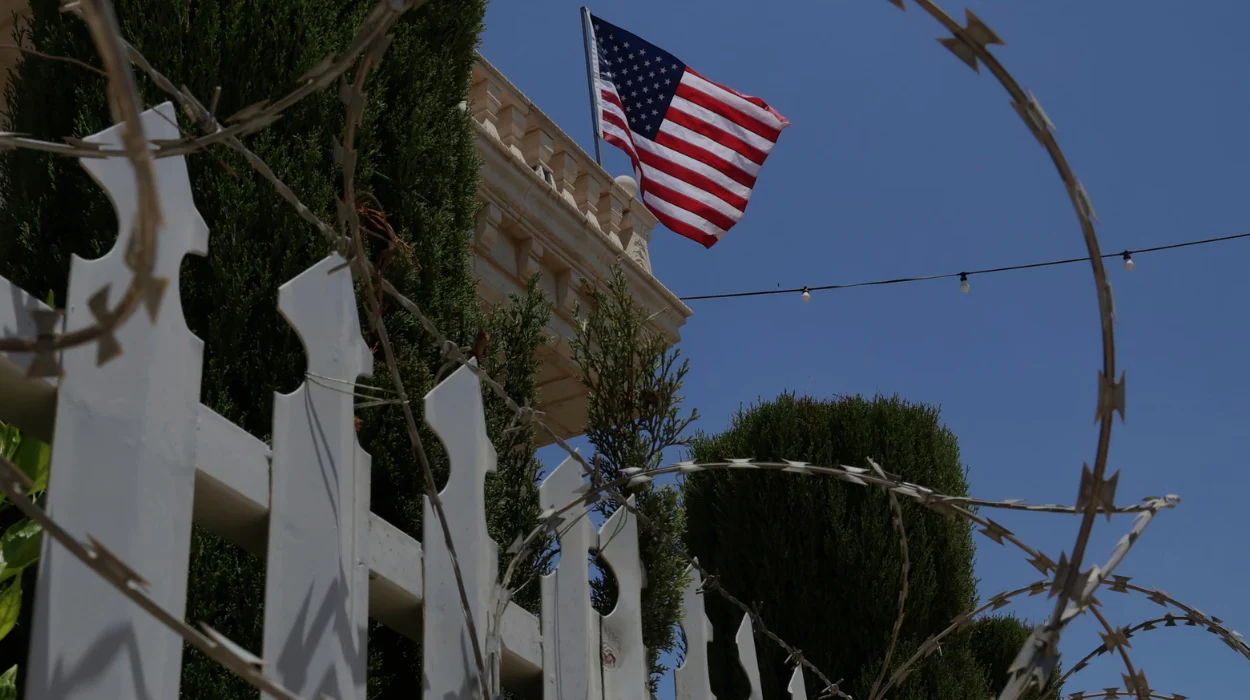
The surge of Israeli settler violence in the West Bank has turned Turmus Ayya into a symbol of Palestinian American vulnerability, anger, and political abandonment. For families with U.S. passports or green cards, the violence is not only local, but also a direct test of whether American citizenship carries any real protection when the threatened place is an occupied Palestinian village.
The new reporting frames this as a story of people trapped between two failures: the inability of Israel’s security apparatus to stop the attacks and the inability of the United States to protect its own citizens. Palestinian American residents say that after U.S. Ambassador Mike Huckabee visited the nearby settlement of Shilo, attacks on Turmus Ayya intensified, deepening the sense that Washington is present only when it is politically convenient, not when residents are under fire.
Why the anger is rising
The frustration at Turmus Ayya is derived from both the magnitude and repetitiveness of the acts of violence. The Human Rights Watch noted that settlers and Israeli forces have forcibly displaced whole communities and the increase in the violent attacks has been attributed to Israel’s negligence as the military has participated in the attacks or has failed to prevent them. Another legal study notes that it is the duty of the occupying power to protect civilians in the occupied territory from any third-party violence, which Israel has failed to do. The legal and human rights framework in this case is significant because the acts of violence are not portrayed as individual criminal acts. They are considered part of the larger scheme of “indulgence” where the attacks by settlers are predictable but inadequately punished.
The numbers behind the crisis
The figures in the reporting show why this story has widened beyond one village. A 2023 issue brief said settler violence had reached about three violent attacks per day on average, with 475 settler-related incidents causing Palestinian casualties or property damage in the first five months of that year.
Following October 7, it seems to have picked up even more speed. According to Human Rights Watch, between October 7 and April 3, there were more than 700 settler attacks, almost half of which had soldiers present, and that 1,200 or so people, including 600 children, were forced to leave rural herding areas. Another 2025 report claims that 757 settler attacks occurred in the first half of 2025, marking an increase of 13% from the corresponding period in 2024.
Also noteworthy is the high toll in terms of human costs on Americans’ lives. As reported in the sources cited by the searches, since 2022, no less than nine Palestinian Americans have been killed in the West Bank area by settlers or Israeli military, and later sources indicate at least five, and then six, American citizens dead in the area within a two-year period. The exact number may be different according to sources and the date used for calculations in each account, but the core of the situation remains the same: Palestinian Americans are being killed, injured, displaced, and stuck in a conflict where their U.S. citizenship did not protect them.
What Turmus Ayya symbolizes
Turmus Ayya is not a marginal village in this story; it is the epicenter. Reporting from 2023 described it as a prosperous West Bank town where 70% to 80% of residents had U.S. citizenship or permanent residency, while another account put the figure at more than 90% American. The difference reflects differing estimates, but both underscore the same point: this is a community with unusually deep ties to the United States and unusually weak protection on the ground.
The village has long been connected to the diaspora, with families returning in summer and building homes as both an act of investment and an act of belonging. That is why the violence has landed so hard. One resident described homes that “belong to Americans” but have “zero protection,” while the mayor estimated the damage from one rampage at around $10 million. For families who came back to reconnect with their roots, the attacks are also a warning that return itself can become a liability.
The attacks and the response
One of the most detailed cases of such violence happened in June 2023. According to Human Rights Watch, settlers from nearby illegal settlements set fires on cars, broke windows, firebombed buildings, burned five houses and 22 cars, and attacked the residents. Later, the army confessed to the fact that “it had failed to prevent the attack,” saying that it did not have enough time to get there due to overstretched forces. This information is significant as it contradicts the claim that such acts of violence happen randomly and uncontrollably. At the same time, Israeli officials confessed to the fact that they arrested some settlers in such incidents, but in the case of the attack on Turmus Ayya, there were no arrests made, nor was any compensation provided to the residents.
The American connection
It is the American aspect that makes this story political. The residents of Turmus Ayya had complained to the U.S. Embassy before and complained that the embassy had not responded to their needs with the urgency they had hoped for. According to one of the villagers, “the village was peaceful but was full of U.S. citizens who had American passports that had done nothing when the violence erupted.”
The anger is a reflection of anger by Palestinian-Americans trapped in Gaza and who then sued the U.S. government for failing to protect them from harm during the war. During that lawsuit, the plaintiffs claimed that the State Department discriminated against Americans of Palestinian descent by abandoning them in the midst of a war zone while evacuating Israeli-Americans.
Competing narratives on the ground
Settler leaders reject the suggestion that the violence is one-sided. Some say the area has seen repeated attacks on roads, that fears among settlers are growing, and that local Israelis are living under threat. One regional council leader said people are becoming “very reckless” because they fear for their lives, while another official called the rampage wrong but argued it was a reaction to terror attacks against Israelis.
Palestinian residents, however, say these explanations cannot justify arson, beatings, and land seizure. In Turmus Ayya, families describe being prevented from accessing land, having olive trees uprooted or burned, and being attacked during the harvest season by settler groups and sometimes by the army. The result is a familiar cycle in the West Bank: an attack on Palestinians is framed as retaliation, while the retaliation itself creates new trauma and displacement.
Why the US is being blamed
However, the issue with Washington’s inaction does not lie just in the fact that it did not do anything about it. Some critics pointed out that if the country managed to provide billions of dollars in aid to Israel every year, then it must also be able to secure protection of its Palestinian American citizens. Another point was that their human rights are no different from the human rights of any other individual, yet their rights were violated on grounds of ethnicity/nationality. The problem with such criticism lies in the fact that it goes beyond the field of consular services and enters the domain of accountability and foreign policy. While condemning the violence, the U.S. often uses the phrase that calls for “full accountability” and compensation for victims, yet Palestinian Americans state that their lives are not being protected in any way.
It is important to note that this issue concerns much more than just the village and its administration. In essence, this is whether Palestinian Americans can be sure that the country they have citizenship from will defend them when they face threat in the land they live in, visit, or have connections with. In addition to that, it is an issue whether the settlement process in the West Bank, which is supported by state power and lacks strong implementation, can continue to grow by instilling fear into people without receiving any consequences. At the moment, the facts suggest that the process is likely to repeat itself once again: attacks on Palestinians, lack of justice, evictions, murder of Palestinian Americans, and insufficient response from the United States.