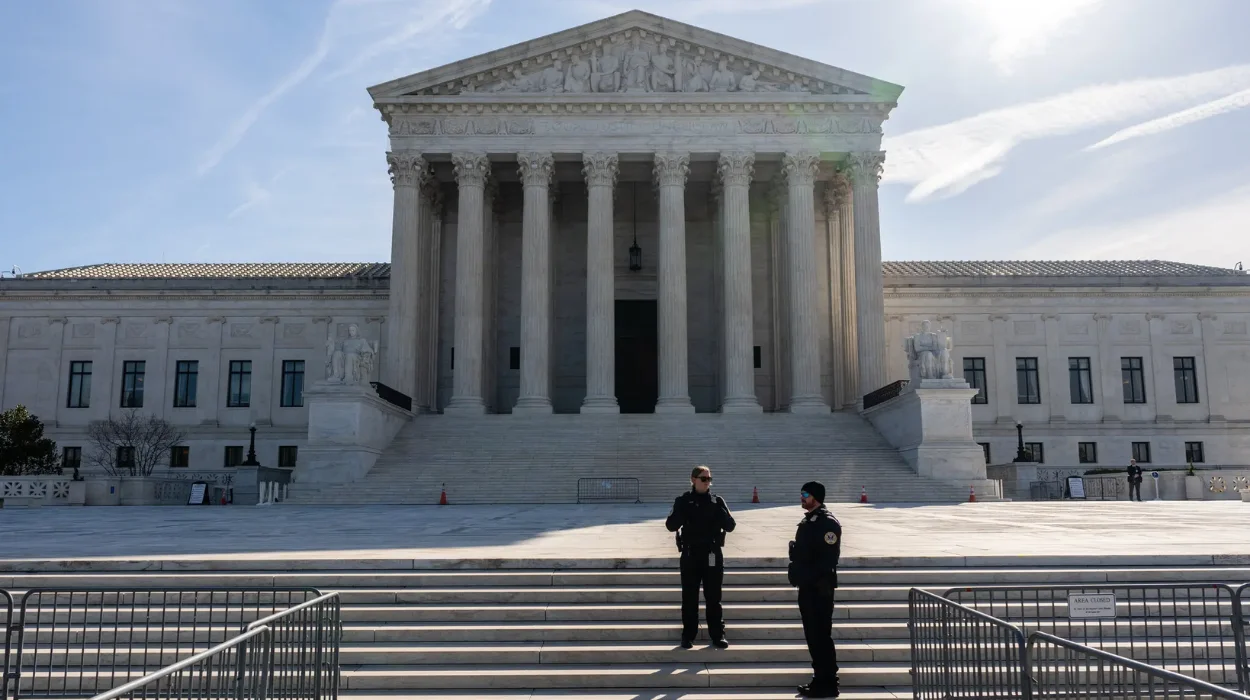
The Supreme Court has taken the unusual step of sending two of its most prominent justices to Capitol Hill to ask Congress for more money to protect the institution and the people who serve it. In a rare appearance that underscores how seriously the court views the current threat environment, Justices Elena Kagan and Amy Coney Barrett are expected to press lawmakers for additional security funding amid rising concerns about threats, protests, and the safety of the judiciary. The move is notable not only because of the subject matter, but because sitting Supreme Court justices almost never testify before Congress, making this a significant moment in the relationship between the judicial and legislative branches.
It all boils down to making sure that the judiciary operates without fear. The justices are not asking for a change in any policy or anything like that; all they want are some resources which will enable the judiciary to take care of its justices, employees, and court buildings better. This is significant since in the present political environment, every institution finds itself drawn into a political contestation, but the judiciary wants to make it clear that its security is a non-negotiable issue.
Why the hearing matters
This development happens as issues about security threats to judges and government officials have come into sharp focus. The stories surrounding the hearing are characterized by growing threats against the court and mounting pressures on those who work in the federal judiciary. In light of this, the request for “millions” in increased budget is being portrayed as a necessary step rather than simply a symbolic one. What makes the situation important is how it looks. Justices of the Supreme Court normally communicate their thoughts in form of opinions but not congressional hearings. When they communicate outside the courtroom, it is always in a highly controlled environment. The fact that there is going to be such a hearing is already an indication that the Supreme Court takes the issue very seriously.
The court’s position is also consistent with a broader concern about institutional independence. The judiciary depends on public confidence and physical safety to do its work. If threats become normalized, the effect can reach beyond any one courtroom or judge. The hearing is, in that sense, about defending the legal system’s ability to operate without fear.
Who is speaking
The two justices at the center of the story are Elena Kagan and Amy Coney Barrett. Their joint appearance is especially striking because they come from different ideological backgrounds and are widely viewed as representing different wings of the modern Court. That combination gives the request broader credibility and signals that the issue cuts across judicial philosophy.
That these two justices appeared at the same time also indicates their intention to convey a message that this is an issue beyond political divides. The presence of these two justices is a way of stressing the unity regarding the issue that should transcend any partisan interests. With the current highly charged political atmosphere, the decision to have both justices present during this discussion is one that makes the event appear as more of an institutional affair than an ideological one. Their appearance in front of legislators for the first time since 2019 as stated by the media reports regarding the hearings shows just how special this event is.
What the court wants
The court is seeking additional money to strengthen security around the justices and court operations. The reporting describes the request as involving “millions” of dollars, aimed at bolstering protective measures, personnel, and related security infrastructure. While the exact line-item figures may vary by budget document and hearing testimony, the scale indicates the court is not asking for a marginal adjustment. It is asking for a meaningful upgrade in response to a changing risk environment.
The request likely includes several categories of spending. That typically means enhanced protection for individual justices, more secure transportation or movement protocols, improvements to the Supreme Court building’s defensive systems, and extra resources for threat monitoring and emergency response. In practical terms, the court is trying to reduce vulnerabilities that could affect both personal safety and institutional continuity.
This kind of funding request is also part of a larger federal budgeting reality. The judiciary cannot simply appropriate money on its own; it must come to Congress for approval. That makes the hearing not just an appeal for help, but a reminder of how the constitutional system handles the court’s operational needs. The justices are effectively asking lawmakers to treat judiciary security as a national governance issue.
Threats and pressure
In the context of the hearing, there exists an atmosphere of increased hostility against the judicial branch. The reports on the hearing indicate a rise in threats and protests against important judicial verdicts as well as against the Supreme Court as such. Such an atmosphere has forced the judicial branch to consider security issues more thoroughly. Threats against the judges are particularly disturbing as they may have an impact not only on the judges themselves but also on the way in which the judges will perform their functions. The fear for one’s safety can be a powerful deterrent to a person performing his/her functions independently and competently.
This is why the request is being treated as more than a standard budget issue. It is being presented as a direct response to the risk that public anger, when combined with threats, can create conditions where judicial independence is under strain. The court’s move suggests that the problem is no longer abstract. It is operational, immediate, and costly.
Political and institutional stakes
The hearing carries political implications even if the justices themselves are trying to keep the issue above politics. Any time the Supreme Court appears before Congress, the separation of powers becomes part of the conversation. Some lawmakers will likely see the request as entirely reasonable, while others may worry about how public perception shifts when justices directly lobby for resources.
But the underlying point remains hard to refute. No judicial institution can work safely when there are credible threats against the judges but there are no security measures available. It is not a question of whether the security is needed or not, it is more about how much is needed, who will supervise it and whether it will remain transparent. These questions become relevant considering the fact that congressional appropriation is an allocation of taxpayers’ money and the members have to reconcile the judiciary’s demands with the financial realities. Perhaps it is this very bipartisan nature of the problem which made the incident gain prominence. Even in a polarized Congress, judge’s security becomes a rare area where consensus can be reached irrespective of political affiliations.
What this says about the Court
The Supreme Court’s decision to seek security funds publicly says a great deal about the atmosphere surrounding the institution. It suggests a court that sees itself not only as an arbiter of legal disputes, but as a vulnerable institution that must now actively defend the conditions under which it can perform its work. That is a sober acknowledgment of the pressures facing the federal judiciary.
It also reveals how much the Court has changed in the public imagination. Once seen largely as a distant and reserved institution, it now sits at the center of political and cultural conflict. That attention has brought scrutiny, criticism, and in some cases hostility. The security request is a sign that the consequences are no longer limited to rhetoric. They are now shaping institutional behavior.
The presence of both Kagan and Barrett also offers a subtle but important message: the issue transcends judicial ideology. Security is not about liberal or conservative outcomes; it is about preserving the rule of law. If the court cannot protect its own members, it weakens the public’s confidence that the legal system can protect anyone fairly.
This is more than a budget hearing. It is a measure of how stressed the relationship between institutions has become. The Court is asking Congress for help because the cost of security has risen along with the temperature of public anger. In that sense, the hearing is a symptom of a broader democratic strain.
At the same time, the request is also a test of whether the system can respond responsibly. If Congress provides the funds, it will be affirming that judicial independence includes a duty to protect judges from intimidation. If lawmakers hesitate, the result could be slower protection for the Court at exactly the moment it says it needs it most.
The most important takeaway is that the Court is not trying to expand its authority. It is trying to protect its ability to operate without fear. That may sound procedural, but in a democracy it is deeply consequential. A judiciary that feels unsafe is a judiciary under pressure, and that is why this hearing matters.