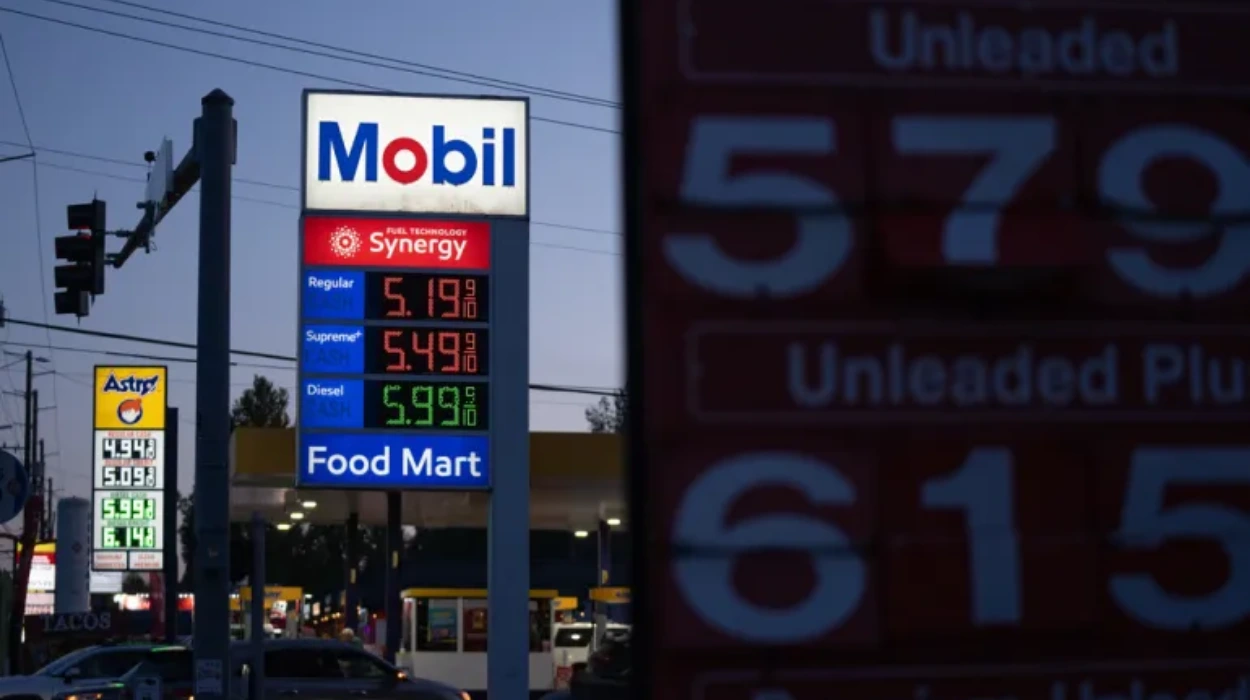
US gas priced at 4.30 a gallon has turned out to be one of the most evident signs that the Iran war is not the preserve of foreign policy debate anymore. It has penetrated into daily household budgeting choices in a manner that is instant and apparent. The increase of levels that were lower than 3 at previous times to now above 4.30 in a narrowed time span indicates how easily instability in the world can be passed on to inflation in the country.
Gasoline is very visible in the U.S. economy. As opposed to other elements of inflation which build up over time, fuel prices are monitored regularly and in an open manner. This renders them as a political and psychological magnifier of world events. When there is sharp price change at the pump, crisis image becomes localized, and the focus of the people is not on debates about strategy but on the cost-of-living issue.
Inflation psychology and consumer pressure
According to economists, fuel is usually termed as an inflation anchor since it influences the expectations of other sectors. Once the new standard of gas in the US is set at $4.30, it changes the way people expect food to be priced, how much they spend on traveling or even on transportation. This may be an expectation effect that may continue even after the stabilization of crude prices.
This dynamic has been exacerbated by the pace of recent increases. Instead of slow changes, weekly jumps instill a feeling of instability, as consumers start to change in advance. These involve less discretionary travel, and heightened responsiveness to more general economic policy choices relating to foreign war.
Strait of Hormuz tensions and global oil market sensitivity
The Strait of Hormuz continues to be the key to the possibility of US gas at 4.30. This seaway route transports a large portion of oil exports around the world and even the perception of a threat has been sufficient to change the world pricing systems. In the Iran war escalation, even physical flows that were not fully impacted saw a rise in shipping risk premiums.
Markets are not only sensitive to disruption, but also to probability. Traders modify the prices as soon as they expect the possible congestion or unpredictability. This preemptive action is the reason behind the fact that retail gasoline can increase very quickly before supply chains are completely constrained. The risk anticipation turns out to be a pricing process itself.
Crude oil transmission into retail fuel costs
The process of crude oil prices to retail gasoline is not usually rapid, but geopolitical shocks shorten that time. As the Brent crude market surged to over 100 barrels during peak tension times, downstream fuel markets responded rapidly and pushed the retail gasoline market to and beyond 4 thresholds.
This is enhanced by refining margins and distribution networks. Uncertainty bodes higher logistical costs and insurance coverage to transport and store goods. These indirect impacts intensify the initial increase in crude prices, increasing the rate of change in the rise in costs at the pump by consumers.
Political messaging and economic reality divergence
Political framing of US gas at 4.30 has centred on the anticipation that prices will fall as the geopolitical tensions relax. Suggestions that fuel prices will tumble after conflict resolution are based on assumption that the price increase is a temporary event that is externally induced.
Nonetheless, this message is in tandem with a more intricate economic truth. The oil markets in the world are risk sensitive, and even partial instability can perpetuate high prices. The difference between estimated relief and instantaneous consumer experience poses a challenge to credibility of policymakers especially where stabilization timelines are still unpredictable.
Domestic perception of global strategy outcomes
The macroeconomic analysis is often at odds with household interpretation of fuel prices. In the Iran conflict, weekly fuel costs are understood as the outcomes by consumers, whereas policy discourses focus on strategic goals. This puts a rift between geopolitical framing and experienced economic life.
With the US gas at $4.30 continuing, the commoners are finding it hard to distinguish between foreign policy justification and domestic financial pressure. Such overlap renders political sensitivity when it comes to energy-related decisions that relate to military or diplomatic escalation.
2025 escalation pathway and structural energy pressure
The state of fuel that we exist in today has not come into being overnight in the year 2026. In 2025, the global energy markets experienced a steady rise in risk premiums due to the ongoing growing tensions, sanction changes, and the occasional diplomatic breakdowns. Traders were already pricing in instability along major supply routes even before escalating into full scale conflict.
Mid-2025 already started to show a tendency to increase the price of gasoline, as it was anticipated that the supply conditions would be tightened. The shift in anticipation to active fight in the Iran war turned the anticipations into price pressure, which remained, in the form of high costs, in retail markets.
Global inflation spillovers from energy shocks
The effects of increased prices of crude oil are not limited to gasoline. Energy prices also rise drastically, which leads to an increase in transportation, aviation, and logistics. These trickle down into the larger inflation trends that impact on the distribution of food and industrial production.
The cost of US gas at 4.30 is thus just one of the tip of an iceberg in terms of economic realignment. The oil pricing is global and this implies that even those parts of the world that are not directly affected by the conflict have indirect effects of inflation, which supports the interconnectedness of the energy markets today.
Domestic economic strain and political sensitivity
The role of fuel prices in the economic sentiment of households is disproportionately large. At 4.30 gasoline it has a direct impact on commuting expenses, small business operations and price differentials in the region. This renders energy inflation to be one of the most politically sensitive economic indicators in the United States.
Fuel costs demand immediate behavior change as opposed to other types of inflation which are assimilated over time. This involves a decrease in travel, a change of consumption, and questioning of policy choices with reference to international stability.
Strategic trade-offs in crisis management
Policymakers have to balance between geopolitical goals and national economic stability. The response to the Iran war has actions that affect the expectations of the world supply that eventually has a backlash on domestic price levels. This forms a reciprocal association between foreign policy and domestic economics.
Unless the energy markets are no longer subject to geopolitical changes, US gas at 4.30 will remain an economic barometer, as well as a political bargaining point. This will be not solely dependent on market forces but also on the course of the international stabilization efforts.
Energy pricing as a reflection of geopolitical stability
The rise of US gas at $4.30 illustrates how deeply interconnected global conflict and domestic economic conditions have become. Energy markets now translate geopolitical risk into immediate consumer pricing, reducing the time lag between international events and household impact.
What remains uncertain is whether this pricing level represents a temporary shock or a new baseline shaped by sustained instability. As the Iran war continues to influence global oil flows and market expectations, the direction of fuel prices will remain closely tied to developments far beyond domestic economic policy, reinforcing the extent to w hich global security dynamics now shape everyday financial reality.