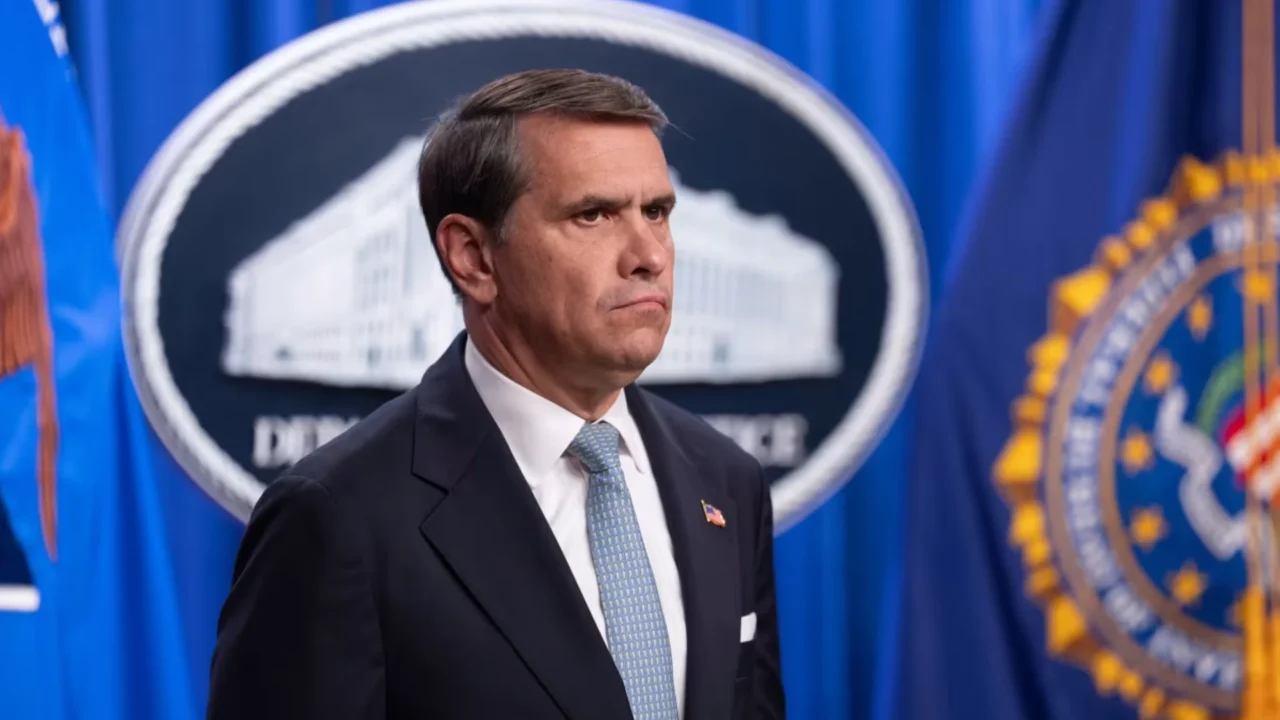
Todd Blanche’s confirmation as attorney general has placed Donald Trump’s former personal lawyer at the head of the United States Justice Department, giving the president one of his most loyal legal allies permanent control of the country’s top federal law-enforcement agency.
In an early Saturday vote, the Senate, with Republicans in control, confirmed Blanche by 50 to 49 after weeks of uncertainty and opposition from some Republican senators. While all Democrats rejected the nomination, the Republican senators, including Susan Collins from Maine and Lisa Murkowski from Alaska, voted against Blanche. With the support of Republican Senator Bill Cassidy from Louisiana, Blanche was able to achieve the narrow majority needed for confirmation. This is not only a case of a simple change of leadership at the Justice Department. Blanche is not an outside individual who has simply become part of the Trump administration. Prior to his appointment at the Justice Department, he represented Trump, in what are some of the most significant cases against a former president of the United States.
The confirmation of Blanche therefore presents a question that cannot be easily answered, whether Blanche will be independent as the law-enforcement head of the nation after representing Trump in court for several years. That question will define his tenure.
From Manhattan Lawyer to Attorney General
Blanche established himself within the American legal system in his early years. He worked as a federal prosecutor in New York and was a partner in the prestigious law firm Cadwalader, Wickersham & Taft. By leaving this profession in 2023 to work for Trump, he changed his career and political orientation. He represented Trump in the criminal case related to the payments made to the adult-film star Stormy Daniels in New York. Furthermore, he represented him in the classified documents case in Florida and the election interference case in Washington on a federal level. Blanche was a lead counsel for Trump in the New York trial where a Manhattan jury found the ex-president guilty of 34 felony counts of falsifying business records.
This case brought Blanche to prominence among other lawyers in America and put him into confrontation with Judge Juan Merchan who found something inappropriate about his conduct in court. However, there were many risks of representing the former president as he faced several criminal charges and even a risk of being imprisoned. Nevertheless, Trump managed to avoid severe consequences and Blanche’s participation in these cases improved his political career significantly.
Trump later appointed him deputy attorney general. The Senate confirmed Blanche to that position in March 2025 by a 52–46 vote. After Pam Bondi’s departure, Blanche became acting attorney general in April 2026. Trump formally nominated him for the permanent position in June.
The promotion illustrated the extraordinary speed of Blanche’s rise. In only a few years, he moved from private criminal defense to the second-highest Justice Department position and then to its top office.
Trump has repeatedly portrayed Blanche as a trusted and effective ally. During the confirmation standoff, Trump wrote that “Todd Blanche is a STAR”, while also making clear that Blanche would remain acting attorney general even if the nomination were withdrawn.
That statement reflected both Blanche’s political value to Trump and the administration’s determination to keep him in control of the department.
A Justice Department Reshaped
The department Blanche inherits has already undergone a major transformation. The administration has dismissed, reassigned or pressured out experienced prosecutors, investigators and senior officials associated with cases involving Trump and the January 6, 2021, Capitol attack.
In a March CPAC appearance, Blanche stated that the individuals associated with the investigation of Trump have been forced out of the Justice Department and/or FBI. According to CNN, Blanche talked about over 200 individuals, yet the exact number couldn’t be verified. A movement against his appointment, known as the Justice Connection campaign, says that over 16,000 people who worked in the Justice Department left while Blanche was leading the department, including about one-quarter of its lawyers. While this figure is provided by an advocacy organization and therefore still unverified, this shows how worried people were about this matter.
It is also alleged that Blanche was overseeing the firing of hundreds of prosecutors, agents, and other officials associated with the January 6 cases or those involved in investigations by special counsel Jack Smith. Critics say that such firings are a message across the whole department: if you prosecute politically controversial cases and make the president unhappy about your work, then you may lose your job.
Blanche and his supporters describe the personnel changes differently. They say the Justice Department was used against Trump and conservative groups during the Biden administration and that officials involved in politically motivated prosecutions should not continue to hold influential positions.
That argument has become the central justification for the administration’s restructuring. But it also creates a serious institutional risk. Career prosecutors are expected to serve the law rather than a president. If professional independence is replaced by loyalty to the White House, future administrations may inherit a department in which law-enforcement decisions are shaped by political retaliation.
The Justice Department’s official profile says Blanche will oversee more than 100,000 employees, including the FBI, the Drug Enforcement Administration, the Bureau of Prisons, the US Marshals Service and 93 US attorneys’ offices.
His decisions will therefore affect not only Trump-related investigations but also immigration enforcement, organized crime, civil rights, terrorism cases, public corruption prosecutions and federal litigation across the country.
The Presidential Immunity Question
Blanche’s opinions regarding presidential power assume a lot of importance in the context that the opinions have been developed when he was defending the person in question, Trump. Blanche defended President Trump in Trump v. United States. The defense position included arguments in favor of granting immunity to former presidents against prosecution for their official acts. One of the main arguments for the defense position was that the president should not be prosecuted for his official acts unless he had been impeached and convicted by the Senate. Supreme Court did not accept this broad theory.
Nevertheless, in 2024 Supreme Court ruled that a former president enjoys absolute immunity from prosecution for actions within his conclusive and preclusive constitutional authority, and he enjoys presumptive immunity from prosecution for other official acts. Immunity cannot be extended to any unofficial act. Thus, this ruling provides more protection to the presidents and limits the capacity of prosecution in charging a president with crimes based on official acts.
As attorney general, he will now oversee the federal government’s position in cases involving presidential authority. That includes disputes over executive orders, federal prosecutions, classified information, congressional investigations and the president’s ability to remove executive officials.
The conflict-of-interest concern is unavoidable. Blanche previously worked to protect Trump from criminal liability. He now commands the department that may be asked to investigate the president, his family, political allies or allegations involving the White House.
During his confirmation hearing, Blanche attempted to downplay the personal relationship. But critics argued that his career was built on loyalty to Trump and that the administration selected him precisely because of that loyalty.
The Anti-Weaponization Fund Controversy
The most immediate threat to Blanche’s confirmation came from a Justice Department fund created through a settlement linked to Trump’s lawsuit against the Internal Revenue Service.
Trump and members of his family had sued the IRS for $10 billion, alleging that a contractor improperly disclosed the president’s tax information. The resulting settlement included an approximately $1.776 billion Anti-Weaponization Fund intended to compensate people who claimed they had been unfairly targeted by the government.
The arrangement alarmed senators from both parties. Blanche initially refused to rule out payments to individuals involved in the January 6 riot, including people accused or convicted of violence against police officers. “Anybody can apply,” Blanche said in explaining the possible eligibility for payments.
The possibility that public money could compensate January 6 rioters created a political crisis for the nomination. Republican senators John Cornyn and Thom Tillis demanded assurances that the fund would not be used to reward political allies or undermine federal prosecutions.
Blanche eventually rescinded the fund in writing. A Justice Department order stated that the May 18 order creating the Anti-Weaponization Fund
“is rescinded and shall have no force or effect.”
The reversal helped persuade Republican holdouts to support advancing the nomination. But the controversy exposed the broader political character of Blanche’s Justice Department. The fund was presented by the administration as a remedy for alleged federal “weaponization,” while opponents saw it as a potential mechanism for compensating Trump allies and punishing officials involved in investigations of the president.
Murkowski remained unconvinced and voted against confirmation. Her opposition reflected concern that the fund could be recreated later through another legal structure.
Conflict With Federal Judges
Under Blanche’s tenure, there have been many instances of conflicts between the Justice Department and federal judges. In Rhode Island, the judges refused to appoint a new interim US attorney as there was an ongoing conflict between the administration and the judges regarding the behavior of the Justice Department. The judges wanted to protect the “non-political professional operation of the US Attorney’s office.” Blanche appointed the current prosecutor through another means of appointment, thus creating more controversy over the powers of the President and the federal judge. Democrats from the House Judiciary later charged that the Justice Department attorneys had misled the courts on various occasions and ignored the orders of the judges.
Another dispute involved records associated with Jeffrey Epstein. Federal Judge Emmet Sullivan said Blanche had effectively conceded violations concerning the handling and redaction of Epstein-related files. The judge ordered the department to remove redactions or justify them in detail.
These cases have made Blanche’s legal strategy a subject of judicial scrutiny. Judges across the country are not merely challenging individual Justice Department decisions; they are questioning whether the department is respecting the traditional separation between executive enforcement and judicial review.
Blanche’s supporters argue that the president must retain control over executive officials and that courts should not micromanage the administration’s personnel decisions. His opponents counter that presidential authority does not permit the Justice Department to ignore court orders or manipulate prosecutions for political purposes.
What His Confirmation Means for Trump
Blanche’s confirmation strengthens Trump’s control over the Justice Department at a time when the administration is pursuing an aggressive agenda on immigration, federal prosecutions, drug trafficking, violent crime and alleged political retaliation.
Among the priorities for Blanche, as mentioned in the statement released by the Justice Department, are the fight against illegal immigration, the dismemberment of transnational drug cartels, violent crimes, and the protection of the taxpayers from frauds. However, those priorities may well run concurrently with the ongoing struggle with what Trump and his supporters refer to as “weaponization of federal law enforcement.”
The department has already established mechanisms to investigate potential misconduct of the officials dealing with cases involving Trump. The problem, in the words of Blanche’s critics, is that law-enforcement priorities might be mixed up with presidential political agenda. And while a department devoted to prosecutions for immigration and violent crimes can remain independent, a department where prosecutors are fired because they investigated the president cannot.
Blanche’s confirmation does not settle that debate. It moves it into the next phase.
His supporters see him as a seasoned lawyer capable of restoring discipline and accountability to an institution they believe targeted conservatives. His critics see a former presidential defense attorney taking command of the very department that should provide an independent check on executive misconduct.
The decisive test will come when the Justice Department must choose between protecting the president’s political interests and enforcing the law against those interests. Todd Blanche has now secured the authority to make that choice.