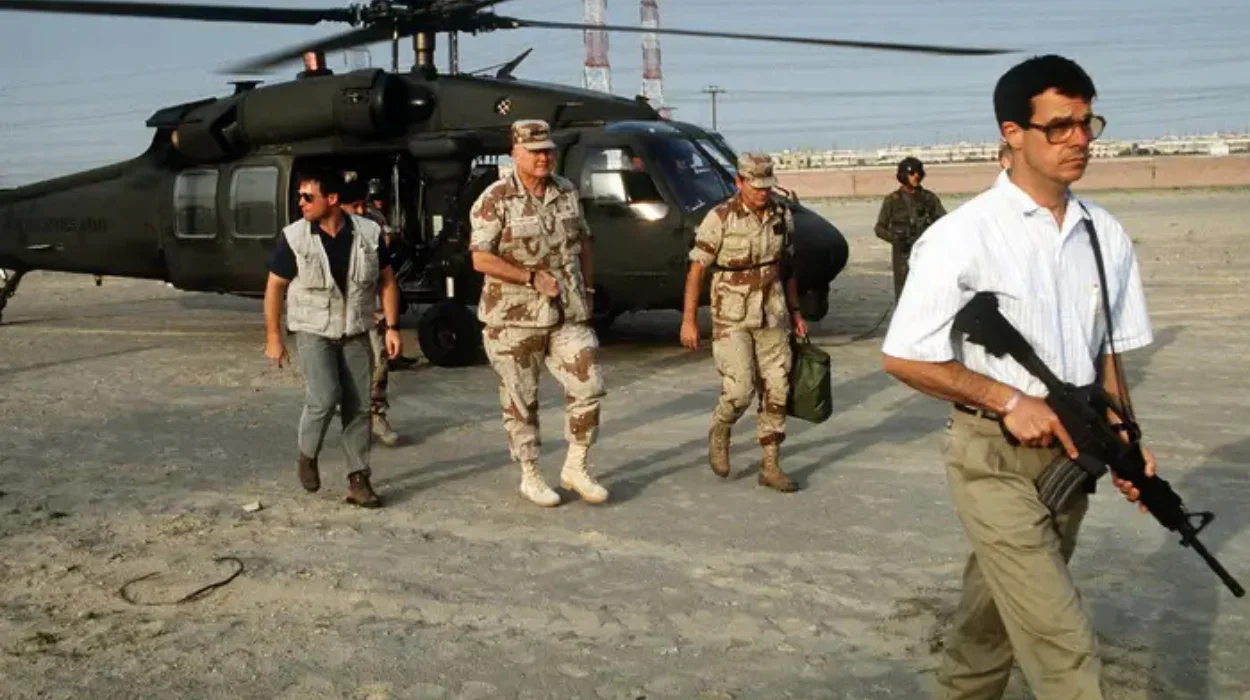
The arrival of several hundred US Special Operations Forces including Navy SEALs and Army Rangers alongside thousands of Marines and elements of the 82nd Airborne Division signals a marked escalation in Washington’s military posture toward Iran. Officially, the deployments are framed as measures to “bolster deterrence,” support regional partners, and provide the US president with flexible options short of a full-scale conflict. Yet the positioning of elite ground units suggests a strategic pivot from primarily air‑and‑naval campaigns toward a structure capable of precision operations on the ground, should policymakers decide to act.
Roughly 50,000 US troops are now in the region, an increase of about 10,000 over peacetime levels. This surge implies that the United States is no longer simply projecting power from afar. Instead, it is assembling the necessary forces to execute rapid, limited operations, reducing the time lag that would otherwise delay a response to emerging threats. The signal is clear: the administration intends to maintain operational flexibility while conveying to Tehran that high-value targets and strategic nodes could be contested with precision if deterrence fails.
Tactical reasoning behind the deployment
Special Operations Forces are designed for small-scale, high-impact missions such as raids, sabotage, and the seizure of critical infrastructure. Complementing them, Marine Expeditionary Units and airborne elements provide rapid strike and temporary hold capabilities. The UXSS Tripoli amphibious group, carrying more than 2,500 Marines, alongside a second Marine Expeditionary Unit and at least 1,500 paratroopers from the 82nd Airborne, positions mobile forces capable of intervention in Persian Gulf chokepoints or austere harbor and airfield environments. The combination of elite precision forces and expeditionary units allows US decision-makers to escalate selectively without committing to a full-scale invasion.
Deterrence and signaling
The deployment serves a dual purpose. It reassures regional allies that the United States remains committed to Gulf security while signaling to Iran that any misstep could trigger an immediate, credible response. The presence of Special Operations Forces functions less as a preparation for imminent action and more as a tangible demonstration of capability and intent, shaping Tehran’s calculations on risk and escalation.
What Special Operations capabilities imply
Analysts note that the presence of Special Operations Forces in the Gulf is significant for where and how they could be employed, even in the absence of assigned missions. Media reporting and statements from anonymous officials indicate potential scenarios involving the Strait of Hormuz, Iran’s Kharg Island oil terminal, and the Isfahan nuclear enrichment facility. Each target presents distinct operational challenges: clearing mines and disabling missile systems in the Strait, conducting raids on export infrastructure at Kharg, and neutralizing high-value nuclear materials at Isfahan.
Precision and political deniability
Special Operations units are uniquely suited for missions where collateral damage must be minimized, and political deniability is a priority. These capabilities allow the US to retain leverage while reducing the risk of triggering a broader conventional confrontation. The buildup signals a shift from “remote-strike capability” to “on-the-ground operational readiness,” marking a new phase in US contingency planning for Iran.
Strategic flexibility
The functional nature of these deployments is central. Numbers alone are less important than the combination of mobility, precision, and the ability to secure or neutralize high-value targets rapidly. This mix provides policymakers with options to apply calibrated pressure without fully committing to war, maintaining a spectrum of escalation that can be adjusted in real time.
Regional and Iranian readings of the deployment
Iranian officials have framed the US Special Operations buildup as preparation for potential ground operations, even as Washington stresses it is not planning an invasion. The Islamic Revolutionary Guard Corps warned that any US incursion would provoke a “forceful” response, leveraging missile, drone, and naval capabilities. Tehran interprets the presence of SEALs, Rangers, and airborne troops as a direct signal that the US is prepared to contest control of the Strait of Hormuz and key energy infrastructure. Hard-line elements in Iran view the deployment as a red-line escalation designed to permanently degrade Iranian regional influence.
Gulf-Arab perspectives
Gulf states have publicly welcomed the US presence, arguing that it strengthens deterrence amid Iran’s expanding naval and missile reach. Privately, some officials express caution, concerned that visible Special Operations and airborne deployments could escalate the risk of miscalculation. Any incident involving Iranian proxies or critical infrastructure might be misinterpreted as a larger-scale operation, heightening tension. The prevailing view is that US forces stabilize the region only if used strictly as deterrent tools rather than for operational raids.
The risk of miscalculation
While elite troop deployments convey strength, the ambiguity surrounding their potential use carries inherent risks. Iran may probe US and Gulf responses, potentially creating flashpoints that could spiral unintentionally. This duality—stabilizing on one hand, provocative on the other—defines the strategic calculus in the Gulf today.
Broader strategic implications for the Gulf
The buildup reflects a broader US posture of “escalation management,” leveraging the threat of precise, credible ground action to control the bargaining range. By positioning elite units capable of rapid, high-lethality responses, Washington communicates that critical thresholds such as Strait closures or attacks on Gulf-linked facilities could trigger actions beyond airstrikes. Yet, the absence of a declared invasion plan maintains political and diplomatic flexibility.
Strategic ambiguity and deterrence
The uncertainty over the threshold for deploying these forces is both deliberate and risky. Tehran is left to guess which provocations might trigger a US Special Operations response, potentially increasing the frequency of probing actions. The US deployment thus operates as both a deterrent and a potential spark, shaping Iranian behavior while leaving the precise boundaries deliberately vague.
Redefining Gulf deterrence
This surge may be remembered not for a single engagement but as a turning point in US regional strategy: the moment when reliance on long-range airpower gave way to ground-ready, elite-force posturing. By quietly embedding operational capability in the Gulf, the US has recalibrated deterrence, signaling that the option to act decisively on the ground now exists alongside traditional air and naval power.
The presence of Special Operations Forces in the Gulf exemplifies a nuanced approach to crisis management, blending deterrence, operational readiness, and strategic ambiguity. As regional actors interpret and react to these deployments, the broader calculus of Gulf security, maritime control, and Iran‑US interactions will continue to evolve. The full implications of this shift in US force posture are yet to be tested, but they promise to reshape both decision-making thresholds and the very perception of military leverage in a strategically vital theater.